.svg&w=384&q=75 "Pitchgist logo")
Spain Crowned World Champions After 1-0 Victory Over Argentina
Spain 1-0 Argentina (after extra time) at MetLife Stadium crowns Spain as world champions, their patience in possession and superior control finally breaking Argentina’s resistance deep into extra time. Spain add one more goal to an already flawless defensive record to complete a perfect tournament, while Argentina fall just short despite reaching the Final from a dominant group-stage position.
Match Report
The Final opened in cagey fashion, with Spain monopolising the ball and Argentina largely content to sit in a compact 4-4-2 block. The first major disciplinary flashpoint came on 41', when Lisandro Martínez (Argentina) collected a yellow card for a foul, underlining the strain Spain’s circulation was beginning to place on the Albiceleste back line.
Argentina reacted quickly to that booking. On 44', Nicolás Otamendi replaced Lisandro Martínez (Argentina), a like-for-like change designed to preserve defensive stability and avoid the risk of a second caution for the Manchester United defender.
Just before the interval, Lionel Scaloni made a second adjustment to his side’s shape. On 45', Leandro Paredes replaced Nicolás Iván González (Argentina), moving Argentina towards a more midfield-heavy structure to gain a measure of control against Spain’s passing carousel.
Early in the second half, Argentina’s discipline wavered again. On 52', Leandro Paredes (Argentina) received a yellow card for argument, reflecting growing frustration as Spain continued to dominate territory and possession.
Scaloni then sought fresh legs down the right. On 58', Nahuel Molina replaced Gonzalo Montiel (Argentina), aiming to add more energy and overlapping threat on a flank where Spain had largely kept Argentina pinned back.
Spain’s first wave of changes arrived on 62', with Luis de la Fuente introducing additional attacking thrust. Ferrán Torres replaced Mikel Oyarzabal (Spain), and in the same minute Pedri replaced Fabián Ruiz (Spain), moves that injected more direct running and creative passing between the lines against an increasingly deep Argentine block.
Argentina, under mounting pressure, reshaped their defensive core on 70'. Facundo Medina replaced Cristian Romero (Argentina), while Giuliano Simeone Baldini replaced Rodrigo De Paul (Argentina). The double switch signalled a desire to refresh both the back line and the right side of midfield to cope with Spain’s sustained pressure and wide overloads.
Spain answered with their own double change on 75', further rotating their attacking midfield options. Nico Williams replaced Alejandro Baena Rodríguez (Spain), bringing pace and one‑v‑one threat from wide areas, and Mikel Merino replaced Daniel Olmo Carvajal (Spain), adding physicality and late runs from midfield to attack Argentina’s box.
Argentina’s card count continued to climb as the tension rose. On 82', Enzo Fernández (Argentina) was shown a yellow card for dissent, then on 90+2' Cristian Romero (Argentina) also received a yellow card for dissent, emblematic of a side struggling to get out and increasingly reliant on last‑ditch defending and emotional resistance as the match drifted towards extra time.
With the game still goalless after 90 minutes, Spain refreshed their spine for the additional half hour. On 99', Martín Zubimendi replaced Rodrigo Hernández Cascante (Spain), and in the same minute Eric García replaced Aymeric Laporte (Spain), ensuring Spain had fresh legs both screening and building from the back for the decisive phase.
Argentina made another change on 102', with Marcos Senesi replacing Julián Álvarez (Argentina), effectively sacrificing a forward to reinforce defensive solidity as they braced for a Spanish onslaught in extra time.
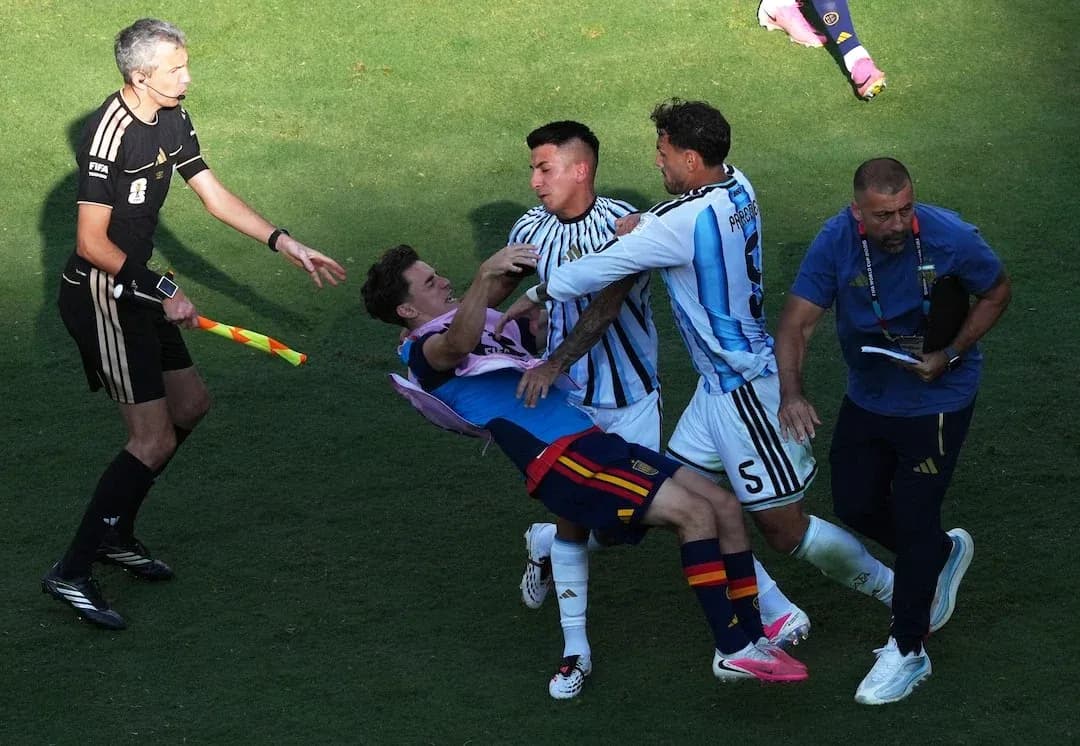
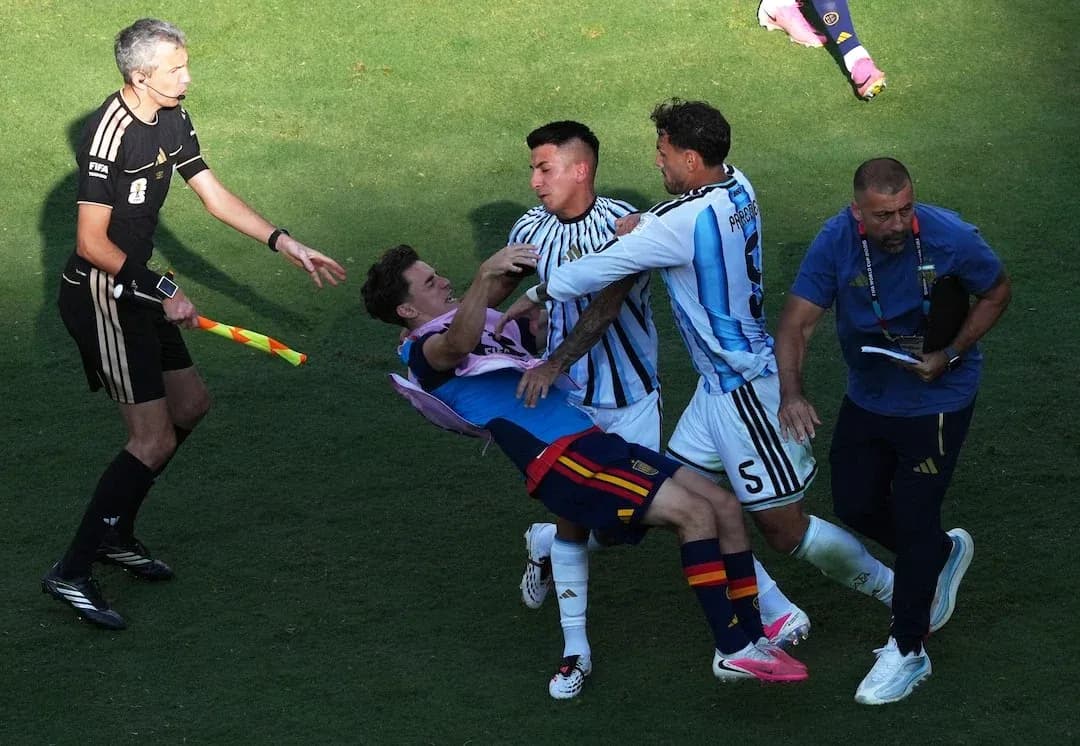
The touchline tension also boiled over. On 104', Argentina head coach Lionel Sebastián Scaloni was shown a yellow card for dissent, underlining the sense that Argentina were hanging on more through emotion than control.
The breakthrough finally arrived on 106'. Spain goal — Ferrán Torres (assisted by Nico Williams). Williams drove at a tiring back line before supplying the decisive pass, and Torres applied the finish to give Spain a 1-0 lead after extra time, rewarding their territorial dominance and relentless probing.
Argentina’s frustrations culminated in one final caution on 111', when Alexis Mac Allister (Argentina) received a yellow card for a foul, as Spain managed the closing stages and protected their slender advantage to see out the Final.
Fixture Statistics & Tactical Audit
- xG: Spain vs Argentina (not provided numerically)
- Possession: Spain 65% vs 35% Argentina
- Shots on Target: Spain 12 vs 0 Argentina
- Goalkeeper Saves: Spain 0 vs 11 Argentina
- Blocked Shots: Spain 3 vs 1 Argentina
Spain’s win was rooted in territorial and chance creation dominance. With 65% possession and a 20–2 total shot advantage, including 12 shots on target to Argentina’s 0, Spain controlled both the ball and the shot quality landscape. Argentina’s game plan was overtly reactive: a deep, narrow 4-4-2 that ceded the ball and relied heavily on Emiliano Martínez, who made 11 saves, and on a back line that blocked and scrambled to keep Spain at bay. Spain’s structure — a 4-1-2-3 with Rodri anchoring — allowed them to recycle possession and patiently probe, while the introduction of Nico Williams and Ferrán Torres tilted the shot profile even further in their favour. Given Argentina failed to register a single shot on target, the 1-0 scoreline arguably flatters the South Americans; Spain’s control and volume of chances made their extra-time breakthrough a statistically and tactically fair outcome.
Standings Update & Seasonal Impact
Spain, who came into the knockout phase as Group H winners with 7 points, 5 goals scored and none conceded, finish their World Cup campaign with an additional 3 points from this Final, moving to 10 points in total. They add one goal for and none against on the night, taking their tally to 6 goals scored and 0 conceded, for a goal difference of +6 — a champion’s profile built on control and defensive perfection.
Argentina, who arrived as Group J winners with a perfect 9 points, 8 goals scored and 1 conceded (goal difference +7), end their tournament with no additional points from the Final, remaining on 9. The 1-0 defeat adds one goal conceded without reply, leaving them with 8 goals scored and 2 conceded overall, and a final goal difference of +6. Despite matching Spain’s overall goal difference, Argentina’s inability to create in the Final — and their first knockout loss — leaves them as runners-up rather than back-to-back world champions.
Lineups & Personnel
Spain Starting XI
- GK: Unai Simón
- DF: Pedro Porro, Pau Cubarsí Paredes, Aymeric Laporte, Marc Cucurella
- MF: Rodri, Dani Olmo, Fabián Ruiz, Álex Baena
- FW: Lamine Yamal, Mikel Oyarzabal
Argentina Starting XI
- GK: E. Martínez
- DF: G. Montiel, C. Romero, Lisandro Martínez, N. Tagliafico
- MF: R. De Paul, E. Fernández, A. Mac Allister
- FW: N. González, L. Messi, J. Álvarez
Post-Match Verdict
Spain delivered a dominant performance (65% possession, 20–2 shots, 12–0 shots on target) built on positional play, patience, and depth from the bench. Their structure smothered Argentina’s transitions, and the introduction of Nico Williams and Ferrán Torres decisively increased penetration, culminating in the winning goal they combined for in extra time. Defensively, Spain were controlled rather than stretched, with Unai Simón not required to make a single save.
Argentina, by contrast, produced a reactive and ultimately unsustainable defensive display, relying heavily on Emiliano Martínez’s 11 saves and a back line that accumulated six yellow cards across players and staff. Their attacking plan misfired: just two attempts all match and none on target in 120 minutes underline how effectively Spain neutralised Lionel Messi and Julián Álvarez. In the end, this Final was decided by structure and control; Spain’s proactive, ball-dominant approach was rewarded, while Argentina’s deep, attritional strategy ran out of road once fatigue set in and Spain’s bench tilted the contest decisively in extra time.