.svg&w=384&q=75 "Pitchgist logo")
Spain’s Tactical Mastery Secures World Cup Victory Over Argentina
Spain’s 1-0 extra-time win over Argentina at MetLife Stadium was a territorial siege decided by structure, control and attrition. Across 120 minutes of the World Cup Final, Spain’s 4-2-3-1 systematically pinned back Argentina’s 4-4-2, turning overwhelming possession (65% to 35%) and shot volume (20–2 total, 12–0 on goal) into a late, decisive breakthrough from Ferran Torres.
Tactical Overview
Spain’s positional play was the defining tactical axis. Luis de la Fuente’s 4-2-3-1 built with Rodri and Fabián Ruiz as a double pivot, full-backs Pedro Porro and Marc Cucurella stepping high to form a 2-3-5 in settled attack. Pau Cubarsí and Aymeric Laporte held a high line near halfway, compressing the pitch and keeping Argentina’s forwards permanently disconnected from their midfield. With 852 passes at 89% accuracy (762 accurate), Spain circulated relentlessly, constantly re-opening the far side and dragging Argentina’s 4-4-2 block out of shape.
Between the lines, Dani Olmo and Alex Baena initially shared responsibility for occupying the half-spaces, but the key dynamic was wide: Lamine Yamal on the right and Mikel Oyarzabal on the left (later supported and then replaced by Ferran Torres and Nico Williams) stretched Argentina’s full-backs, forcing Gonzalo Montiel and Nicolás Tagliafico into deep, reactive positions. Spain’s 9 shots inside the box against just 1 for Argentina underline how consistently they managed to arrive in advanced zones with numbers.
Defensive Structure
Defensively, Spain’s counter-press was aggressive and well-coordinated. The front four immediately hunted the ball on turnovers, with Rodri screening Lionel Messi and Julián Alvarez and stepping out to engage any vertical pass. Argentina were restricted to only 2 total shots and none on target, a product of Spain’s rest-defense structure: both centre-backs plus one pivot always behind the ball, full-backs ready to collapse inward on any counter. The foul count (Spain 21, Argentina 25) reflects a high-intensity pressing game, but Spain’s discipline in duels was superior; they avoided any cards while repeatedly halting transitions high up the pitch.
Argentina's Response
Lionel Scaloni’s 4-4-2 was designed to be compact and combative, but it quickly became a survival block. The early yellow card for Cristian Romero for “Argument” set an edgy tone, and Lisandro Martínez’s booking for “Foul” at 41' further constrained Argentina’s ability to defend on the front foot. With Spain monopolising the ball, Argentina’s midfield four—Rodrigo De Paul, Enzo Fernández, Alexis Mac Allister and Nicolás González—were forced into a narrow, low block, leaving the flanks exposed to Spain’s full-backs and wingers.
Substitutions were reactive and largely defensive from Argentina. Nicolás Otamendi (IN) came on for Lisandro Martínez (OUT) at 44', shoring up the left side of central defence but sacrificing some ball progression. At 46', Leandro Paredes (IN) replaced Nicolás González (OUT), effectively converting the shape into a more central 4-3-1-2 without natural width, ceding even more of the flanks to Spain. Nahuel Molina (IN) for Gonzalo Montiel (OUT) at 58' refreshed the right-back slot but did not alter the strategic pattern; Argentina remained pinned back.
Spain's Tactical Adjustments
Spain’s changes, by contrast, were geared toward increasing tempo and penetration. At 62', Pedri (IN) for Fabián Ruiz (OUT) and Ferran Torres (IN) for Mikel Oyarzabal (OUT) sharpened the attacking line. Pedri’s ability to receive between lines and accelerate combinations added verticality to Spain’s possession, while Ferran Torres provided more aggressive penalty-box movement. At 75', Nico Williams (IN) for Alex Baena (OUT) and Mikel Merino (IN) for Dani Olmo (OUT) further rebalanced the side: Williams offered pure depth and 1v1 threat on the left, Merino gave extra physicality and late-box runs from midfield. These layers of attacking substitutions steadily wore down Argentina’s defensive block.
Argentina’s attempt to change the attacking picture came at 70', with Facundo Medina (IN) for Cristian Romero (OUT) and Giuliano Simeone (IN) for Rodrigo De Paul (OUT). Medina’s left-footed profile allowed slightly more direct outlet passes down the left, but by removing De Paul, Argentina lost one of their few ball-carrying outlets from midfield. The late introduction of Marcos Senesi (IN) for Julián Alvarez (OUT) at 102' was essentially a move to survive extra time, not to chase the game.
Disciplinary Issues
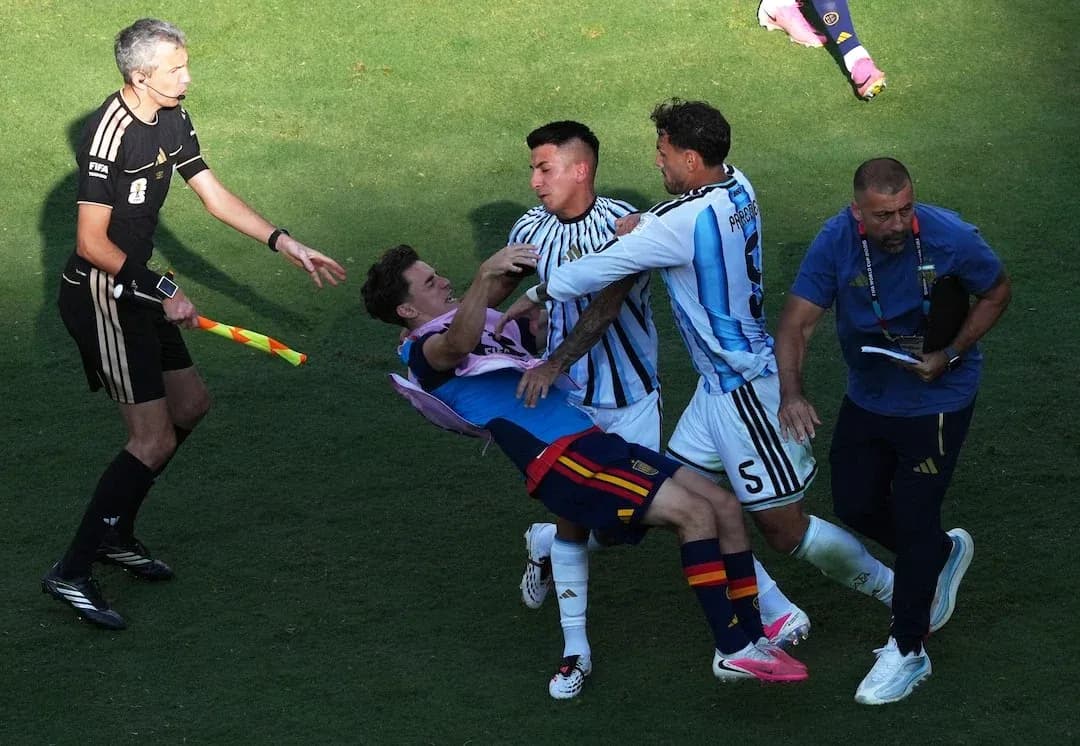
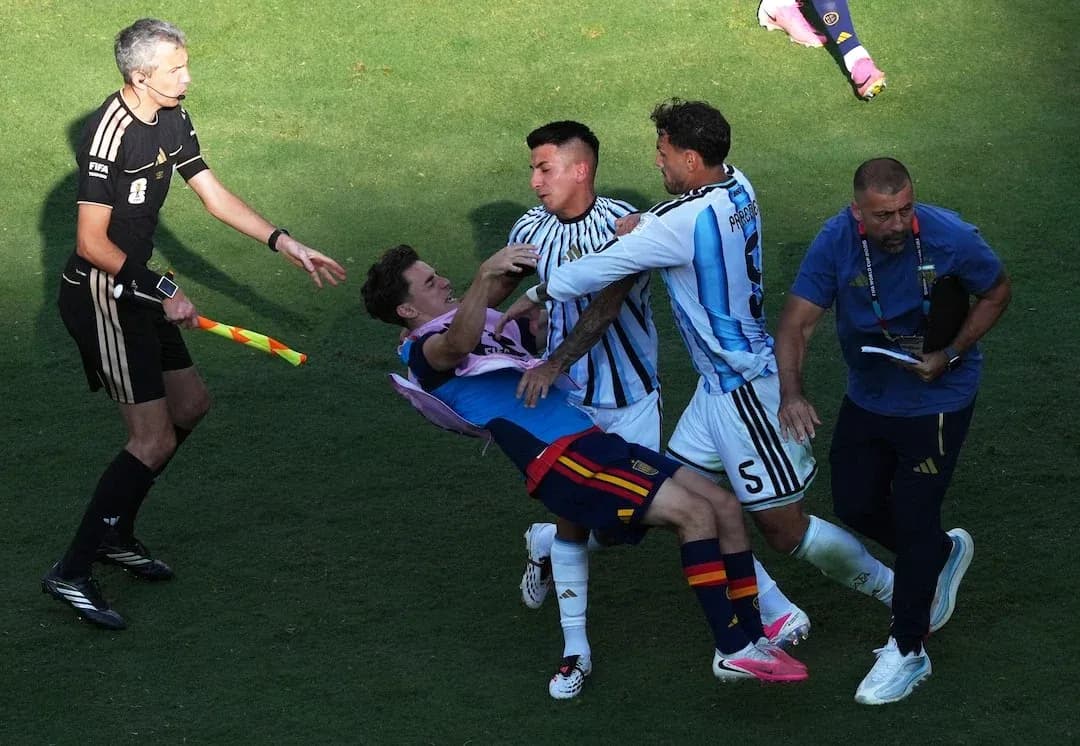
The disciplinary spiral in the second half further undermined Argentina’s structure. Leandro Paredes’ yellow for “Unsporting behaviour” at 52' and Enzo Fernández’s sequence—yellow for “Argument” at 83', then yellow and red for “Foul” at 90+3'—left Argentina down to ten men for extra time. Reduced to a 4-4-1, with Messi isolated and the midfield overworked, Argentina’s already limited ability to contest possession collapsed. Alexis Mac Allister’s late yellow for “Foul” at 111' was emblematic of a side constantly arriving late into duels, chasing shadows.
Winning Moment
The winning moment encapsulated Spain’s tactical superiority. In extra time at 106', Ferran Torres (Spain) finished a move created by Nico Williams, whose introduction had been aimed precisely at attacking tiring legs in wide areas. It was Spain’s 12th shot on goal against an Argentina side that never tested Unai Simón (Spain); all 11 recorded saves belonged to Emiliano Martínez (Argentina), whose shot-stopping and 1.81 goals prevented kept the scoreline respectable and dragged the contest into extra time.
Statistical Summary
Statistically, Spain’s 1.94 xG to Argentina’s 0.22 xG aligns perfectly with the tactical picture: Spain dominated territory, created sustained pressure and multiple high-quality chances, while Argentina produced almost nothing in attack. Spain’s 9 corner kicks to Argentina’s 4 and their superior passing volume and accuracy reflect a team that controlled both phases—possession and transition. The card tally—Argentina 6 yellows and 1 red, Spain none—underlines how often Scaloni’s side were forced into emergency defending and emotional reactions rather than proactive control.
In the end, the World Cup Final was decided less by a single moment than by a 120-minute structural imbalance. Spain’s coherent 4-2-3-1, intelligent substitutions and suffocating press systematically dismantled Argentina’s 4-4-2, and Ferran Torres’ extra-time strike was the logical conclusion of that tactical dominance.