.svg&w=384&q=75 "Pitchgist logo")
Lionel Messi Reflects on World Cup Heartbreak
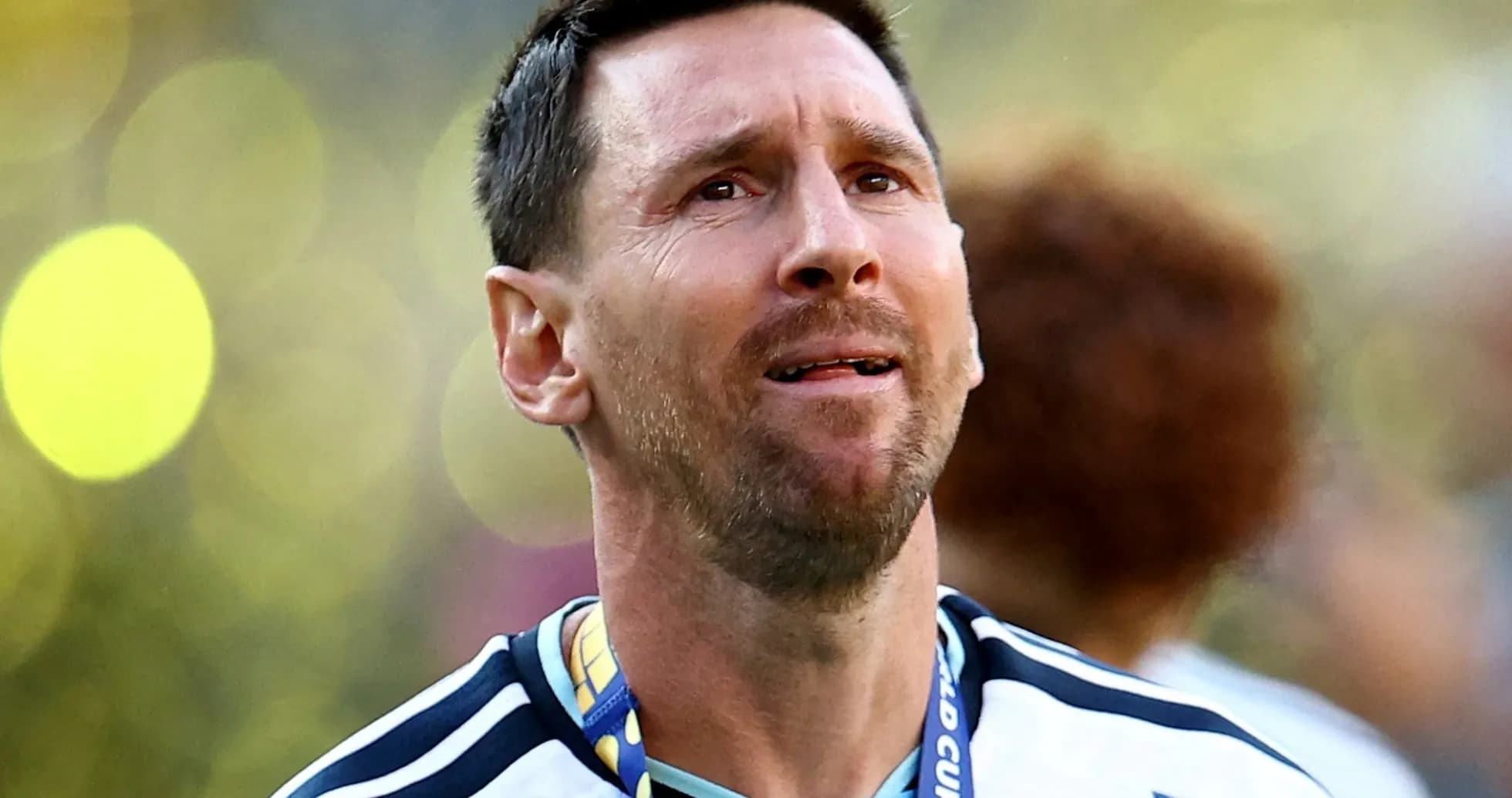
Lionel Messi stood alone on the MetLife Stadium turf, silver medal around his neck, eyes wet, the noise of a World Cup final fading into a kind of stunned silence. If this was the last act of his World Cup story, it ended not with a coronation, but with a man staring into the night, replaying a chance that never really came.
Spain 1, Argentina 0. A title defended in 2022, surrendered in 2026. No shot on target. No late rescue. No miracle.
Messi did not say the words “this is the end.” He didn’t need to. At 39, after a fifth World Cup that carried Argentina all the way back to the final, the images told their own story.
Tears, a medal, and a message
By Monday evening, the tears had given way to reflection. From his Instagram account, Messi sent out a message that sounded like both a farewell and a fight to keep perspective.
“The pain is immense, and this wound will take time to heal,” he wrote in Spanish, alongside a photo of himself with the runner-up medal. The caption cut straight through the usual post-tournament platitudes. This one hurt. Deeply.
But he refused to let the defeat erase the journey.
“I also hold onto all the good things… The matches we turned around by giving it our all – moments that will remain in our memories forever – and the support of an entire country which, combined with this group’s hard work and effort, brought us back among the world’s elite once again.
“It is hard to fully appreciate our achievement right now, but this group reached two consecutive World Cup finals.”
For a player who spent half his career being told he needed a World Cup to complete his legacy, that line matters. Two straight finals. One trophy. One heartbreak. A complete arc.
From Qatar glory to North American heartbreak
Four years earlier in Qatar, Messi had scaled the one mountain that always seemed just out of reach. Argentina’s wild 3-3 draw with France, settled on penalties, delivered the trophy that had eluded him for so long and cemented his status in the eyes of many as the greatest of all time.
This time, in North America, the narrative felt like a sequel set up for a perfect ending. Argentina looked like champions again. They played with authority, experience, and the calm of a team that knew how to suffer and survive.
They rallied past England in the semifinal, summoning that familiar mix of grit and brilliance that defined their 2022 run. The momentum felt eerily similar. The belief, almost identical.
Then came Spain.
Luis de la Fuente’s side did what so few teams have ever managed against a Messi-led Argentina: they suffocated them. Argentina did not register a single shot on goal in the final. The Spanish defence closed passing lanes, cut off transitions, and starved Messi of the spaces he usually bends to his will.
The pressure that had so often broken opponents this time boxed in Argentina’s captain. For once, there was no gap, no half-yard, no moment of chaos to exploit. The game drifted away from him, and with it, the dream of back-to-back titles.
Time, records and the shadow of 2030
Messi turned 39 during this World Cup. When the next one kicks off in 2030 in Spain, Portugal and Morocco, he will be 43. He has not shut the door on returning, but the arithmetic is merciless.
He leaves this tournament with more World Cup records, and even more history. Early in the competition, he broke Miroslav Klose’s all-time World Cup scoring record of 16 goals. By the end, Messi stood on 21.
Even that, remarkably, did not last. Kylian Mbappé, the man who pushed him to the brink in 2022 and now chases his shadow on the global stage, surged past him to finish on 22. The French forward also snatched the Golden Boot, his 10 goals edging Messi’s eight.
The numbers will live forever. The sight of Messi in East Rutherford, shoulders heavy, might not.
A nation united, again
Messi’s message was not just about himself. It rarely is when he pulls on the sky blue and white.
“Thank you from the bottom of my heart for every greeting and message,” he wrote. “Once again, we managed to unite as a country and stand together, sharing the immense pride of being Argentine.
“I also want to congratulate Spain on winning the championship.”
Even in defeat, he leaned into what this Argentina era has become: a shared project between team and country. The bond forged in Qatar carried through to 2026, through every comeback and every anthem sung at full volume.
Argentina leave North America without the trophy, but not without status. They came as defending champions and left as beaten finalists, still firmly lodged among the world’s elite – just as Messi said.
Rest, recovery, and what comes next
The immediate future is quieter. According to ESPN, Messi and his Argentina and Inter Miami teammate Rodrigo De Paul will sit out Inter Miami’s next two regular-season matches and skip the MLS All-Star Game to rest and recover from the World Cup.
It is a pause, not a retirement announcement. Club football will resume, the cameras will follow, and the debates about his future with the national team will only grow louder.
For now, the last image of Messi on a World Cup pitch is not of him lifting a trophy, but of him clutching a silver medal, eyes reddened, applauding a crowd that knows it may never see his like again on this stage.
If this really was his final World Cup match, the question is no longer what he needed to prove. It is whether football will ever feel quite the same without him at its greatest tournament.