.svg&w=384&q=75 "Pitchgist logo")
Manchester United 3–2 Nottingham Forest: Match Analysis
Manchester United 3–2 Nottingham Forest at Old Trafford, a result that consolidates United’s top-four push and keeps them firmly in the Champions League places, while Forest remain in the lower reaches of the table with work still to do to avoid being dragged back towards the relegation battle on the final day.
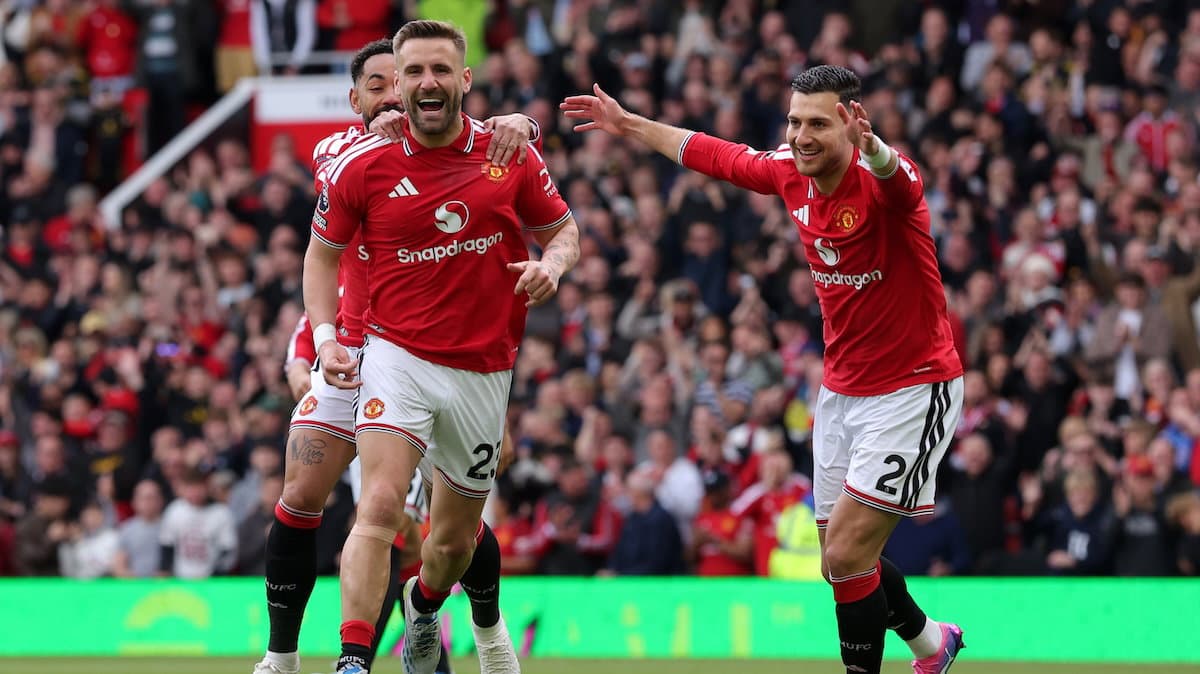
United struck first almost immediately. On 5 minutes, Luke Shaw surged forward and finished a move himself, his goal an unassisted effort that gave the hosts the ideal platform.
Forest regrouped and found their equaliser early in the second half. In the 53rd minute, Morato arrived to convert after Elliot Anderson’s delivery, the defender’s finish making it 1–1 and briefly silencing Old Trafford.
The parity lasted only two minutes. At 55', Matheus Cunha restored United’s lead with a solo effort, again unassisted, punishing Forest’s inability to reset after their own goal.
Vitor Pereira reacted with a triple substitution on 70 minutes to chase the game: Dilane Bakwa replaced Omari Hutchinson, Taiwo Awoniyi replaced Chris Wood, and Ibrahim Sangaré replaced Nicolás Domínguez, a clear shift towards more direct attacking threat and fresh legs in midfield.
United then appeared to put the contest to bed. On 76 minutes, Bryan Mbeumo finished clinically from a Bruno Fernandes pass, the forward’s goal from Fernandes’ assist stretching the lead to 3–1 and reflecting United’s sustained pressure in the final third.
Forest, however, hit back almost immediately. Two minutes later, at 78', Morgan Gibbs-White struck to make it 3–2, again created by Elliot Anderson, whose second assist of the afternoon kept the visitors alive.
Moments after that goal, the game’s physical edge was underlined when Casemiro was booked for tripping in the 78th minute, halting a Forest transition and accepting a yellow card to break up play.
Michael Carrick then turned to his bench to manage the closing stages. On 80 minutes, Joshua Zirkzee replaced Bryan Mbeumo, and Patrick Dorgu came on for Matheus Cunha, moves designed to inject energy up front and secure the left side. A minute later, at 81', Mason Mount replaced Casemiro, adding more control and ball retention in midfield as United looked to protect their narrow lead.
Forest made their final push with another double change on 84 minutes: James McAtee replaced Igor Jesus to add creativity between the lines, while Jair came on for Luca Netz to freshen up the back line and support the late offensive reshuffle.
In stoppage time, the tension spiked again. At 90+3', Luke Shaw received a yellow card for tripping as Forest pressed forward, and a minute later, at 90+4', Elliot Anderson — Forest’s key creator — was booked for a foul, capping an industrious but increasingly desperate display.
Fixture Statistics & Tactical Audit
- xG (Expected Goals): Manchester United 4.19 vs Nottingham Forest 1.75
- Possession: Manchester United 49% vs Nottingham Forest 51%
- Shots on Target: Manchester United 8 vs Nottingham Forest 4
- Goalkeeper Saves: Manchester United 2 vs Nottingham Forest 5
- Blocked Shots: Manchester United 12 vs Nottingham Forest 3
The underlying numbers point to a United performance built on sustained attacking volume and high-quality chances (xG 4.19 vs 1.75), even if the final scoreline remained tight. Despite having marginally less of the ball (49% vs 51%), United were far more incisive in the final third, registering double the shots on target (8 vs 4) and forcing Matz Sels into five saves. Forest’s slightly higher possession reflected longer spells of build-up, but with fewer penetrative moments and more reliance on Anderson’s creativity. The shot and xG profile suggests the 3–2 scoreline slightly flatters Forest; United’s attacking output was closer to a comfortable win than a narrow escape, while Forest were notably efficient with the limited clear openings they created (4 shots on target from 11 total, xG 1.75).
Standings Update & Seasonal Impact
Manchester United started the day third with 68 points, 66 goals scored and 50 conceded (goal difference +16). This 3–2 win moves them to 71 points, with 69 goals for and 52 against, improving their goal difference to +17. That return keeps them entrenched in the top three and strengthens their grip on Champions League qualification going into the final round, maintaining pressure on the sides above while giving them a cushion over the chasing pack.
Nottingham Forest began in 16th place on 43 points, with 47 goals scored and 50 conceded (goal difference -3). Scoring twice but losing leaves them on 43 points, now with 49 goals for and 53 against, their goal difference slipping to -4. They remain in the lower mid-table zone, still looking over their shoulder at the relegation places; the gap to the bottom three will make the final day nervy if results elsewhere tighten the picture.
Lineups & Personnel
Manchester United Actual XI
- GK: Senne Lammens
- DF: Diogo Dalot, Harry Maguire, Lisandro Martínez, Luke Shaw
- MF: Casemiro, Kobbie Mainoo, Amad Diallo, Bruno Fernandes, Matheus Cunha
- FW: Bryan Mbeumo
Nottingham Forest Actual XI
- GK: Matz Sels
- DF: Neco Williams, Nikola Milenković, Morato, Luca Netz
- MF: Omari Hutchinson, Nicolás Domínguez, Elliot Anderson, Morgan Gibbs-White
- FW: Igor Jesus, Chris Wood
Expert's Post-Match Verdict
Carrick’s United delivered an attacking display that was both aggressive and largely well-structured, underpinned by a high volume of shots and strong chance quality (29 total shots, xG 4.19). The use of a 4-2-3-1 allowed Bruno Fernandes to orchestrate between the lines, while wide rotations involving Shaw and Mbeumo created repeated overloads — reflected in United’s dominance in shots inside the box (21 vs 11) and blocked efforts (12 vs 3), signs of sustained pressure around the Forest area. Defensively, conceding twice from an opponent with relatively modest xG (1.75) points to some fragility in transition and set defensive structures, but United’s attacking weight ultimately compensated.
For Forest, Pereira’s side showed resilience and efficiency in front of goal (4 shots on target, 2 goals) and were competitive in possession (51%), but they struggled to contain United’s multi-lane attacks. The late triple change on 70 minutes injected energy and helped produce a quick response at 3–1, yet the underlying numbers highlight a defensive unit that allowed too many high-quality opportunities and relied heavily on Sels’ interventions (5 saves) to stay in touch. Forest’s attacking threat was heavily channelled through Elliot Anderson, whose two assists and constant involvement contrasted with the team’s overall lack of depth in chance creation. In the end, United’s superior structure and volume in the final third made the victory a fair reflection of the balance of play, while Forest leave with credit for their resilience but also a clear reminder of their defensive shortcomings.