.svg&w=384&q=75 "Pitchgist logo")
Everton vs Manchester City: A 3–3 Premier League Thriller
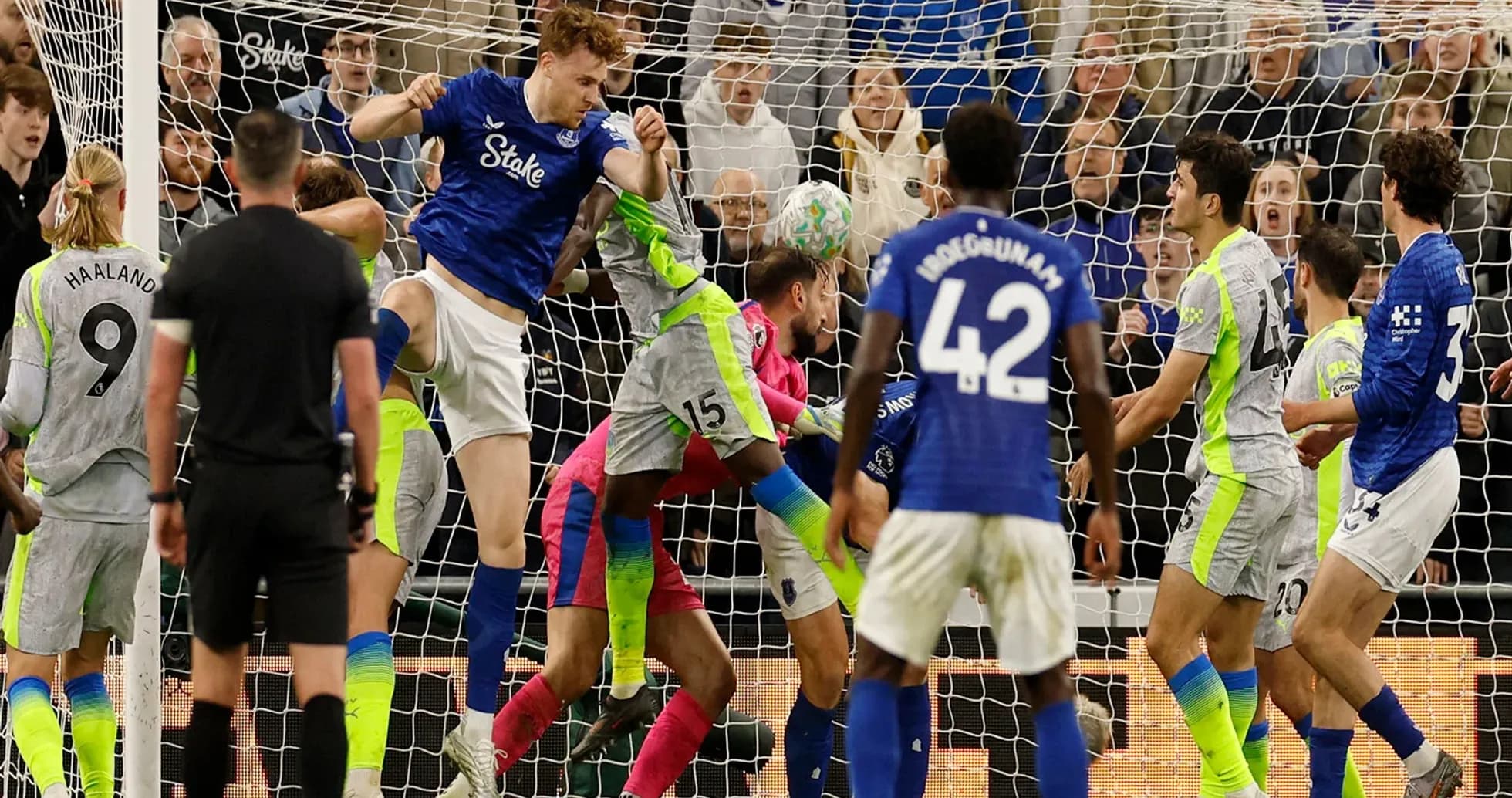
Everton and Manchester City produced a chaotic 3–3 draw at Hill Dickinson Stadium in Premier League Round 35, a match that flipped the script on almost every underlying number. City dominated territory and possession, led 1–0 at half-time and later clawed back from 3–1 down, but Everton’s direct, transition-heavy 4-2-3-1 repeatedly ripped through a structurally exposed City back line. With City holding 75% of the ball and outshooting Everton 20–14, the underlying xG (Everton 2.77, City 1.37) underlined how much more dangerous Everton were per attack, and how ruthlessly they exploited Guardiola’s high-possession, high-risk structure.
First Half
Everton’s scoring and disciplinary story began late in the first half. Manchester City struck first on 43', J. Doku finishing a flowing move assisted by R. Cherki, capitalising on sustained City pressure and Everton’s deep block being pulled apart on the left side. Just before the interval, Michael Keane collected a yellow card on 45' for a foul, signalling the physical edge Everton would lean into to survive long spells without the ball. The half-time score was 0–1 to City.
Second Half
After the break, Everton’s aggression escalated. Beto was booked on 48' for a foul, followed by James Tarkowski’s yellow on 53', again for a foul, as Everton’s centre-backs stepped out late against City’s rotations. The match flipped with Leighton Baines’ first substitution: on 64', T. Barry (IN) came on for Beto (OUT), adding vertical threat in behind.
Barry immediately changed the game. On 68', he scored Everton’s first, a normal goal with no listed assist, punishing City’s high line. Five minutes later, on 73', right-back J. O’Brien surged forward to make it 2–1, finishing from a J. Garner assist, a clear pattern of Everton’s full-backs exploiting wide gaps in City’s rest defence.
City’s frustration surfaced on 74' when Gianluigi Donnarumma received a yellow card for argument, immediately followed by a structural reshuffle: A. Semenyo (OUT) made way for P. Foden (IN) on 74', and Nico (OUT) was replaced by M. Kovacic (IN) on 75', adding control and line-breaking from deeper midfield.
Yet Everton struck again first. On 81', Barry scored his second, again a normal goal, to make it 3–1 and complete a devastating cameo impact. City responded on 83', E. Haaland finishing from a Kovacic assist to cut the deficit to 3–2, exploiting the central channel as Everton’s lines tired.
Everton’s final booking came on 86', when Jake O’Brien was shown a yellow card for a foul, reflecting the strain on the back line as City pushed for an equaliser. Guardiola’s last attacking tweak saw B. Silva (OUT) replaced by O. Marmoush (IN) on 87', adding a more direct forward threat.
Deep into stoppage time, Baines refreshed legs: on 90+2', M. Rohl (OUT) was replaced by N. Patterson (IN), and K. Dewsbury-Hall (OUT) by C. Alcaraz (IN), signalling a shift to protect wide areas and central energy. At 90+6', T. Iroegbunam (OUT) came off for H. Armstrong (IN), another defensive-minded adjustment. The final twist arrived on 90', when J. Doku struck again, assisted by M. Guehi, to level the match at 3–3.
Tactical Analysis
Tactically, this was a clash between Everton’s compact, counter-focused 4-2-3-1 and City’s possession-dominant mirror shape. Everton’s double pivot of T. Iroegbunam and J. Garner was key: out of possession, they stayed narrow to deny central progression, forcing City into wide circulation and crosses. In possession, Garner in particular provided the vertical pass that released O’Brien and Barry into space, as seen on the 73' goal.
Everton’s back four – V. Mykolenko, M. Keane, James Tarkowski, and J. O’Brien – defended deep and narrow, accepting crosses but struggling whenever City isolated them 1v1. The three yellow cards for Keane, Tarkowski, and Jake O’Brien underline how often they were forced into recovery fouls. Yet their box defence, aided by bodies around Haaland, limited City’s shot quality despite conceding 20 attempts.
Ahead of them, M. Rohl, K. Dewsbury-Hall, and I. Ndiaye formed a fluid band of three behind Beto, later Barry. Initially, Beto’s role was to occupy City’s centre-backs and contest first balls, but Everton’s attack truly ignited once Barry entered. His willingness to run beyond the last line, combined with Ndiaye’s drifting and Dewsbury-Hall’s late surges, turned Everton into a devastating transition side. Barry’s brace came from exactly this pattern: rapid, vertical attacks into the space behind M. Nunes and N. O’Reilly, with City’s full-backs caught high.
For City, the 4-2-3-1 was more of a 2-3-5 in possession. Nico and B. Silva formed the initial double pivot, with N. O’Reilly and M. Nunes high and wide, Doku and Cherki between the lines, and Haaland central. This created overwhelming territorial control (75% possession, 610 passes at 90% accuracy), but the rest defence was repeatedly exposed. When Everton broke the first line, Khusanov and Guehi were often left in large spaces against multiple runners.
The introduction of Kovacic and Foden aimed to stabilise the structure: Kovacic added press resistance and progressive passing from deep, directly assisting Haaland’s 83' goal, while Foden offered more controlled final-third occupation than Semenyo. Marmoush’s late arrival for B. Silva was a last push for a more direct, penalty-box presence alongside Haaland, contributing to the pressure that preceded Doku’s 90' equaliser.
In goal, J. Pickford recorded 1 save, reflecting how City’s volume of shots did not always translate into on-target danger, while Donnarumma made 3 saves but still conceded three times. The xG data is revealing: Everton’s 2.77 xG from 14 shots and only 25% possession shows their chances were higher quality, often in transition or from close range. City’s 1.37 xG from 20 shots indicates a lot of lower-quality attempts from less optimal positions.
Everton’s Overall Form in this match, measured by attacking efficiency and resilience, was strong despite territorial inferiority. Their Defensive Index is more mixed: conceding 20 shots and three goals, yet limiting City’s xG and repeatedly forcing them wide, suggests a functional but stretched low block. City’s Overall Form with the ball was typically dominant in control metrics, but their Defensive Index was poor relative to their standards: conceding 3 goals and 2.77 xG from only 25% possession underlines structural vulnerabilities in transition and rest defence that Everton exploited ruthlessly.