.svg&w=384&q=75 "Pitchgist logo")
Burnley and Aston Villa Share Spoils in Thrilling 2-2 Draw
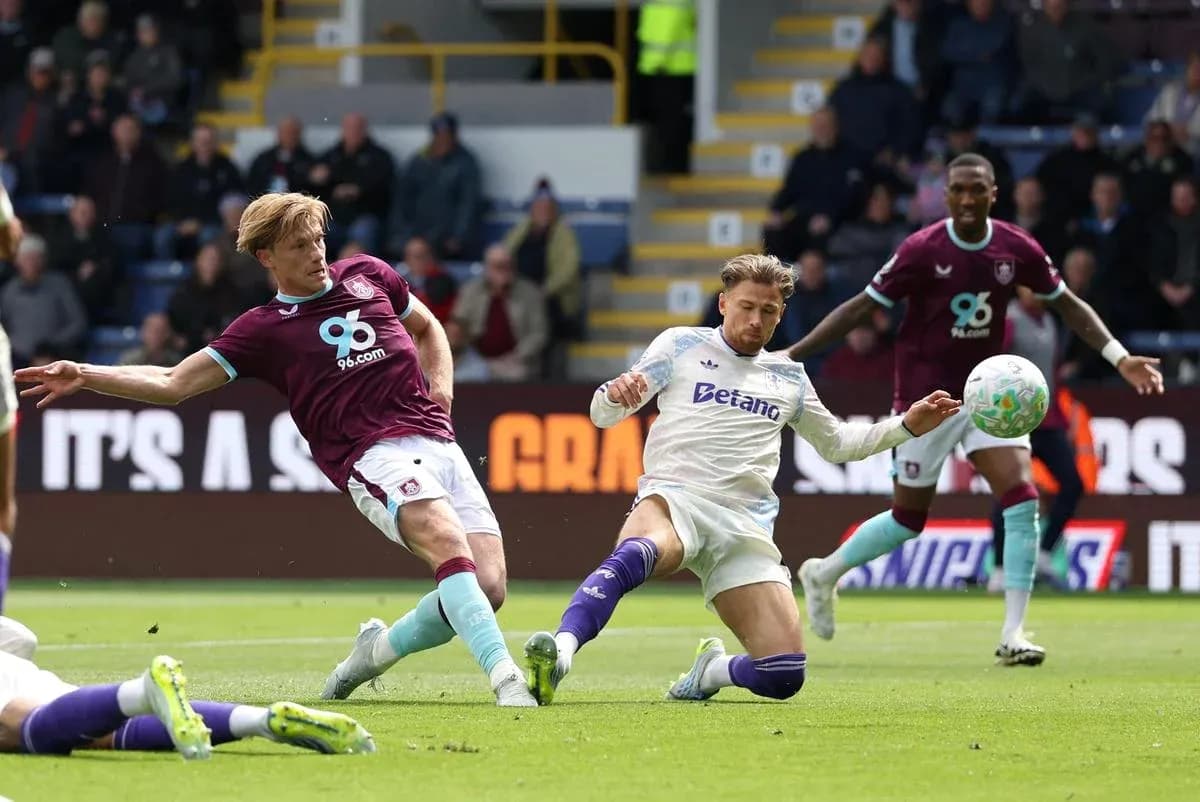
Turf Moor under grey May skies has rarely felt this conflicted. The league table says this is a mismatch – 19th-placed Burnley, marooned on 21 points after 36 matches, against a Champions League-chasing Aston Villa side sitting 5th with 59 points. Yet the scoreline that flickers on the old ground’s boards at full time reads 2-2, a draw that feels like a microcosm of both seasons: Burnley spirited but flawed, Villa dangerous yet defensively vulnerable.
I. The Big Picture – Clash of Identities
Following this result, Burnley’s overall record of 4 wins, 9 draws and 23 defeats in 36 matches underlines the scale of their struggle. Their overall goal difference of -36 is the brutal arithmetic of 37 goals for and 73 against. At home, they have been marginally more stubborn – 2 wins, 6 draws and 10 losses at Turf Moor, scoring 17 and conceding 28 – but the averages tell the story: just 0.9 goals for and 1.6 against at home.
Across the halfway line, Villa’s campaign has been built on a more balanced, if occasionally chaotic, platform. Overall, they have 17 wins, 8 draws and 11 defeats, with 50 goals scored and 46 conceded – a goal difference of 4 that reflects both attacking ambition and defensive looseness. On their travels, they are perfectly symmetrical: 6 wins, 6 draws, 6 defeats, with 22 scored and 26 conceded, averaging 1.2 goals for and 1.4 against away from home.
Both sides lined up in a 4-2-3-1, but the systems carried very different emotional weights. For Mike Jackson’s Burnley, it was a structure of survival and counter-punching; for Unai Emery’s Villa, it was a familiar, possession-oriented shape designed to suffocate and then strike.
II. Tactical Voids – The Missing Pieces
Burnley entered this fixture shorn of defensive and midfield stability. J. Beyer’s hamstring injury removed a centre-back option who could have rotated with A. Tuanzebe or M. Esteve. J. Cullen’s knee injury deprived them of a deeper passer who might have eased the burden on Florentino and L. Ugochukwu in the double pivot. C. Roberts’ muscle injury also limited full-back rotation, increasing the physical load on K. Walker.
For Villa, the absences subtly reshaped Emery’s options. B. Kamara’s knee injury removed a natural screening midfielder, which helps explain the use of V. Lindelof in that central role. A. Onana’s calf problem and Alysson’s muscle injury cut into depth and late-game flexibility, particularly in the engine room and wide rotations.
Disciplinary trends framed the risk profile. Heading into this game, Burnley’s yellow-card distribution showed pronounced spikes in the 16-30 and 76-90 minute windows, each accounting for 19.67% of their cautions – a sign of early and late emotional volatility. Their red cards were spread in a worrying pattern: 33.33% between 31-45 minutes, 33.33% between 76-90, and 33.33% between 91-105, a team prone to boiling over at key psychological moments.
Villa, by contrast, concentrate their aggression after the break: 29.09% of their yellows arrive between 46-60 minutes, with another 18.18% in the 91-105 stretch. Their single red card this season has come in the 61-75 window, a reminder that their press can tip into recklessness just as legs tire.
III. Key Matchups – Hunter vs Shield, Engine vs Enforcer
The headline duel was always going to be Z. Flemming against Villa’s back line. With 10 goals in 27 appearances, and 2 penalties scored from 2 taken, Flemming is Burnley’s one reliable finisher in a side that otherwise fails to score in 13 of 36 league matches. His 37 shots, 20 on target, and 5 blocked shots underline a player who both creates and finishes under pressure. Against a Villa defence that concedes 1.4 goals per away game, Flemming’s ability to attack spaces between E. Konsa and T. Mings was central to Burnley’s plan.
On the other side, O. Watkins carried the “Hunter” tag for Villa. With 12 league goals and 2 assists in 35 appearances, he is less about volume than timing and movement. His 51 shots (31 on target) and 22 key passes sketch a forward who drifts into channels, combining with the line of three behind him rather than simply finishing moves.
Behind Watkins, M. Rogers was the creative metronome and secondary threat. Nine goals and 5 assists, 43 key passes, and 117 dribble attempts (41 successful) mark him out as the primary conduit between midfield and attack. His duel with Burnley’s double pivot – Florentino and Ugochukwu – was the “Engine Room” battleground. Florentino’s job was to screen and disrupt, while Ugochukwu had to shuttle and connect to H. Mejbri and L. Tchaouna in the half-spaces.
On the flanks, K. Walker’s role was double-edged. As Burnley’s most-booked player with 9 yellows, he walks a disciplinary tightrope, yet his 53 tackles, 10 blocked shots and 43 interceptions make him their most active defensive outlet. Up against M. Rogers drifting left or J. McGinn drifting inside, Walker had to choose his moments to step out, knowing that one mistimed challenge could tilt the match.
For Villa, the shield was a collective. Lindelof and Y. Tielemans as a double pivot had to monitor Flemming’s drops into pockets and the runs of J. Anthony and L. Tchaouna beyond him. With Burnley averaging 1.0 goals per game overall but just 0.9 at home, Villa’s task was to keep the game in front of them, avoiding transitions where Flemming thrives.
IV. Statistical Prognosis – xG Logic, Emotional Reality
If we map the season’s numbers onto this fixture, a narrow Villa edge feels logical. Burnley concede an overall average of 2.0 goals per game, while Villa score 1.4. Flip the pitch, and Villa concede 1.3 overall while Burnley score 1.0. The statistical midpoint hovers around a 1-2 away win scenario in Expected Goals terms, with Villa’s higher attacking ceiling and more robust clean sheet record (9 overall, 3 away) nudging them ahead.
Yet the 2-2 draw at Turf Moor fits a different narrative thread. Burnley’s biggest home win this season is 2-0; their biggest home defeat margin is 3 goals. They live on fine margins and emotional surges. Villa’s away profile – 22 for, 26 against – speaks of a side that can both dominate and be dragged into chaos.
In the end, this match felt like those numbers colliding. Burnley, desperate and direct, leaned on Flemming’s movement and the energy of Mejbri and Tchaouna between the lines. Villa, through Rogers and Watkins, repeatedly found ways to stress a defence that has already shipped 73 goals overall. The draw is less an upset than a statistical outlier that still sits within the bounds of both teams’ season-long volatility.
Following this result, Burnley remain on the brink, their survival hopes hanging by a thread woven from Flemming’s finishing and Walker’s last-ditch defending. Villa, still 5th with a positive goal difference of 4, will see this as two points dropped – a reminder that their attacking flair must be matched by greater defensive control if their Champions League push is to become a habit rather than a fleeting dream.