.svg&w=384&q=75 "Pitchgist logo")

Arsenal's Tactical Victory Over West Ham: Key Moments and Insights
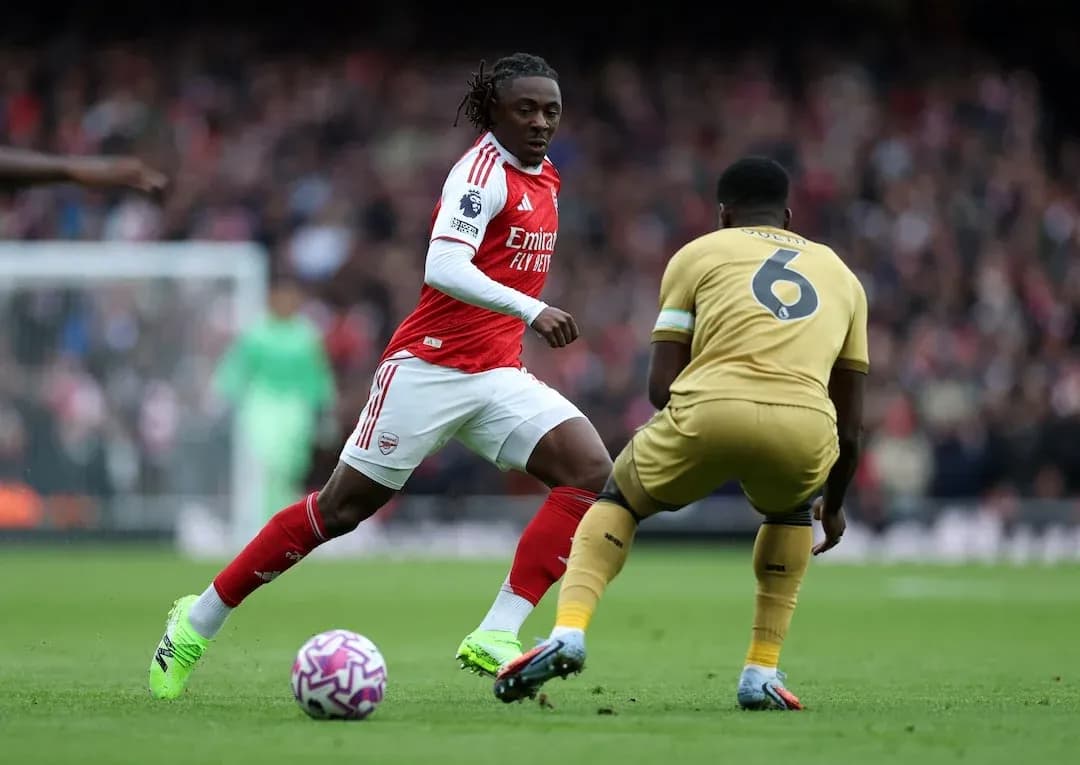
West Ham’s 0-1 home defeat to Arsenal at London Stadium unfolded as a territorial siege decided late by Leandro Trossard, but underpinned by structural choices from both coaches. Nuno Espirito Santo committed to a 3-4-2-1 that sought verticality and counter-punches; Mikel Arteta’s 4-2-3-1, with Declan Rice and Myles Lewis-Skelly at the base, aimed to suffocate West Ham through possession and width. Over 90 minutes, Arsenal’s 64% of the ball, 15 shots and superior pass volume gradually eroded West Ham’s compact block, even as the hosts generated comparable expected goals (1.3 vs Arsenal’s 1.36) and came within a VAR intervention of rescuing a point.
Disciplinary Log
- 34' Valentín Castellanos (West Ham) — Foul
- 38' Crysencio Summerville (West Ham) — Foul
- 68' Jean-Clair Todibo (West Ham) — Foul
- 77' Bukayo Saka (Arsenal) — Foul
- 79' Cristhian Mosquera (Arsenal) — Foul
- 89' William Saliba (Arsenal) — Time wasting
- 90+1' Leandro Trossard (Arsenal) — Time wasting
Card totals: West Ham: 3, Arsenal: 4, Total: 7.
The scoring sequence and key incidents followed the events array strictly. Arsenal’s first structural tweak came on 28', when Ben White (OUT) was replaced as Martín Zubimendi (IN) came on, shifting the balance towards an extra midfielder and allowing Riccardo Calafiori to carry more responsibility in the first line of buildup. West Ham’s front three responded aggressively: by 34', Valentín Castellanos’ “Foul” yellow reflected the physical edge in West Ham’s pressing on Arsenal’s back line, followed four minutes later by Crysencio Summerville’s own “Foul” caution as he chased transitions.
At half-time it remained West Ham 0-0 Arsenal, with the hosts’ 3-4-2-1 successfully protecting central zones despite conceding territory. Immediately after the interval, Arsenal adjusted again: at 46', Riccardo Calafiori (OUT) made way as Cristhian Mosquera (IN) came on, preserving the back four structure but refreshing the left side defensively. West Ham’s first attacking reshuffle came on 66', when Valentín Castellanos (OUT) was replaced as Pablo Felipe (IN) came on, a like-for-like change aimed at adding fresh pressing energy and depth running.
On 67', Eberechi Eze (OUT) departed as Martin Ødegaard (IN) came on, a decisive move by Arteta. Ødegaard’s arrival sharpened Arsenal’s occupation of the half-spaces and would later prove crucial. One minute later, West Ham’s resistance frayed: Jean-Clair Todibo’s yellow at 68' (“Foul”) underlined the strain on the back three as Arsenal’s rotations drew them into wider duels. Arsenal’s next attacking injection came on 68' as an unnamed Arsenal player (OUT) left the pitch and Kai Havertz (IN) entered, adding penalty-box presence and allowing Viktor Gyökeres to vary his movements.
Arsenal’s increased pressure provoked further discipline: Bukayo Saka’s “Foul” yellow at 77' and Cristhian Mosquera’s “Foul” caution at 79' reflected Arsenal’s willingness to counter-press high and disrupt West Ham’s counters. At 80', Saka (OUT) was replaced as Noni Madueke (IN) came on, keeping the right flank dynamic and direct.
The breakthrough arrived on 83': Leandro Trossard finished a move orchestrated by Martin Ødegaard’s assist to put Arsenal 1-0 up, a goal consistent with the visitors’ territorial control and volume of shots (15 total, 9 inside the box). West Ham responded with attacking substitutions: at 85', Axel Disasi (OUT) was withdrawn as Callum Wilson (IN) came on, effectively moving West Ham towards a more aggressive shape by sacrificing a centre-back for a striker.
Arsenal then leaned into game management. William Saliba’s yellow at 89' for “Time wasting” and Leandro Trossard’s caution at 90+1' for “Time wasting” captured Arsenal’s deliberate slowing of the tempo to protect the narrow lead. Deep into stoppage time, at 90+8', a potential goal by Callum Wilson was disallowed by VAR, denying West Ham an equaliser and confirming the final score of West Ham 0-1 Arsenal.
From a tactical perspective, West Ham’s 3-4-2-1 was built on a narrow back three of Axel Disasi, Konstantinos Mavropanos and Jean-Clair Todibo shielding Mads Hermansen, with wing-backs Aaron Wan-Bissaka and El Hadji Malick Diouf tasked with enormous vertical workloads. Tomáš Souček and Mateus Fernandes formed a combative double pivot, while Jarrod Bowen and Crysencio Summerville supported Castellanos between the lines and in transition. This structure prioritized central compactness and quick release into the front three, which explains why West Ham, despite only 36% possession and 281 total passes, still produced 9 shots (6 inside the box) and 1.3 xG.
Arsenal’s 4-2-3-1, by contrast, was about control and layering. William Saliba and Gabriel Magalhães anchored the defence, flanked by Ben White then later a reshaped back line with Cristhian Mosquera. Declan Rice and Myles Lewis-Skelly as the double pivot provided both ball progression and counter-pressing security. Ahead of them, Bukayo Saka, Eberechi Eze and Leandro Trossard supported Viktor Gyökeres, with Ødegaard’s second-half introduction upgrading Arsenal’s ability to break West Ham’s block with line-breaking passes and positional rotations.
Goalkeeper reality aligned with the shot profiles: Mads Hermansen registered 1 save against Arsenal’s 4 shots on target, reflecting that the West Ham block often forced Arsenal into blocked or off-target attempts (5 blocked, 6 off target). David Raya made 3 saves from West Ham’s 3 shots on goal, underlining his clean handling in the few moments West Ham broke through. Both keepers posted 0.85 goals prevented, indicating that neither side’s finishing wildly exceeded or underperformed the quality of chances.
Statistically, Arsenal’s control was clear: 503 passes, 413 accurate (82%) versus West Ham’s 281 passes, 189 accurate (67%). The visitors’ 64% possession and higher shot volume (15 vs 9) aligned with their marginal xG edge (1.36 to 1.3). Yet the near-parity in expected goals and West Ham’s late VAR-disallowed opportunity show that Nuno Espirito Santo’s low-possession, high-leverage approach was competitive. The defensive index for both sides was solid—Arsenal limiting West Ham to 3 shots on target, West Ham forcing Arsenal into numerous blocked efforts—while overall form tilted towards Arsenal’s superior control and game management, crystallised in Trossard’s winner and the disciplined, if card-heavy, closing of the match.