.svg&w=384&q=75 "Pitchgist logo")
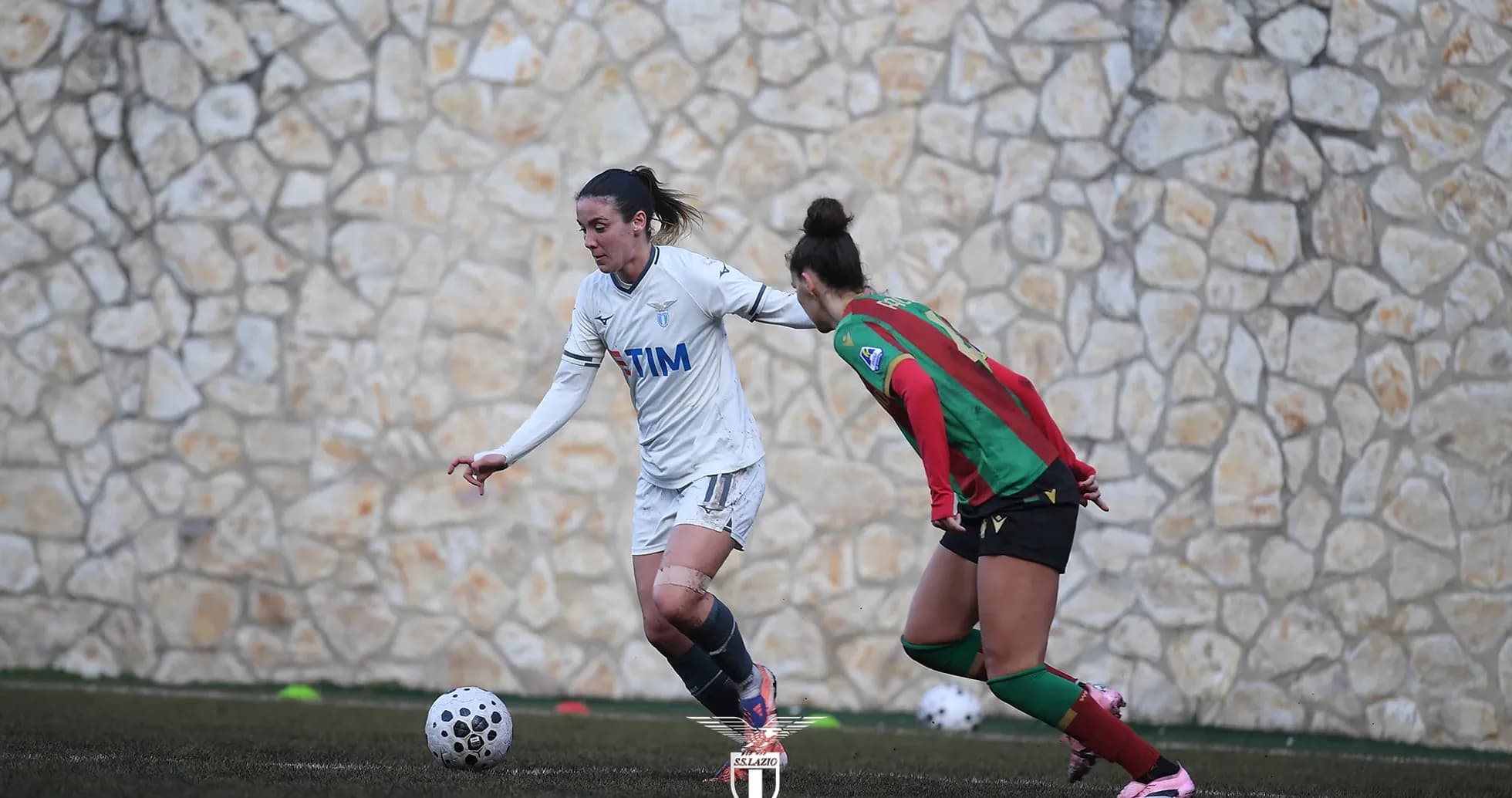
Lazio Women Secure 2–0 Victory Against Ternana Women
On a warm afternoon at Campo Mirko Fersini in Rome, Lazio W closed out a demanding stretch of the Serie A Women regular season with a 2–0 home win over Ternana W, a result that neatly mirrored the gap between a side pushing the top four and one fighting to escape the lower reaches. Following this result, Lazio sit 4th on 33 points with a goal difference of 2, while Ternana remain 11th with 14 points and a goal difference of -22. Over 21 league matches, Lazio’s profile is that of a high-variance contender: 10 wins, 3 draws, 8 defeats, with 30 goals scored and 28 conceded. Ternana, by contrast, have laboured through the campaign with 3 wins, 5 draws and 13 losses, scoring 18 and conceding 40.
The match itself, decided 2–0 after a 1–0 half-time lead, felt like a condensation of those season-long patterns. Lazio’s home numbers heading into this game already hinted at a narrow but effective edge: 11 matches at Campo Mirko Fersini had brought 5 wins, 2 draws and 4 losses, with 13 goals for and 12 against. Ternana arrived with one of the league’s most fragile away records – 1 win, 1 draw and 9 defeats on their travels, scoring just 4 and conceding 23 – and the 90 minutes in Rome never truly contradicted that story.
Starting XI
Gianluca Grassadonia’s starting XI had a familiar spine. In goal, F. Durante provided the platform for a back line anchored by C. Baltrip-Reyes, whose season numbers (29 tackles, 6 successful blocks, 21 interceptions in league play) underline her importance as a proactive defender rather than a mere last-ditch stopper. Around her, F. D’Auria, M. Connolly and E. Goldoni helped Lazio build from deep, while E. Oliviero and A. Castiello formed the technical heart of midfield. Ahead of them, M. Zanoli and F. Simonetti supported a front line spearheaded by N. Visentin and M. Monnecchi.
If there was a tactical void for Lazio, it lay not in absences – there is no official missing list for this fixture – but in how they had to reconfigure their attack without some of their season’s headline scorers in the starting XI. Martina Piemonte, the club’s top scorer in Serie A Women with 7 goals from 21 shots (12 on target), and Nikola Karczewska, with 3 league goals, both began on the bench. That forced Grassadonia to lean more heavily on movement and combination play than on pure penalty-box presence, at least in the early exchanges.
Ternana's Lineup
Mauro Ardizzone’s Ternana lined up with G. Ciccioli in goal and a back unit built around L. Peruzzo and M. Massimino, flanked by C. Martins and S. Breitner. In midfield, C. Labate and C. Ciccotti were tasked with screening, while A. Regazzoli, M. Petrara and A. Gomes tried to link to the absent headline forward options from the league’s scoring charts, such as V. Pirone and Giada Cimò, who were not named in the matchday XI. Their omission left Ternana short of the individual quality that has occasionally pierced games this season: Pirone’s 6 goals and 14 key passes, and Cimò’s 3 goals, 15 key passes and 25 tackles, have often been the difference between defeat and survival.
Disciplinary Trends
Disciplinary trends for both clubs added another layer of tension. Lazio’s season-long yellow-card distribution shows a clear spike between 46–60 minutes, where 23.33% of their cautions arrive, and a sustained aggression into the final quarter of an hour (16.67% between 76–90). Their red-card profile is scattered but telling: 33.33% of dismissals fall in the 16–30 range, another 33.33% between 76–90, and the remaining 33.33% in added time (91–105). With players like F. Simonetti – 4 yellows and 1 red across 14 appearances – and the attacking trio of Piemonte and Karczewska (both sent off once this season), Lazio walk a thin line between intensity and indiscipline.
Ternana’s card map is even more volatile. Yellow cards peak late, with 22.22% between 76–90 minutes and 18.52% in each of the 0–15, 46–60 and 61–75 windows. Their red cards are brutally concentrated: 100.00% of dismissals have arrived between 31–45 minutes, a sign of emotional overload just before half-time. Figures like V. Di Giammarino (4 yellows) and F. Quazzico (1 red in limited minutes) embody that edge. In Rome, however, Ternana managed to avoid the catastrophic mid-half meltdown, but they never quite shook the sense of walking on a disciplinary tightrope.
Key Matchups
Within that context, the key matchups were clear even before kick-off. The “Hunter vs Shield” duel pitted Lazio’s overall attacking threat – 1.4 goals per game in total, 1.2 at home – against a Ternana defence conceding 1.9 goals per game overall and 2.1 on their travels. Lazio’s best attacking performances this season have come when Piemonte’s penalty-area instincts are paired with the creative lines of Clarisse Le Bihan and Oliviero. Le Bihan’s 3 goals, 2 assists, 31 key passes and 72% passing accuracy mark her as the side’s chief conduit between midfield and attack. Oliviero, with 5 assists and 15 key passes, adds a second playmaking hub from deeper zones, winning 50 of 88 duels and blocking 6 shots.
Opposite them, Ternana’s “Shield” was led by Peruzzo, who has 22 tackles, 2 successful blocks and 15 interceptions this season. Yet even her defensive reading has struggled to compensate for the structural fragility of a unit that has allowed 23 away goals in 11 matches. The 2–0 in Rome felt almost conservative relative to that pattern; Lazio’s clean sheet was their 4th at home and 6th overall, while Ternana failed to score away for the 7th time this league campaign.
Midfield Battle
In the “Engine Room”, Lazio’s Oliviero and Castiello squared off against Ternana’s Labate and Ciccotti. Lazio’s midfield, buoyed by Oliviero’s 414 passes at 71% accuracy and 23 tackles, dictated tempo and second balls, allowing the hosts to compress the pitch and keep Ternana’s counters sporadic. Without Cimò’s ball-carrying and duel-winning (72 duels won this season), Ternana lacked the vertical thrust to break lines consistently.
From a statistical prognosis standpoint, this result sits exactly where the numbers would have placed it. Lazio’s goal difference of 2 (30 scored, 28 conceded) suggests a side that creates slightly more than it allows, while Ternana’s -22 (18 scored, 40 conceded) points to chronic defensive leakage. With Ternana’s attack averaging just 0.4 goals per game away and Lazio conceding only 1.1 at home, the likelihood of the visitors breaching F. Durante’s goal was always slim. Conversely, Lazio’s 1.2 home goals per match met a defence shipping 2.1 on the road; a multi-goal home performance was the statistically logical outcome.
Even without explicit xG figures, the underlying season data paints a clear picture: Lazio are a flawed but dangerous side whose attacking structure, guided by Le Bihan and Oliviero and buttressed by Baltrip-Reyes at the back, will keep them in the upper tier. Ternana, unless they can stabilise their away defending and reintegrate the creative and scoring influence of players like Pirone and Cimò into their strongest XI, will remain trapped in a cycle where narrow margins invariably tilt against them – just as they did over 90 controlled minutes in Rome.