.svg&w=384&q=75 "Pitchgist logo")
AC Milan W Triumphs Over Parma W in Serie A Women’s Match
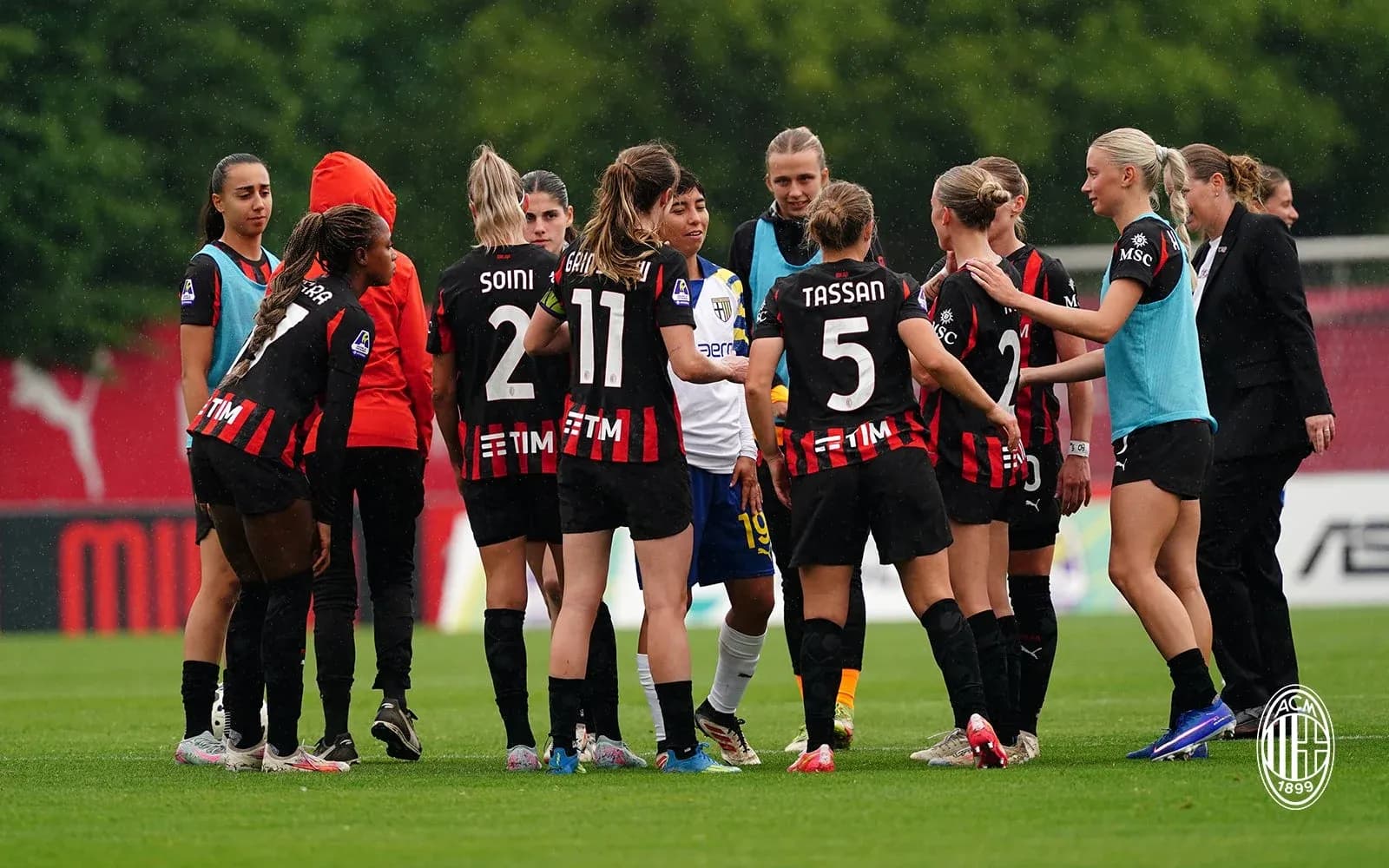
The late-morning sun over Centro Sportivo Peppino Vismara felt almost theatrical as AC Milan W and Parma W walked out, the stakes of Serie A Women’s Regular Season - 21 quietly woven into the calm Milan air. By the time E. Cappai blew for full time, the script was clear: a 3–1 home win that underlined the gap between a side consolidating itself in the upper half and another still fighting to keep its head above water.
Following this result, the table snapshot tells its own story. AC Milan W sit 6th with 32 points, their goal difference of 6 built from 31 goals scored and 25 conceded overall. Parma W, 10th on 16 points with a goal difference of -13 (15 scored, 28 allowed overall), remain a team that lives on fine margins and long defensive shifts.
I. The Big Picture – Milan’s Structure vs Parma’s Stubbornness
Milan’s season-long identity is that of a side that leans into control and variety in possession. Overall they average 1.5 goals for and 1.2 against per game, but the home split is more revealing: 1.6 goals scored at home versus 1.4 conceded. They are not a purely defensive side; they embrace risk, and at Vismara that often pays off.
Parma arrive as a team defined by grind and resistance. Overall they score 0.7 goals per game and concede 1.3, but the real fracture line is away from home: on their travels they average just 0.2 goals for while conceding 1.3. Eleven away matches, two goals scored. Every away fixture is essentially an exercise in survival.
The 1–1 half-time score suggested a contest, but the 3–1 full-time outcome reflected the underlying seasonal DNA: Milan’s capacity to keep creating and Parma’s inability to sustain their resistance for 90 minutes.
II. Tactical Voids and Discipline – Where Edges Emerged
There is no explicit injury list, so the absences are more tactical than medical. For Milan, the most intriguing omission from the starting XI was Kayleigh van Dooren. The league’s 7th-ranked scorer for the club, she has 5 goals from 18 shots (12 on target) and a 6.9 rating. Yet she began on the bench, leaving the creative and scoring burden to a more workmanlike front line of C. Dompig, T. Kyvag and S. Stokic.
In midfield, Suzanne Bakker doubled down on energy and balance. M. Mascarello, one of the league’s top yellow-card collectors with 4 bookings, anchored the centre alongside G. Arrigoni and C. Grimshaw. Mascarello’s 368 passes overall at 77% accuracy and 15 key passes show a player who dictates rhythm but does not shy from contact – 15 fouls committed testify to that. Grimshaw, with 2 assists and a 6.93 rating, offers the vertical thrust and late box runs that make Milan’s midfield more than just a platform.
Defensively, M. Keijzer’s presence is significant. Across the season she has 23 tackles, 3 blocked shots and 10 interceptions, but also a red card on her record. She represents Milan’s willingness to defend aggressively on the front foot, stepping in rather than dropping off.
Parma’s voids are structural rather than individual. Their starting XI in Milan was built on a 3-at-the-back identity that has defined their season: multiple variants of 3-4-2-1, 3-4-3 and 3-5-1-1. Giovanni Valenti’s choice to start M. Uffren and C. Prugna in midfield, with G. Distefano and A. Kerr higher, reinforced a clear idea: compress the centre, break Milan’s rhythm, and use transitions as their main weapon.
Discipline is a double-edged sword for Parma. Uffren leads the league in yellow cards with 7 and has also missed a penalty, a reminder that her influence comes with risk. She has 32 tackles, 3 blocks and 34 interceptions – elite defensive numbers – but 24 fouls committed show how often she walks the disciplinary tightrope. As a team, Parma’s yellow-card distribution peaks at 76–90 minutes with 29.17% of their bookings in that period, and they have a red card in that same late window. When fatigue sets in, their defensive bravery can tip into recklessness.
Milan’s own card profile is similar in its late-game intensity: 31.58% of their yellows arrive from 76–90 minutes, with red cards spread evenly across 46–60, 61–75 and 76–90 (each 33.33%). This is a side that keeps competing aggressively deep into games, sometimes overstepping the line.
III. Key Matchups – Hunter vs Shield, Engine Room vs Enforcer
The “Hunter vs Shield” duel is embodied more by roles than a single head-to-head. Milan’s attacking threat is distributed, but van Dooren’s 5-goal season looms over any defensive plan. Even when she does not start, her presence on the bench changes the psychological landscape. Parma’s shield is collective, but Uffren is its spearhead: 512 passes at 82% accuracy, 110 duels with 60 won, and those 34 interceptions make her the first line of resistance in front of a back three that often sits deep.
In Milan’s 3–1 win, the pattern was clear. With Parma averaging just 0.2 away goals, their margin for error is microscopic. Once they concede a second, their model – built on narrow, low-scoring contests – begins to crumble. Milan’s home average of 1.6 goals for and 1.4 against suggests chaos is their natural habitat; they are comfortable in games where the scoreline moves.
The “Engine Room” matchup pits Milan’s midfield trio against Parma’s central block. Grimshaw’s 263 passes and 11 key passes, combined with her 10 successful dribbles, give Milan a vertical engine that constantly tests compact blocks. Mascarello, with her balance of passing and bite, complements that by recycling possession and breaking up counterattacks. Against them, Uffren and Prugna must both screen and build, a dual role that often leaves Parma stretched as the match wears on.
On the flanks, the presence of E. Koivisto and A. Soffia for Milan against Parma’s wing-backs shapes the territorial battle. Koivisto’s reliability and Soffia’s energy allow Milan to pin Parma’s wide players back, denying them the easy out-ball that a 3-4-2-1 structure normally relies on.
Further forward, G. Distefano is Parma’s creative reference. With 2 assists, 16 key passes and 31 dribble attempts (11 successful), she is both progressor and outlet. Her 151 duels with 81 won show a player who does not shy away from contact. But against a Milan side that defends aggressively and can rotate midfielders to crowd her space, her influence is often forced into deeper, less dangerous zones.
IV. Statistical Prognosis – Why 3–1 Felt Inevitable
Even without explicit xG numbers, the season data points toward a match tilted heavily in Milan’s favour. Heading into this game, Milan had 9 wins from 21 matches overall, Parma just 2. Milan had scored 31 goals; Parma only 15. At home, Milan’s 18 goals from 11 matches contrast brutally with Parma’s 2 away goals from 11.
Defensively, Parma’s away average of 1.3 goals conceded is not catastrophic on its own, but when paired with their 0.2 goals scored on their travels, the expected pattern is a narrow defeat unless they produce an outlier performance. Milan, meanwhile, combine a positive overall goal difference of 6 with 7 clean sheets and 7 matches where they failed to score – a volatile profile, but one that trends toward open games rather than stalemates.
Layer on the disciplinary profiles – both teams prone to late cards, Parma’s red card clustered in the 76–90 window, Milan’s aggression sustained across the second half – and the likelihood of Milan pulling away late grows. As fatigue hits Parma’s compact block, space opens between midfield and defence. That is precisely the zone where players like Grimshaw and Dompig thrive, arriving between the lines or attacking the box.
So the 3–1 scoreline is less a surprise than a crystallization of the season’s numbers and narratives. Milan’s deeper attacking options, home scoring rate and assertive midfield ultimately overpowered a Parma side whose away model leaves almost no margin for conceding first, let alone chasing the game in Milan.