.svg&w=384&q=75 "Pitchgist logo")

West Ham vs Arsenal: A Tactical Analysis of the Premier League Clash
The London Stadium under late‑season cloud has seen plenty of drama, but this felt like a slow suffocation. Following this result, West Ham’s 1-0 home defeat to league leaders Arsenal distilled the story of both seasons: a relegation-threatened side straining to survive, and a title-chasing machine that no longer needs to dazzle to dominate.
I. The Big Picture – Context and Contrasts
This was Premier League, Regular Season - 36, with everything on the line for both clubs. West Ham came into the round 18th with 36 points, their goal difference at -20 (42 scored, 62 conceded). Across 36 matches they had won 9, drawn 9, and lost 18; at home they had taken 5 wins, 4 draws and 9 defeats, scoring 24 and conceding 30. Arsenal arrived as league leaders on 79 points, with a goal difference of 42 (68 for, 26 against) from 24 wins, 7 draws and 5 losses. On their travels, they had been relentlessly efficient: 10 away wins, 5 draws, 3 defeats, with 28 scored and only 15 conceded.
The formations told their own story. Nuno Espirito Santo rolled out a 3-4-2-1, a pragmatic shell aimed at protecting a defence that has shipped an average of 1.7 goals per game overall, 1.7 at home. Arsenal, under Mikel Arteta, went with a 4-2-3-1 variation of their usual structure, a slight tweak from their more common 4-3-3, but still built on control and territorial pressure. The full-time scoreline – 0-1 – underlined the gap in defensive standards: Arsenal’s season average of 0.7 goals against per match (0.8 away) once again held firm.
II. Tactical Voids – Absences, Discipline and Structural Risk
Both sides arrived with important absentees. West Ham were without L. Fabianski (back injury), removing a veteran presence from the bench and confirming M. Hermansen as undisputed starter. A. Traore’s muscle injury stripped Nuno of a direct, transitional outlet who might have stretched Arsenal’s high line in the channels.
Arsenal’s own absences were more about depth than system, but still telling. M. Merino’s foot injury denied Arteta a progressive, ball-winning midfielder who could have rotated with D. Rice or added a different passing angle. J. Timber’s ankle injury removed a versatile defender capable of inverting into midfield, which meant the back four had to remain more orthodox in their rest defence.
Season-long card patterns framed the risk profiles. West Ham’s yellow cards spike at 31-45 minutes with 24.24% of their bookings, and they maintain a high late-game intensity with 22.73% between 91-105 minutes. Their red-card profile is volatile: one red between 46-60, one between 76-90, and one between 91-105, each band accounting for 33.33% of their dismissals. That history hangs over a back three containing J. Todibo, who has already collected 5 yellows and 1 red this season. Arsenal, by contrast, have no red cards at all and a yellow-card peak at 76-90 minutes (26.53%), a sign of controlled aggression and game management rather than chaos.
Those profiles shaped the tactical risk: West Ham needed to defend deep and compact without tipping into desperation; Arsenal could press the issue late knowing they tend to keep 11 men on the pitch and manage transitions cleanly.
III. Key Matchups – Hunter vs Shield, Engine Room Battles
Hunter vs Shield was defined by V. Gyökeres against West Ham’s fragile defensive record. Gyökeres has 14 league goals and 3 penalties scored, a powerful, duel-heavy forward (230 duels contested, 72 won) who thrives on physical battles and penalty-box chaos. He led the line ahead of a creative trio of B. Saka, E. Eze and L. Trossard. Against a West Ham side conceding 1.7 goals per game overall and 1.7 at home, the matchup was always skewed. The Hammers’ biggest home defeat this season – 1-5 – is a reminder of what happens when their defensive structure collapses.
Yet Nuno’s 3-4-2-1 was built to insulate that vulnerability. Todibo, K. Mavropanos and A. Disasi formed a narrow back three, with A. Wan-Bissaka and M. Diouf tasked with doubling as wing-backs and auxiliary full-backs. Todibo’s season numbers – 37 tackles, 13 blocked shots, 16 interceptions – speak to a defender who throws himself into the line of fire, but his disciplinary record adds jeopardy. The job was to keep Gyökeres facing away from goal, deny him space to turn, and rely on numbers rather than individual duels.
Further forward, West Ham’s main attacking hope lay in J. Bowen and C. Summerville floating behind T. Castellanos. Bowen is one of the league’s premier creators: 8 goals and 10 assists, with 43 key passes and 113 dribble attempts (52 successful). His duel with Arsenal’s defensive block – W. Saliba, Gabriel, and the screening of Rice – was the core of West Ham’s counter-attacking plan. Arsenal’s defence, which has allowed only 26 goals overall and kept 18 clean sheets (10 at home, 8 away), is built around timing and positioning more than last-ditch heroics. Saliba and Gabriel were tasked with squeezing the space between lines so Bowen could not receive on the half-turn.
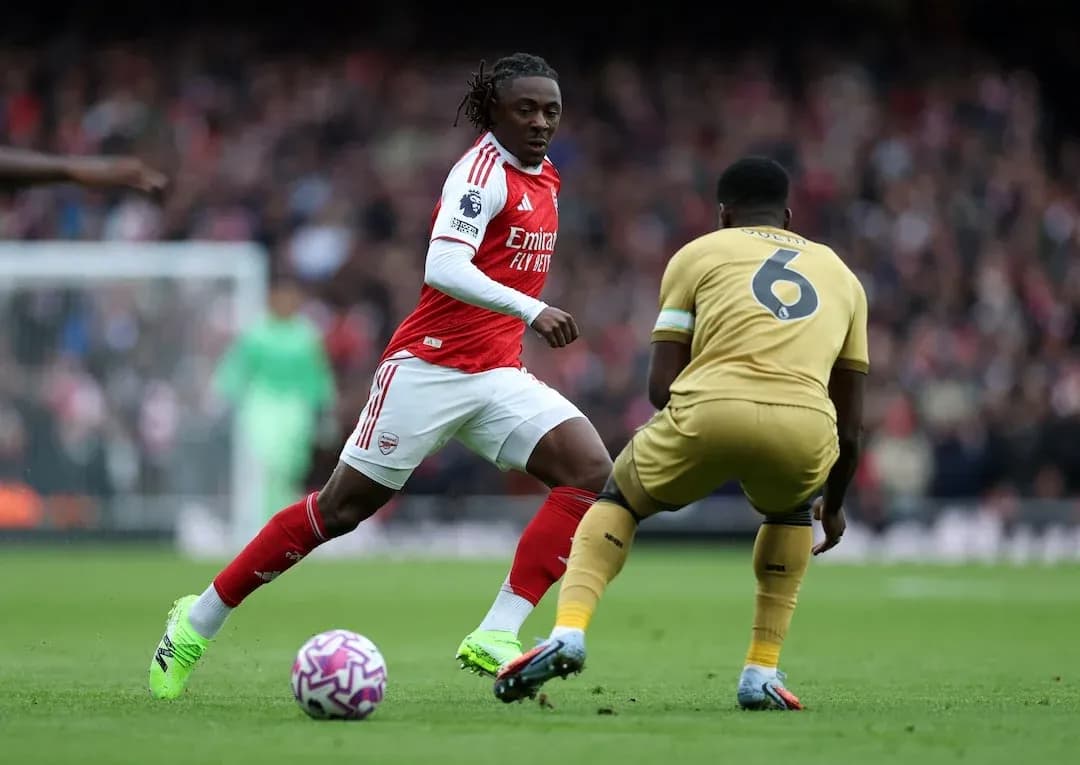
The Engine Room battle was anchored by Rice. With 4 goals, 5 assists, 64 key passes and 65 tackles, plus 12 blocked shots and 36 interceptions, he is both metronome and destroyer. Alongside M. Lewis-Skelly, he controlled the central lanes against West Ham’s double pivot of T. Soucek and M. Fernandes. Soucek’s aerial presence and late runs were supposed to offer an out-ball and set-piece threat, but Arsenal’s structure – a 4-2-3-1 that often morphed into a 2-3-5 in possession – pinned West Ham so deep that their midfield rarely escaped to support Castellanos.
IV. Statistical Prognosis – xG Logic and Defensive Gravity
Even without explicit xG numbers, the season data points towards a predictable balance of chances. Arsenal average 1.9 goals for per game overall (1.6 away) while conceding just 0.7 (0.8 away). West Ham, by contrast, average 1.2 goals for (1.3 at home) and 1.7 against. When a side with Arsenal’s attacking volume and defensive control faces a team with West Ham’s negative goal difference and relegation pressure, the underlying xG tilt is clear: Arsenal are likely to generate more, and better, chances while restricting the hosts to scraps.
The 0-1 scoreline fits that logic. Arsenal’s clean-sheet record – 18 in 36 matches – is not an accident; it is the natural product of structure, pressing traps and territorial dominance. West Ham, who have failed to score 13 times this season (6 at home), once again found their attacking patterns suffocated. Bowen’s creativity was blunted by Arsenal’s compact mid-block, and Castellanos was often isolated against two centre-backs who relish aerial and physical duels.
Following this result, the story is one of trajectories hardening. Arsenal’s statistical profile continues to scream champions: elite defence, reliable attack, and a capacity to edge tight games away from home. West Ham’s numbers still warn of danger: a soft underbelly, disciplinary volatility, and an attack too dependent on moments from Bowen rather than sustained patterns.
On the day, the tactical preview wrote itself: a controlled Arsenal win, a narrow margin, and a performance that aligned almost perfectly with the season’s underlying metrics.