.svg&w=384&q=75 "Pitchgist logo")
Crystal Palace vs Everton: A Season’s Verdict in a 2-2 Draw
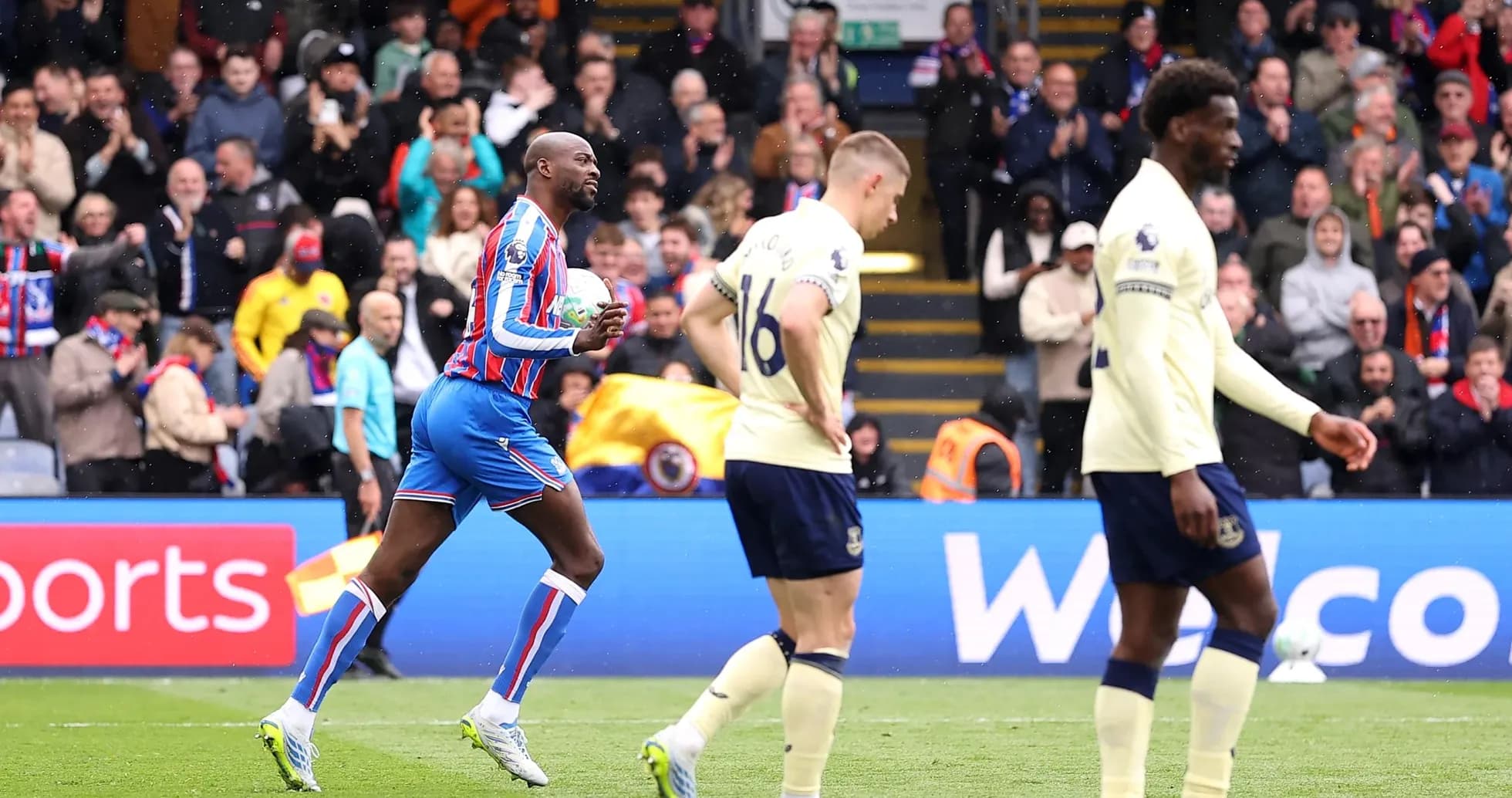
Selhurst Park had the feel of a season’s verdict rather than just “Regular Season - 36” as Crystal Palace and Everton played out a 2-2 draw that neatly mirrored their campaign identities. Following this result, the table still shows Palace in 15th on 44 points with a goal difference of -6 (38 scored, 44 conceded overall), and Everton in 10th on 49 points with a perfectly balanced goal difference of 0 (46 scored, 46 conceded overall). One side has lived on fine margins and structural discipline, the other on resilience and attrition; this game distilled both stories into 90 tense minutes.
I. The Big Picture: Structures and Season DNA
Oliver Glasner doubled down on Crystal Palace’s season-long blueprint, rolling out the familiar 3-4-2-1 that has started 31 league games. D. Henderson anchored a back three of C. Richards, M. Lacroix and J. Canvot, with D. Munoz and T. Mitchell stretching the pitch as wing-backs. Inside them, A. Wharton and D. Kamada formed the central axis, while I. Sarr and B. Johnson floated behind lone striker J. S. Larsen.
Heading into this game, that structure had produced a cautious but coherent home profile: in total this campaign Palace had played 35 league matches, with 18 at home. At home they averaged 1.0 goals for and 1.2 goals against, leaning on organisation and clean sheets (7 at Selhurst Park) rather than attacking fireworks. The 2-2 scoreline therefore represented Palace punching slightly above their usual attacking weight at home while again conceding at a rate consistent with their 1.2 home average.
Everton arrived as the more stable mid-table outfit, 10th with 49 points from 36 games, and a season-long symmetry of 46 goals for and 46 against overall. Their tactical identity has largely been built on a 4-2-3-1, used 21 times, but here they lined up without a declared formation. On the pitch, however, the shape was recognisable: J. Pickford behind a back four of J. O’Brien, J. Tarkowski, M. Keane and V. Mykolenko; T. Iroegbunam and J. Garner as the double pivot; a fluid line of M. Rohl, K. Dewsbury-Hall and I. Ndiaye supporting Beto.
On their travels, Everton’s numbers have been solid rather than spectacular: 18 away games, 7 wins, 5 draws, 6 defeats, with 21 goals for and 22 against, an away average of 1.2 scored and 1.2 conceded. Scoring twice at Selhurst Park fits neatly into that away profile, while the two conceded underline a side that tends to trade chances rather than suffocate games.
II. Tactical Voids: Absences and Discipline
Both squads were subtly reshaped by absences. Crystal Palace were without C. Doucoure (knee), E. Guessand (knee), E. Nketiah (thigh) and B. Sosa (injury). The loss of Doucoure in particular stripped Palace of a natural ball-winner at the base of midfield, forcing Wharton and Kamada to cover more ground and altering the balance of the press. Without Nketiah, Glasner leaned more heavily on J. S. Larsen’s holdup play and the bench threat of J. Mateta.
Everton’s missing core was equally significant. J. Branthwaite (hamstring) and I. Gueye (injury) removed a first-choice centre-back and a key screening midfielder, while J. Grealish’s foot injury robbed them of one of the league’s most creative wide playmakers. In structural terms, it meant more responsibility for Tarkowski and Keane to manage the box, and for Garner to orchestrate both build-up and protection.
From a disciplinary standpoint, this fixture brought together two sides with contrasting season profiles. Palace’s yellow cards skew towards the middle of games: 31-45 minutes accounts for 19.72% of their cautions, with another 18.31% between 46-60. Everton, by contrast, are a late-game flashpoint: 21.74% of their yellows arrive between 76-90 minutes, and another 15.94% in added time (91-105). That pattern framed the final quarter of an hour at Selhurst Park as a zone of heightened risk, especially once fatigue and tactical tweaks began to bite.
Red-card risk was also in the air. Everton’s J. O’Brien has already seen red once this season, while Palace’s M. Lacroix also carries a single dismissal. Team-wide, Palace’s reds are concentrated between 46-75 minutes, Everton’s between 0-15 and 61-90. This undercurrent shaped how both back lines defended transitions, particularly as the game stretched after the break.
III. Key Matchups: Hunter vs Shield, Engine Room Battles
The clearest “Hunter vs Shield” storyline revolved around Palace’s striker pool and Everton’s away defence. J. Mateta, one of the Premier League’s more efficient penalty-box forwards this season with 11 goals overall, started on the bench but loomed as a late-game weapon. His season profile is that of a pure finisher: 55 shots, 31 on target, 4 penalties scored from 4, and a willingness to engage physically (279 duels, 105 won). Against an Everton away unit that concedes 1.2 goals per game on their travels and has managed just 5 clean sheets away, the introduction of Mateta was always going to tilt the game towards chaos in the box.
Everton’s “Shield” was not just the centre-backs but the structure in front of them, led by J. Garner. Officially listed as a defender in the season data but operating here from midfield, Garner is one of the league’s most industrious and influential two-way players: 1,665 total passes with 52 key passes, 115 tackles, 9 blocked shots and 54 interceptions overall. His 11 yellow cards underline how often he lives on the edge of the duel, but also how central he is to Everton’s ability to break up play and launch counters.
In the “Engine Room” duel, Garner and T. Iroegbunam faced Wharton and Kamada. Palace’s double pivot is more technical than destructive, and without Doucoure they lacked a natural enforcer. That shaped the flow: Everton could step Garner higher to press Kamada, trusting Iroegbunam to patrol the space behind, while Palace relied on quick circulation into Sarr and Johnson between the lines rather than sustained central dominance.
Out wide, Munoz and Mitchell had to manage the dual task of pinning Mykolenko and O’Brien back while tracking the inward movements of Dewsbury-Hall and Ndiaye. Everton’s ability to overload half-spaces through those midfield runners has been a quiet strength this season, complementing Beto’s more direct, penalty-area-focused presence.
IV. Statistical and Tactical Verdict
From a statistical perspective, this 2-2 feels almost pre-written by the season data. Heading into this game, Palace’s overall averages sat at 1.1 goals for and 1.3 against per match, Everton’s at 1.3 for and 1.3 against. Combine those profiles and you land in the territory of a game with roughly 2.4–2.6 expected goals in total, split relatively evenly. A 2-2 scoreline, even without explicit xG values, is entirely consistent with that landscape.
Palace’s home caution—4 wins, 9 draws, 5 defeats at Selhurst Park—was again on display. They created enough to score twice, aided by the structural width of the 3-4-2-1 and the movement of Sarr and Johnson, but never fully shut the door defensively. Everton, with 7 away wins and 5 away draws, once more showed why they are one of the league’s more reliable travellers: capable of absorbing pressure, leaning on Pickford’s authority, and trusting Garner to connect phases.
In tactical terms, the absence of Doucoure and Gueye meant this game was always likely to be more open through midfield than either coach might ideally prefer. That openness fed into a contest of traded punches rather than territorial strangulation. Palace’s late attacking substitutions—most notably the option of Mateta from the bench—ensured they always had a route back into the game, while Everton’s structural discipline and set-piece threat kept them dangerous until the final whistle.
Following this result, both teams emerge broadly as the numbers suggest they should. Palace remain a side whose 3-4-2-1 gives them a clear identity but leaves thin margins at both ends. Everton continue to live on the knife-edge of a 0 goal difference, their season a balance of Garner’s control, Beto’s presence and a back line that bends but rarely breaks completely. At Selhurst Park, the narrative and the numbers finally met in the middle.