.svg&w=384&q=75 "Pitchgist logo")
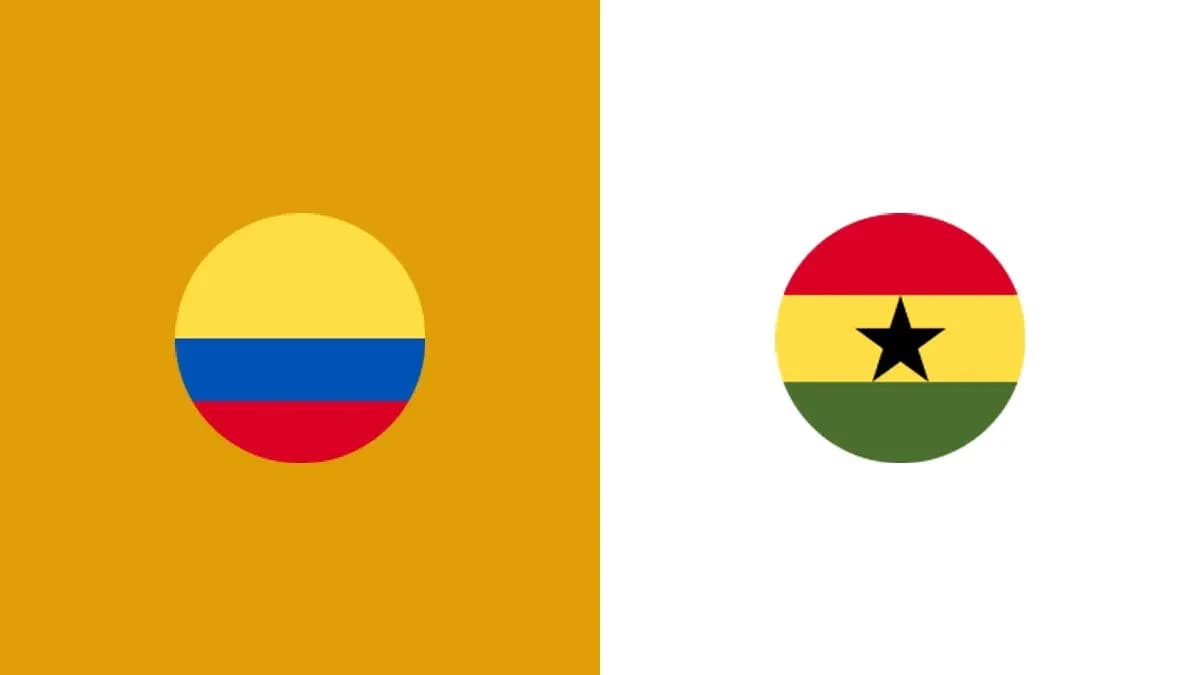
Colombia vs Ghana: A Clash of Styles in Kansas City
The Round of 32 reaches its final bend in Kansas City, where two very different stories collide under the lights.
On one side, Colombia: smooth, confident, and marching into the knockouts with the swagger of a team that has barely been touched. On the other, Ghana: scarred by setbacks, fuelled by history, and already living a landmark World Cup – but desperate for more.
Kick-off is set for 4 July 2026 at 01:30 GMT (20:30 EST on 3 July). The stakes need no translation.
Colombia’s rhythm vs Ghana’s resistance
Néstor Lorenzo has built a Colombia that looks built for tournament football. They topped Group K with seven points, but it was the manner of it that turned heads.
They dismantled Uzbekistan 3-1, then squeezed past DR Congo 1-0. When the level rose against Portugal, they didn’t blink. A 0-0 draw against one of Europe’s powerhouses sealed first place and, just as importantly, underlined a balance that has often eluded Colombian sides at major tournaments.
Only one goal conceded in three games. Six scored across their last five matches, none allowed. Jordan and Costa Rica were brushed aside in pre-tournament friendlies. This is not just a team in form; it is a structure that holds.
Ghana’s road has been far rougher, but no less compelling.
They slipped into the knockouts as one of the best third-placed teams from Group L, finishing on four points. A gritty 1-0 win over Panama steadied them after a setback against Croatia. A disciplined 0-0 draw with co-hosts England showed they could dig in on the biggest stage.
Their form line – W-D-L-D-L – tells of a side that lives on the margins. Three goals scored, four conceded in their last five. But it also tells of a team that refuses to disappear.
For the Black Stars, just being here is historic. For the first time in the modern era, they have survived the group stage. Now they stare at a giant.
Veteran minds, clean bills and clear ideas
Both managers arrive in Kansas City with something coaches crave in tournament chaos: clarity.
Colombia report no fresh injuries or suspensions. Luis Suárez has shaken off the minor issue that restricted him to a substitute role against Portugal and is ready to lead the line again. That restores Lorenzo’s preferred attacking triangle, with James Rodríguez drifting between the lines and Luis Díaz ripping down the flank.
James, 34 now, no longer covers every blade of grass. He doesn’t need to. His game is about angles, pauses, and that one pass that splits a block in half. Colombia will look to him to unlock the tight spaces Ghana will try to create.
Ghana’s medical team have done their own crucial work. Antoine Semenyo, the Manchester City midfielder who carried an ankle concern, is expected to start. His energy and ability to carry the ball under pressure give Carlos Queiroz an outlet when Colombia squeeze high.
Thomas Partey sits at the heart of it all. He will be asked to absorb pressure, dictate tempo, and shut down Colombia’s rhythm in midfield. Ahead of him, Jordan Ayew’s nous and movement remain essential. The veteran forward may not have the legs of old, but he knows where to stand, when to drop, and how to drag defenders into uncomfortable places.
Both teams are settled. Both know exactly who they are. Now the structures face their hardest examination.
Where this game will be won
Look to Colombia’s right. That is where they like to twist the knife.
Daniel Muñoz has been one of their most dangerous weapons, a full-back in name only once the game starts to breathe. Already with two goals in this tournament, he times his surges with the precision of a winger, combining with the advanced midfielders and wide runners to overload that flank.
Those rotations are relentless. Jhon Arias can drift inside, Rodríguez can slide over to create triangles, and Suárez pulls centre-backs out of position. The aim is simple: stretch the block, isolate defenders, then strike.
Ghana’s answer must be discipline. Their plan revolves around a compact mid-block, where distances between lines stay tight and the centre of the pitch remains clogged.
The duel between Richard Ríos and Thomas Partey in midfield could define the night. Ríos is Colombia’s metronome, the man who turns defence into attack with quick forward passes. If Partey can get close, disrupt his rhythm, and force him sideways or backwards, Ghana can starve Díaz and blunt Colombia’s most explosive outlet.
Fail to do that, and Díaz will see too much of the ball in dangerous areas. Few defenders enjoy that experience.
Behind Partey, communication in Ghana’s back line must be flawless. Muñoz’s overlapping runs, Rodríguez drifting into half-spaces, Suárez dropping off the front – all of it is designed to pull a back four apart by inches. Those inches decide knockout ties.
Patience vs the puncher’s chance
For Colombia, the warning is clear. They cannot allow their own ambition to become Ghana’s greatest weapon.
Lorenzo’s side will have more of the ball. They will probe, recycle, and look for the gaps. The danger comes if they flood too many bodies forward, lose their shape, and give Ghana what they crave: space to sprint into.
Ghana’s counter-attacking threat is not built on sheer volume of chances, but on the brutality of the ones they do create. One loose pass from Colombia’s midfield, one mistimed full-back run, and suddenly Semenyo, Kamaldeen Sulemana or another runner has grass in front of them and only one line to beat.
That is why Colombia’s patience matters as much as their flair. They must pick their moments, not chase the game out of frustration if Ghana hold firm early on.
For Queiroz, the equation is different but just as stark. His team cannot afford lapses. A single misread off a Rodríguez feint or a delayed tracking of Muñoz’s surge could be fatal. Yet they also know Colombia have not conceded in their last five matches. Sitting deep and hoping for penalties is a fantasy. At some point, Ghana will have to land a punch.
Likely line-ups and the shapes in play
Colombia are expected to line up in a familiar, fluid 4-3-3:
- Vargas; Muñoz, Lucumí, Sánchez, Mojica; Puerta, Lerma, Arias; Rodríguez, Suárez, Díaz.
It is a side built on a solid central core – Davinson Sánchez and Jhon Lucumí at the back, Jefferson Lerma and Gustavo Puerta screening – with freedom granted to the front three and the advanced midfielders.
Ghana’s projected XI, listed against USA but expected to mirror that structure here, offers a more cautious 4-5-1 that can quickly turn into a 4-3-3 in transition:
- Asare; Senaya, Adjetey, Luckassen, Mensah; Sulemana, Partey, Owusu, Sibo, Semenyo; Ayew.
Sulemana and Semenyo can jump wide or central on the break, while Partey and Kwasi Sibo hold the fort in the middle. Ayew’s role will be as much about linking play and drawing fouls as finishing.
The wider picture
Step back from the tactics for a moment and the contrast sharpens.
Colombia arrive riding a wave: W-W-W-D-W across their last five, with a clean sheet in each of those games. They look like a team that believes this World Cup can carry them deep into July.
Ghana walk in with a more fragile record – W-D-L-D-L – yet also with a sense that they are playing with house money. The pressure of expectation sits heavier on Colombia’s shoulders. The Black Stars have already made history; now they can play with a freedom that often unsettles favourites.
There is no recent head-to-head to lean on. No old scars, no familiar patterns. This is a rare intercontinental meeting at a major tournament, a blank page for both nations.
Colombia topped Group K. Ghana escaped Group L from third. On paper, the gap is clear.
But knockout football rarely reads the script.
If Colombia’s control meets Ghana’s courage in full force, Kansas City might just witness the night this World Cup truly opens up.