.svg&w=384&q=75 "Pitchgist logo")
Argentina's Tactical Mastery Over England in World Cup Semi-Final
England’s 4-2-3-1 under T. Tuchel was built to compress space without the ball, but over 90 minutes at Mercedes-Benz Stadium it was Argentina’s 4-4-2 that imposed the clearer structure and territorial control. The shot and possession profile — 15 total shots to 5, 64% of the ball to 36% — underlines a semi-final where Argentina dictated the game’s geography and rhythm, and England tried to survive in a low-to-mid block and counter selectively.
Out of possession, England’s back four of Reece James, John Stones, Marc Guéhi and Djed Spence stayed narrow, with Declan Rice and Elliot Anderson as a screening double pivot. The line of three — Morgan Rogers, Jude Bellingham and Anthony Gordon — had to cover a lot of lateral ground to close Argentina’s first build line and the double pivot of Leandro Paredes and Enzo Fernández. England’s 11 fouls and a single yellow card, to Elliot Anderson for “Foul” on 37', show a side defending largely in control but frequently under pressure, forced into contact to break Argentine rhythm.
With the ball, England were comparatively direct. They completed 324 passes to Argentina’s 590, but with 272 accurate at 84% they were reasonably clean when they did circulate. The pattern, though, was clear: first look forward, then secure. Harry Kane played as a fixed reference up front, with Gordon and Rogers attacking the half-spaces and Bellingham floating to connect. The attacking return — just 5 total shots, 2 on goal, 2 from inside the box — shows how rarely they managed to progress into true finishing zones. Their 0.53 xG matches that picture: a single high-quality moment, plus scraps.
That moment came on 55', and it was exactly the kind of transition Tuchel’s structure was designed to generate. England had been defending deep, then sprang forward with Gordon attacking space from the left. Morgan Rogers provided the final pass, and Anthony Gordon finished to give England a 1-0 lead. It was a textbook exploitation of Argentina’s advanced full-backs and central spacing: win, play quickly through the first line, then attack the channel behind Nicolás Tagliafico and Nahuel Molina. The fact that England still finished with only 2 shots on target despite leading for over half an hour shows how little sustained pressure they could mount afterwards.
Argentina’s 4-4-2 under L. Scaloni was much more ball-dominant and layered. With 590 passes and 537 accurate at 91%, they constructed long positional attacks, using Paredes and Enzo Fernández to dictate tempo and Lionel Messi to receive between lines. The front pairing of Messi and Julián Álvarez constantly shifted England’s centre-backs, while Giuliano Simeone from the right and Alexis Mac Allister from the left tucked inside to overload central zones. Their shot map — 15 total, 7 inside the box, 8 from outside — shows a team able to arrive both centrally and from distance, gradually grinding England back.
The substitutions on 64' and 72' marked a decisive tactical shift. Nicolás González (IN) came on for Leandro Paredes (OUT) at 64', converting Argentina into a more aggressive, wing-oriented side, with extra running and depth from wide. Then in a sweeping triple change on 72', Gonzalo Montiel (IN) for Nahuel Molina (OUT), Rodrigo De Paul (IN) for Giuliano Simeone (OUT) and Nicolás Otamendi (IN) for Lisandro Martínez (OUT) rebalanced the team: fresh legs at full-back, more vertical passing from midfield, and aerial presence at the back. Lautaro Martínez (IN) for Nicolás Tagliafico (OUT) at 81' finally gave Argentina a true penalty-box striker, and the shot volume and xG (1.84) reflect how effectively those changes tilted the game.
England’s response was more reactive and defensive in nature. Ezri Konsa (IN) for Anthony Gordon (OUT) at 72' effectively converted the left flank into a more conservative lane, prioritising protecting the lead over maintaining an outlet. Later, Dan Burn (IN) for Reece James (OUT) and Nico O'Reilly (IN) for Declan Rice (OUT) on 82', followed by Ivan Toney (IN) for John Stones (OUT) and Marcus Rashford (IN) for Djed Spence (OUT) at 90', created a late, unorthodox structure: extra forwards on but without the controlled possession base to serve them. By then, Argentina were already in full command of territory.
In goal, J. Pickford (England) was central to keeping the match tight as long as it was. He made 3 saves and, crucially, his goals prevented value of 0.02 indicates he performed almost exactly to expectation relative to the quality of shots faced. That aligns with the broader narrative: Argentina’s volume and xG edge were significant, and once they broke through, the scoreline tracked the underlying chances. At the other end, E. Martínez (Argentina) faced only 2 shots on goal and made 1 save, with the same 0.02 goals prevented. He was largely a spectator in build-up, acting as a rest-defence anchor behind a high line and a team that rarely lost control of the ball.
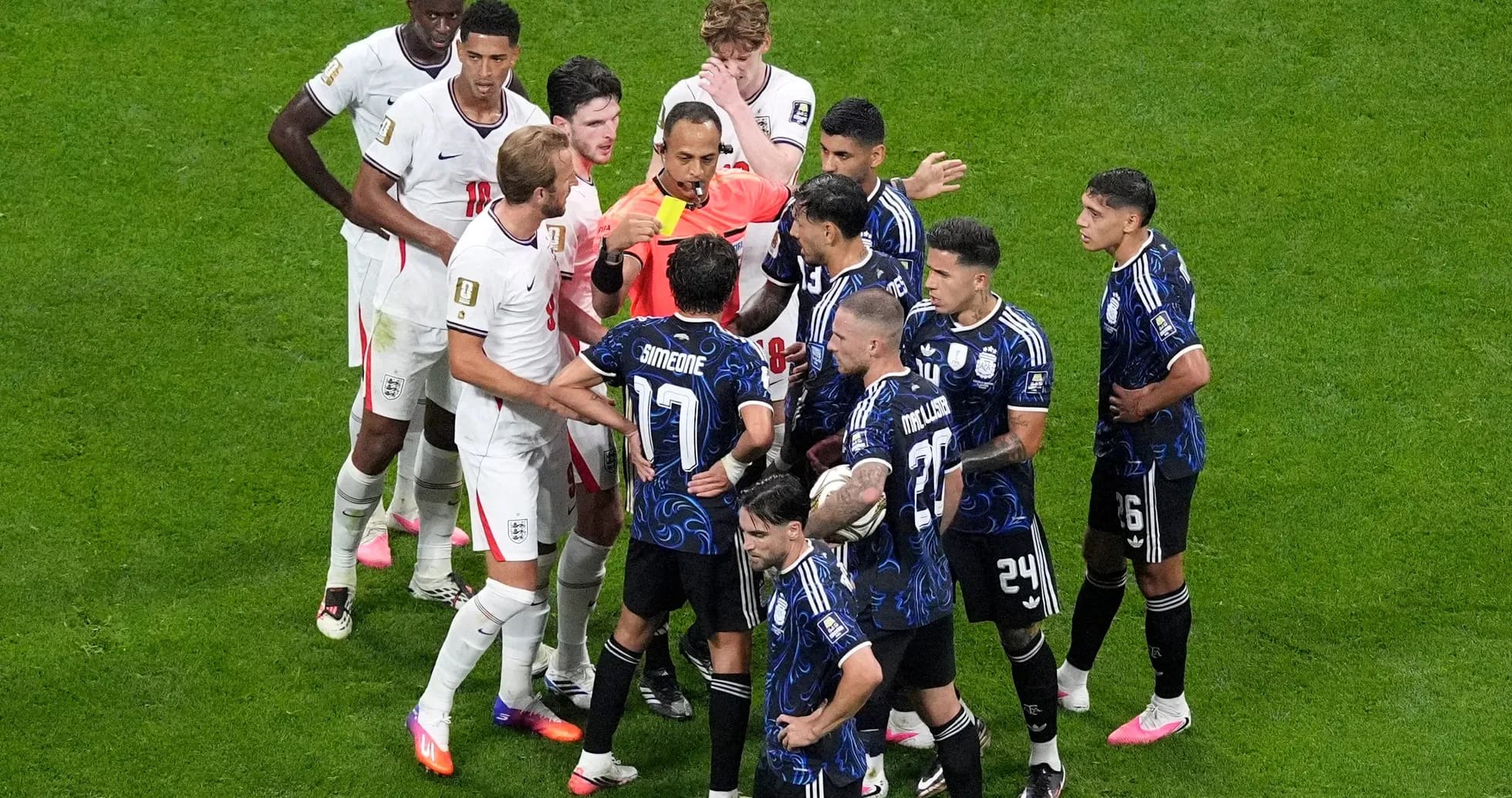
Discipline also tells a tactical story. Argentina’s 15 fouls and three yellow cards — Lisandro Martínez (42' “Foul”), Cristian Romero (51' “Foul”), and Rodrigo De Paul (90+4' “Argument”) — show a side willing to defend aggressively and stop transitions at source, especially after turnovers high up. England’s single yellow, to Elliot Anderson, contrasted with their lower foul count and more passive block: they tried to defend space rather than constantly engaging the man.
Ultimately, the late goals — Enzo Fernández on 86' from a Messi assist, then Lautaro Martínez at 90+2', again from Messi — were the logical endpoint of the tactical arc. Argentina’s superior possession, passing accuracy, and shot volume steadily eroded England’s compactness. England’s early lead and low-block resilience were not matched by an ability to relieve pressure or manage the game with the ball. In a World Cup Semi-finals context, this was a match where structure, bench usage, and control of central zones combined to turn a 0-1 deficit into a 2-1 win, with Argentina’s tactical elasticity ultimately overwhelming England’s more rigid, counter-punching plan.