.svg&w=384&q=75 "Pitchgist logo")
Spain vs France: Tactical Analysis of the Semi-Final
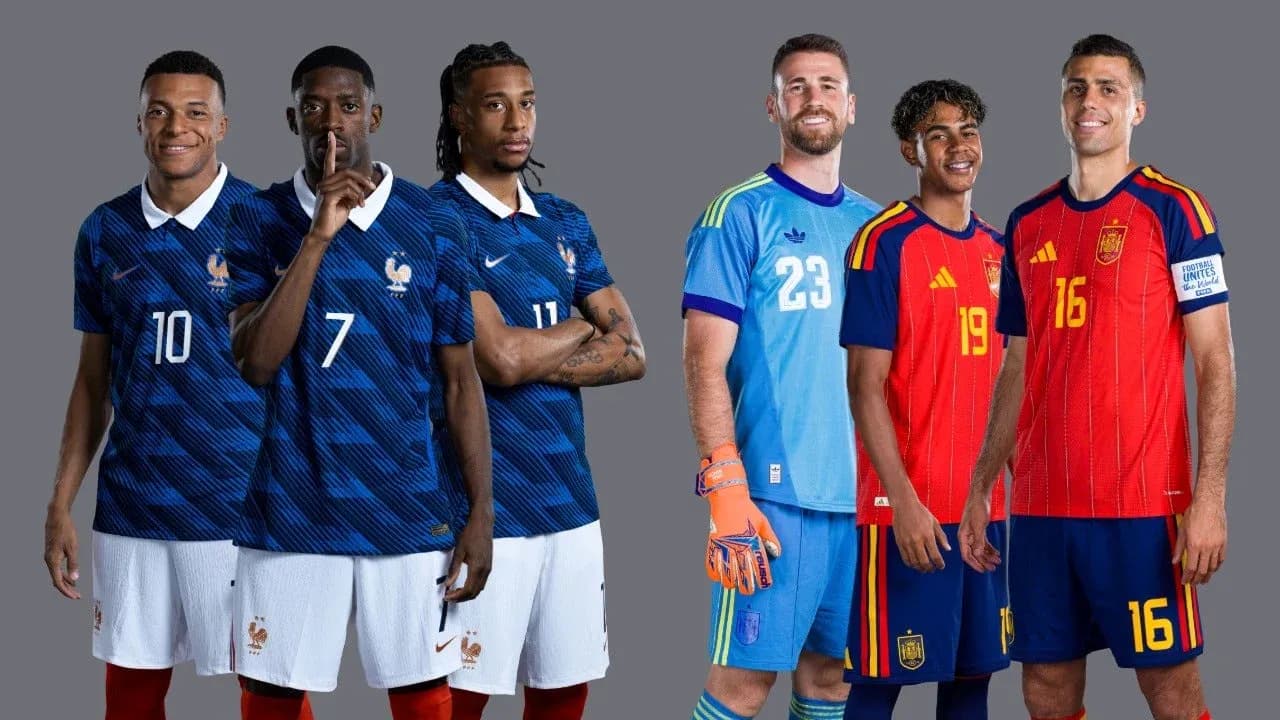
France and Spain mirrored each other structurally in a 4-2-3-1 at Dallas Stadium, but the semi-final was ultimately defined by how cleanly Spain executed their positional play and how little France were able to turn territory into true threat. The 2-0 scoreline, with Spain ahead 1-0 at half-time and closing it out in regulation, reflects not only a difference in efficiency in both boxes but also a clear edge in control and clarity of plan from Luis de la Fuente’s side.
Spain’s 4-2-3-1 operated as a textbook possession structure. With 51% of the ball and 500 passes (428 accurate, 86%), they used Rodri and Fabián Ruiz as a double pivot to dictate tempo, constantly creating a 2v1 against Kylian Mbappé when France tried to press from their 4-2-3-1 base. Pau Cubarsí and Aymeric Laporte were comfortable splitting wide, with Marc Cucurella and Pedro Porro providing the width high and early, which allowed Lamine Yamal and Alex Baena to drift into half-spaces and receive between French lines.
Key Tactical Breakpoint
The first key tactical breakpoint came from this dynamic: Spain’s penalty at 22' to Mikel Oyarzabal was the product of sustained occupation of the final third rather than volume shooting. Spain finished with only 2 shots on goal from 10 total, but their expected goals of 1.63 shows that the chances they crafted were of high quality, reflecting well-constructed attacks rather than hopeful efforts. Dani Olmo’s role as a high “10” connecting the front line was central; his assist for Pedro Porro’s 58' goal underlined Spain’s ability to overload one side, then find the weak-side full-back arriving late.
Defensive Structure
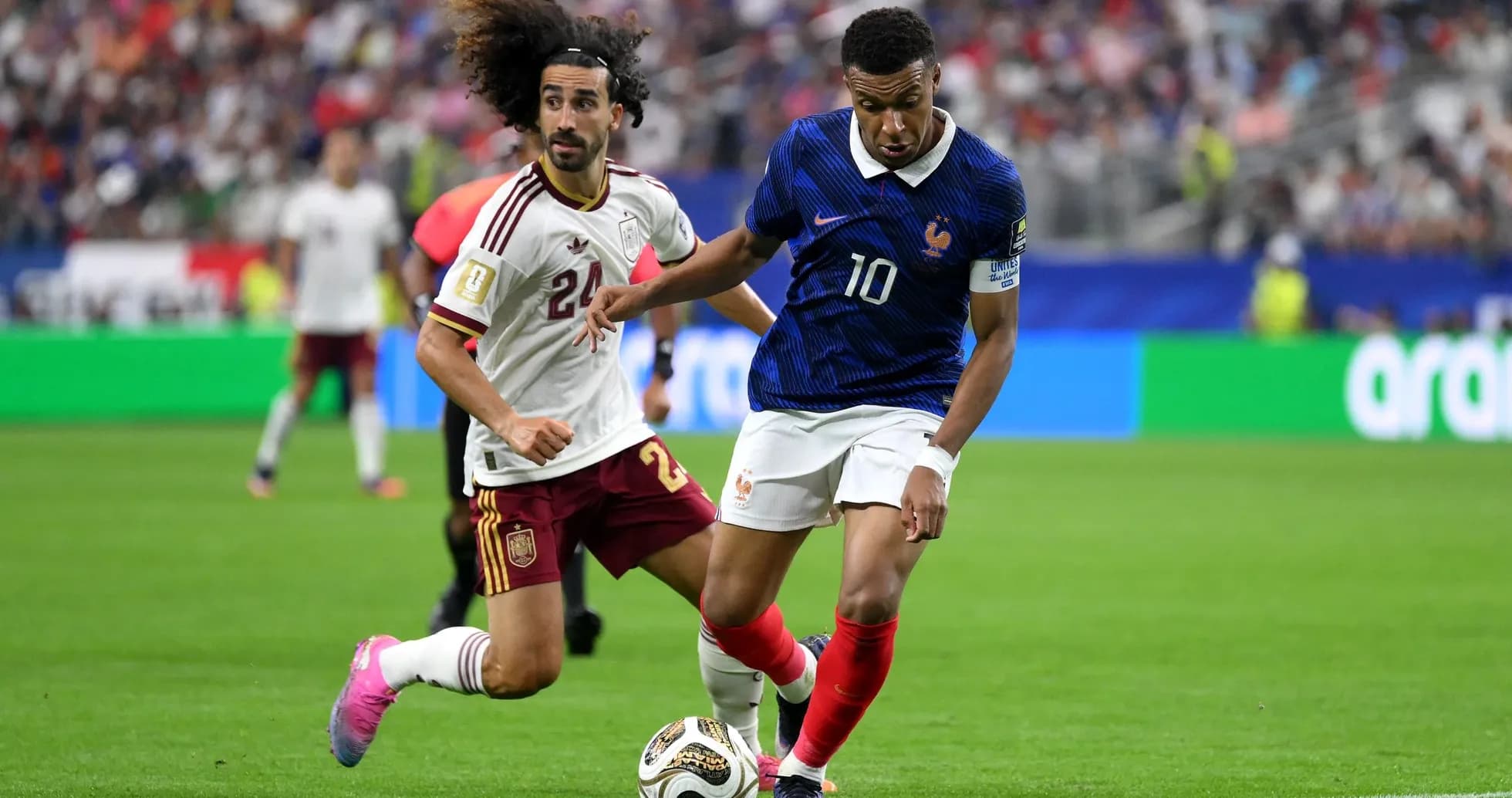
Defensively, Spain’s structure without the ball was compact and intelligent. The double pivot screened passes into Aurélien Tchouaméni and Adrien Rabiot early, forcing France to build via full-backs and long diagonals. Spain committed 12 fouls and took a single yellow card (Marc Cucurella, “Foul” at 31'), but the foul profile was largely tactical: breaking rhythm without losing numerical stability behind the ball. The back four managed France’s lone striker Mbappé with tight distances and good staggering, making sure he rarely received on the half-turn in central zones.
France’s 4-2-3-1 under Didier Deschamps never really solved Spain’s midfield puzzle. They had 49% possession and a similar shot volume (10 total, 3 on goal), but their xG of 0.3 reveals how sterile their attacks were. The double pivot of Tchouaméni and Rabiot was often pinned deep by Spain’s advanced midfield line, leaving the trio of Ousmane Dembélé, Michael Olise and Bradley Barcola (before his substitution) isolated and forced to receive to feet rather than on the run. France’s 473 passes with 396 accurate (84%) indicate they could circulate the ball, but mostly in safer zones, rarely breaking Spain’s last line.
Reactive Defensive Plan
The defensive plan from France was more reactive. With Mike Maignan (France) behind a back four that included Jules Koundé and Lucas Digne, they tried to hold a mid-block, but Spain’s rotations kept pulling their shape out of symmetry. The early yellow card to Adrien Rabiot (“Foul” at 9') hinted at France’s struggle to contain Spanish midfielders between the lines. When Spain scored the second through Pedro Porro at 58', it punished France’s difficulty in defending wide overloads and delayed runs from full-backs.
Substitutions from Deschamps were largely attempts to rebalance a game drifting away from France rather than proactive levers. At 30', Maxence Lacroix (IN) came on for William Saliba (OUT), a rare first-half defensive change that suggested either a physical issue or a tactical attempt to add more recovery pace and aggression against Spain’s vertical runs. At 46', Manu Koné (IN) replaced Rabiot (OUT), aiming to inject more ball-carrying and pressure resistance into midfield. Later, Dési ré Doué (IN) for Bradley Barcola (OUT) at 57' and Theo Hernández (IN) for Lucas Digne (OUT) plus Rayan Cherki (IN) for Michael Olise (OUT) at 72' were offensive shifts: fresher legs and more one-v-one ability on the flanks to chase the game at 0-2. However, the underlying structural issues—difficulty progressing centrally and limited threat between lines—remained.
Spain’s Game Management
Spain’s changes were more about game management and energy preservation. Ferran Torres (IN) for Mikel Oyarzabal (OUT) at 74' added depth running to stretch France’s back line and open space for midfielders. Pedri (IN) for Fabián Ruiz (OUT) and Mikel Merino (IN) for Dani Olmo (OUT) at 78' refreshed the central block with players capable of both pressing and keeping the ball. Marcos Llorente (IN) for Pedro Porro (OUT) and Nico Williams (IN) for Alex Baena (OUT) at 84' increased Spain’s capacity to transition and defend wide spaces as France pushed more men forward.
Goalkeeper Performance
In goal, Mike Maignan (France) and Unai Simón (Spain) had contrasting statistical profiles that underline the flow of chances. Maignan finished with 0 goalkeeper saves and goals prevented of 0.07, a rare combination that suggests Spain’s shots were either blocked, off target, or finished clinically when they did hit the target. Unai Simón (Spain), by contrast, made 3 saves and also recorded 0.07 goals prevented, indicating he had to intervene decisively on the few occasions France broke through; those interventions preserved the 2-0 margin and underlined Spain’s superior box management.
Discipline also carried a tactical dimension. France collected 2 yellow cards—Rabiot (“Foul” at 9') and Mbappé (“Violent conduct” at 86')—to Spain’s 1. Mbappé’s late booking reflected growing frustration as France struggled to create late pressure, while Spain’s composure underlined their control of tempo and emotional state.
Statistically, the match was balanced in surface metrics but tilted in underlying quality. Both sides took 10 shots, yet Spain’s 1.63 xG to France’s 0.3 shows how much more dangerous their shot locations and situations were. Spain also led in blocked shots (3 to 2), hinting at more aggressive last-ditch defending, and conceded only 1 corner to France’s 7, a sign that while France generated set-piece volume, Spain rarely allowed clean central entries from open play. Offside figures (5 for Spain, 4 for France) reflect Spain’s willingness to run behind and test France’s line repeatedly.
Ultimately, this semi-final was not about overwhelming dominance in possession or volume but about Spain’s superior structure in and out of possession, sharper spacing in the final third, and a clearer pressing and rest-defence scheme. France’s 4-2-3-1 never consistently connected its midfield and attacking lines, leaving Mbappé and the wide players to solve problems individually against a collectively well-drilled Spanish block.