.svg&w=384&q=75 "Pitchgist logo")
Sunderland vs Manchester United: A Tactical Stalemate at the Stadium of Light
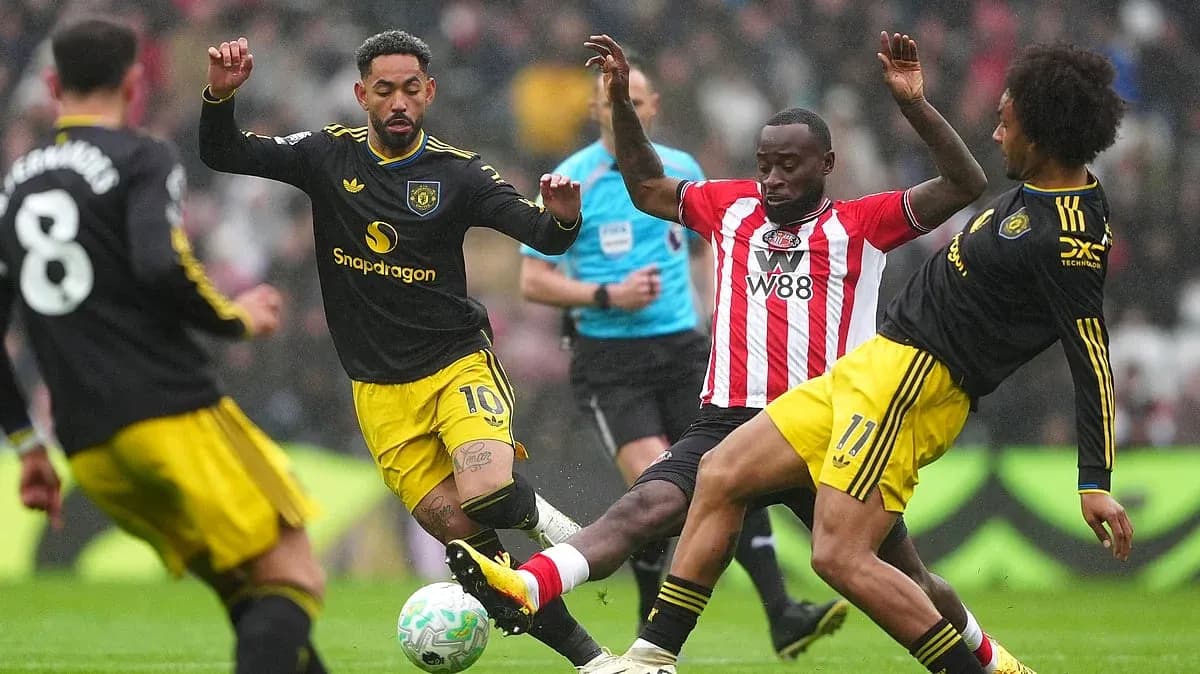
The Stadium of Light had the feel of a crossroads fixture. Sunderland, 12th in the Premier League on 48 points, welcomed a Manchester United side sitting 3rd with 65 points, both teams deep into their own stories as the 2025–26 campaign entered Round 36. By full time, the 0-0 scoreline underlined not just a stalemate on the day, but the collision of two very different seasonal identities.
Sunderland's Campaign
Heading into this game, Sunderland’s campaign had been defined by balance and fragility in equal measure. Overall they had won 12, drawn 12 and lost 12 from 36 matches, scoring 37 and conceding 46. The goal difference of -9 told of a side often competitive but rarely dominant. At home, however, they had been quietly solid: 8 wins, 6 draws and 4 defeats at the Stadium of Light, with 23 goals for and 19 against. An average of 1.3 goals for and 1.1 against at home painted Sunderland as a team that could edge tight contests, especially when the crowd rose with them.
Manchester United's Profile
Manchester United arrived with a more expansive, volatile profile. Overall, they had 18 wins, 11 draws and 7 defeats, scoring 63 and conceding 48 for a goal difference of +15. At Old Trafford they had been ruthless, but on their travels the picture was more nuanced: 6 away wins, 8 draws and 4 defeats, with 27 goals scored and 26 conceded. An away average of 1.5 goals for and 1.4 against suggested a side that attacked with conviction but always left a door ajar.
Lineups and Tactics
The lineups reflected both managers’ instincts. Regis Le Bris leaned into structure and technical security. Robin Roefs started in goal behind a back line of Lutsharel Geertruida, Nordi Mukiele, Omar Alderete and Reinildo Mandava. Ahead of them, Granit Xhaka anchored midfield with Noah Sadiki, Trai Hume and Enzo Le Fée offering legs and passing angles, while Chemsdine Talbi supported Brian Brobbey as the central forward. It was a side built to compress space, circulate the ball and pick its moments rather than chase chaos.
Michael Carrick’s United, by contrast, were configured to dominate territory and tempo. Senne Lammens was protected by Noussair Mazraoui, Harry Maguire, Lisandro Martínez and Luke Shaw. In midfield, Mason Mount and Kobbie Mainoo formed the base, with Amad Diallo, Bruno Fernandes and Matheus Cunha operating between the lines behind Joshua Zirkzee. It was a selection that promised constant movement in the half-spaces and a high volume of final-third entries.
Absences and Their Impact
Tactically, Sunderland’s absences sharpened the stakes. Daniel Ballard, suspended after a red card, removed one of their most combative defenders and a player who had blocked 24 shots across the season. Without him, Alderete and Mukiele had to shoulder more of the aerial and last-ditch burden. R. Mundle’s hamstring injury deprived Le Bris of a change-of-pace option out wide, nudging Sunderland further toward a controlled, central build-up.
United’s missing pieces were just as significant. B. Šeško, with 11 league goals and 51 shots in total, had been their primary penalty-box finisher. His leg injury forced Carrick to rely more on the fluidity of Zirkzee and the multi-layered threat of Cunha, who had 9 goals, 2 assists and 88 dribble attempts this season. M. de Ligt’s back injury removed an experienced organiser from the back line, but Maguire’s presence – 10 blocked shots and a strong duel success rate – ensured United still had a dominant figure to contest Brobbey’s physicality.
Discipline and Dynamics
Discipline hovered over the contest like a quiet warning. Sunderland’s season-long yellow-card distribution showed a particular spike between 46-60 minutes, where 23.38% of their bookings arrived, and a further surge from 61-75 minutes at 18.18%. Reinildo, with 7 yellows and 1 red, and Hume, with 9 yellows, embodied that edge. United, too, had their disciplinary flashpoints: Casemiro, even though not in this matchday squad, had collected 9 yellows and 1 yellow-red this season, a symbol of the aggressive midfield line that Carrick’s system demands. As a team, United’s yellow cards also peaked between 46-60 minutes (21.31%) and 76-90 minutes (19.67%), hinting at a side that pushes the boundaries when games open up late.
Creative Dynamics
Within that context, the “Hunter vs Shield” dynamic tilted towards United’s creative core against Sunderland’s collective defensive shape. Bruno Fernandes entered the fixture as the league’s standout creator with 19 assists, 125 key passes and 8 goals. His duel with Sunderland’s block – anchored by Xhaka’s 1 goal, 6 assists and 83% passing accuracy, plus the aggressive stepping out of Mukiele and Alderete – was always going to define the rhythm. Without Šeško, United’s finishing edge depended heavily on how well Bruno could find Cunha and Zirkzee in pockets rather than simply feeding a pure No.9.
In the “Engine Room”, Xhaka and Le Fée formed a fascinating counterweight to Mount and Mainoo. Xhaka’s 49 tackles, 20 blocks and 29 interceptions underscored his role as Sunderland’s metronome and shield, while Le Fée’s 5 assists, 48 key passes and 83 tackles marked him as the side’s all-action connector. Up against them, Mount and Mainoo were tasked with sustaining United’s 1.8 total goals-for average by ensuring quick progression into Bruno and Cunha, but also with preventing Sunderland’s counters from ever truly breathing.
Statistical Insights
Statistically, heading into this game, United’s profile and attacking talent suggested they should have had the edge in xG terms, particularly given Sunderland’s overall concession rate of 1.3 goals per match and United’s ability to generate chances both home and away. Sunderland, however, had 11 clean sheets overall, 7 of them at home, and had failed to score 5 times at the Stadium of Light. That combination – a home side comfortable in defensive battles and an away side used to open games – always hinted at one of two extremes: a chaotic goal-trade or a tense, tactical stalemate.
Match Conclusion
Following this result, the goalless draw felt like the logical end point of those intersecting trends. Sunderland’s compactness, even without Ballard, held firm. United’s creative patterns, though rich on paper, lacked the penalty-box presence of Šeško to convert territory into goals. The statistical prognosis remains that United, over a larger sample, will usually edge such games on xG and scoreline, but on this afternoon the Shield held, the Hunter misfired, and the story of Round 36 at the Stadium of Light was one of structure winning out over ambition.