.svg&w=384&q=75 "Pitchgist logo")
South Africa's World Cup Journey: Tears and Hope for the Future
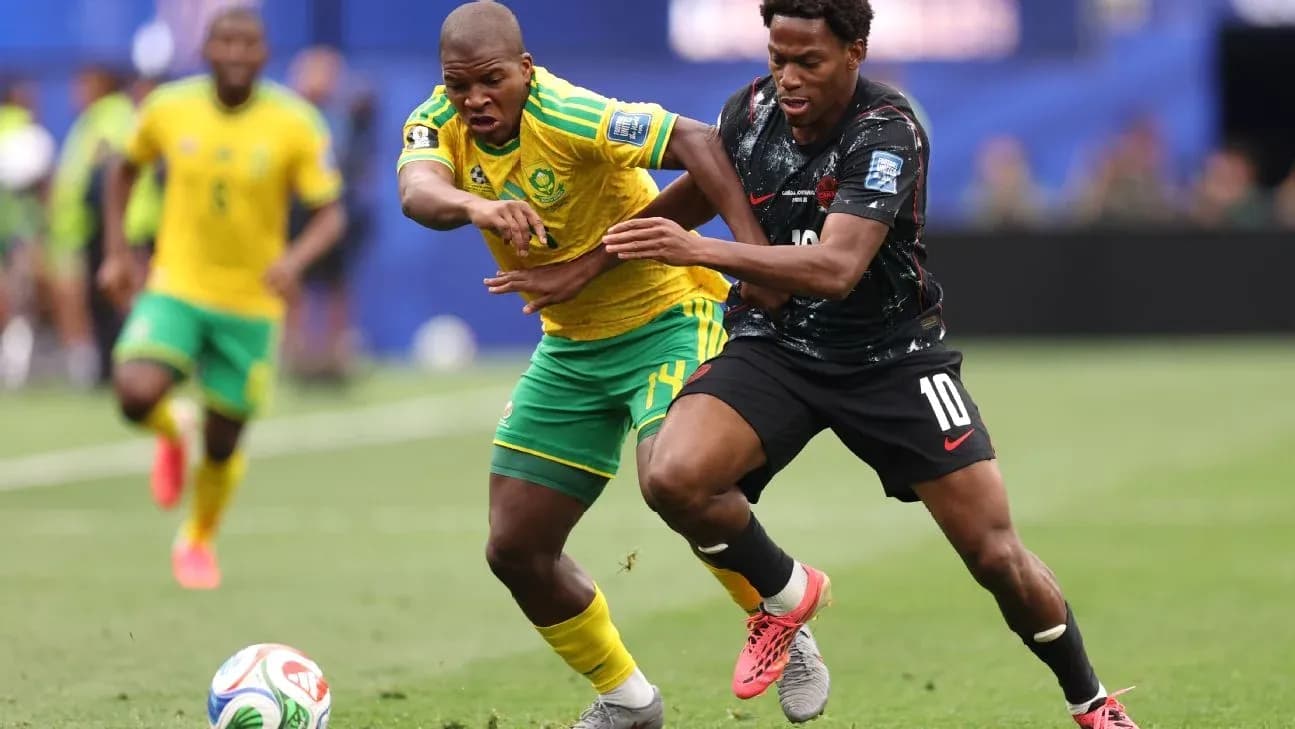
South Africa walked out of the World Cup on the wrong side of a 1-0 scoreline to Canada in the round of 32, but this was no quiet exit. It felt more like a door being kicked open to the future.
Sixteen years after their last appearance on this stage, Bafana Bafana not only returned, they finally broke through the glass ceiling of the group phase. For a nation that has spent too long looking back at 2010, this campaign offered something different: reasons to look ahead.
Centre-backs for a generation
If there is one department South African coaches can stop losing sleep over, it is the heart of defence.
Mbokazi and Okon did more than just start at a World Cup; they owned the stage. The pair handled the pressure and the profile, and Mbokazi, in particular, emerged as one of the standout centre-backs of the entire tournament. He read danger early, dominated in duels and carried himself like a player who expects to be here again.
Behind them, there is depth – real depth, not the wishful-thinking kind. Olwethu Makhanya, Khulumani Ndamane, Tylon Smith, Malibongwe Khoza, Aden McCarthy and others are already pushing from beneath, ready to step in if either “TLB” or Okon is ever sidelined or moved on. The production line at centre-back is humming.
Whoever occupies the Bafana dugout for the next World Cup cycle, whether Hugo Broos stays or not, will inherit a position of strength where South Africa once had a soft spot.
Mofokeng: the ace still in the pack
If there was a frustration that echoed around South African living rooms, it was this: Relebohile Mofokeng did not feature as prominently as many felt he should.
Broos never quite placed the same unshakable trust in the Orlando Pirates playmaker that large sections of the fanbase already have. Yet the story of Mofokeng at this World Cup may be less about what he didn’t do and more about what he hinted at.
He is 21. By the time 2030 comes around, he could be the face of the team.
His performance in the 1-0 win over South Korea was a glimpse of that future. Mofokeng played with no fear, looked comfortable against elite opposition and showed that his talent translates beyond domestic highlight reels. It was the sort of display that makes scouts reach for their phones and coaches redraw their plans.
Reports of an impending move to Royale Union Saint-Gilloise in Belgium underline that trajectory. If that transfer goes through, he will land in a league that has quietly become a launchpad for young talent. For Bafana, it could mean that by the next World Cup cycle, they have a fully-formed attacking midfielder capable of deciding games at the highest level.
South Africa did not fully unleash Mofokeng in 2026. They might be building the team around him in 2030.
Homegrown, world-class
One of the quiet victories of this World Cup for South African football came in the form of a simple truth: you can stay at home and still become a global competitor.
Teboho Mokoena, the heartbeat of Mamelodi Sundowns’ midfield, carried that authority straight into the tournament. Thalente Mbatha of Orlando Pirates added bite and composure alongside him. On the flanks, Sundowns fullbacks Khuliso Mudau and Aubrey Modiba ran themselves into the ground, matching the tempo and intensity of players who ply their trade in Europe’s biggest leagues.
Behind them all, Ronwen Williams reminded everyone why he wears the captain’s armband. The goalkeeper produced big saves in big moments, the kind that keep campaigns alive and reputations intact. He has built his entire club career in South Africa, first at SuperSport United and now at Sundowns, yet his performances here carried global weight.
Yes, young South Africans will benefit from testing themselves abroad. The pathway to Europe should be encouraged, not feared. But this World Cup underlined something crucial: staying in the Premiership is not a dead end. It can be a platform. It can be enough to reach the world stage and thrive on it.
That message will echo through academies and dressing rooms across the country.
Maseko and the goal that changed everything
If the tournament needed a human story to match the footballing narrative, Thapelo Maseko provided it.
Broos had liked him for a long time. Maseko scored his first goal for Bafana at the 2023 Africa Cup of Nations, played in early 2024, when he was just 20. The trajectory seemed clear then: a rising star on a steady climb.
It didn’t work out that way.
His move from SuperSport United to Mamelodi Sundowns stalled his momentum. Under new head coach Miguel Cardoso, appointed in December 2024, Maseko slipped down the pecking order. He spent too much time with the reserves, too little time on the big stage. By January 2026, he was publicly questioning his love for the game on social media.
Five months later, he was on loan at AEL Limassol in Cyprus. That switch changed everything.
The confidence returned. The minutes came. By March, he had fought his way back into the Bafana squad. Then came the moment that will live in South African football folklore: his strike against South Korea, the goal that pushed Bafana into the World Cup knockout rounds for the first time in their history.
It was more than a goal. It was a reminder, to a country and to a player, that careers are not straight lines. They dip, they stall, they revive. Maseko’s story will be told to the next generation not just as a tale of talent, but of resilience.
Money, mistakes and a second chance for SAFA
Away from the pitch, another battle has been raging.
SAFA arrived at this World Cup under a cloud. Financial strain had become a recurring headline: players reportedly paid late after the previous African Nations Championship, operating expenses outstripping revenue, an association that looked and felt like it was clinging on.
The World Cup changed the equation.
Simply by making the group stage, SAFA were guaranteed at least $9 million in performance-based payouts, excluding preparation fees. Reaching the round of 32 pushed that figure to $11 million. For an organisation that has been operating on the brink, that is not just prize money; it is oxygen.
The team’s performances did something else: they made South Africa a more attractive proposition to sponsors. It is far easier to sell a vision when the national team is competing with conviction on the biggest stage, rather than watching from home.
This windfall will not erase years of mismanagement. It will not fix every structural problem in one sweep. But it can provide a safety net for the immediate future, from grassroots programmes to elite preparation. It buys time – and with it, an obligation.
Because now the question facing SAFA is no longer just about survival. It is about intent.
Can the association move from firefighting to forward planning? Can it take the momentum of a historic World Cup run and build something that outlasts this generation of players?
Bafana Bafana leave this tournament with broken hearts, yes, but also with building blocks: a settled centre-back pairing, a coming-of-age core of home-based stars, a potential superstar in Mofokeng, a redemption arc in Maseko and a financial lifeline for the game’s administrators.
The result against Canada will fade. What South Africa do with this platform will not.