.svg&w=384&q=75 "Pitchgist logo")
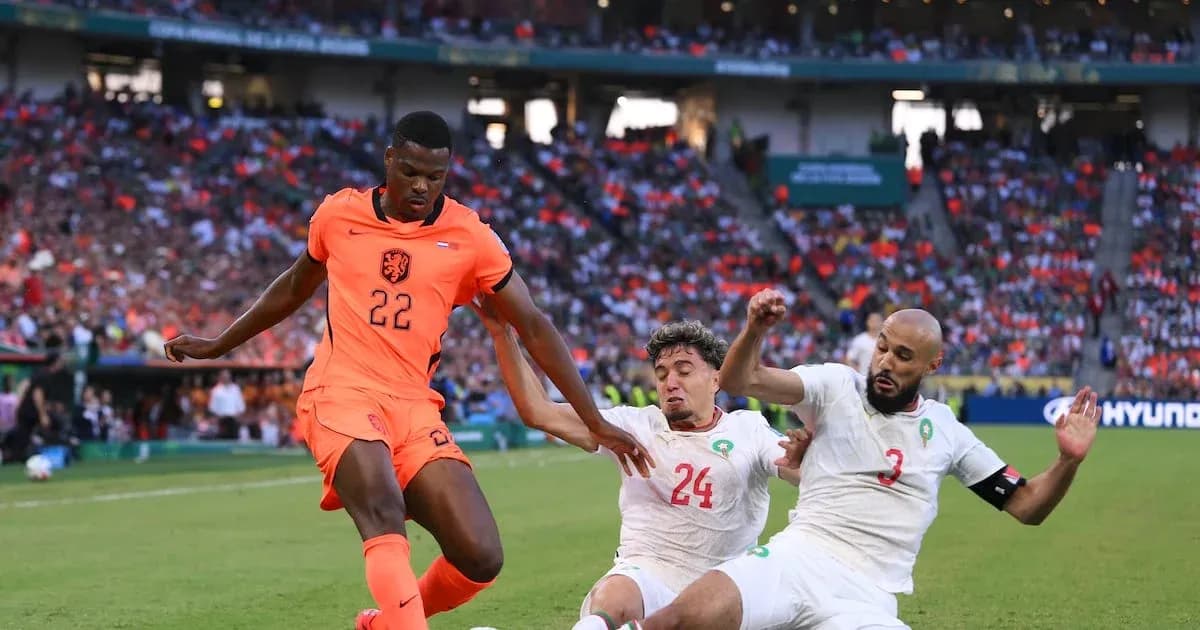
Morocco vs Netherlands: A Dramatic Penalty Shootout Victory
The final whistle of normal time had barely faded when Morocco’s players scattered in every direction, then converged on Ismael Saibari. They caught him. Then they lost him in a tangle of limbs and noise and disbelief. A last‑gasp equaliser, a penalty shootout survived, another European heavyweight removed from their path.
Morocco are doing it again.
Gakpo’s goal, and a grief that wouldn’t stay off the pitch
Earlier in the evening, another bundle told a very different story. When Cody Gakpo thrashed the Netherlands into a 72nd‑minute lead, the Dutch bench didn’t just celebrate; it emptied. Orange shirts sprinted towards him, swallowed him whole, held him there.
Everyone inside the stadium knew why.
Gakpo had chosen to play despite the announcement that he and his partner had lost their unborn son. When the chaos around him finally thinned, he walked slowly back towards halfway, eyes wet, hand raised to the sky. Denzel Dumfries wrapped an arm around him. For a few seconds, football felt like the backdrop, not the main act.
In another version of this night, that goal wins it. The story writes itself: redemption, catharsis, sport as healing. But the game has never promised to be kind. It goes where it wants, and on nights like this it can be brutal.
Koeman’s gamble
Ronald Koeman came into the tie with a team that had scored freely in the group stage. Seven goals against Sweden and Japan, three more against Tunisia. No one at this World Cup had found the net more often.
And yet he didn’t trust them to go toe‑to‑toe.
The Netherlands’ familiar 4‑3‑3 was scrapped. Tijjani Reijnders was sacrificed. In came a five‑man defence, a system built to absorb, spoil and frustrate. The idea was clear: keep Morocco at arm’s length, drag the game into a tight, low‑margin contest.
The cost was obvious from the first whistle. The match everyone had billed as a wide‑open shootout became a slow grind. Morocco monopolised the ball, ending with around 70 per cent possession, while the Dutch sat deep and waited.
They barely threatened before the interval. Micky van de Ven finally broke the pattern with a rising drive that Yassine Bounou had to tip over, but by then Bart Verbruggen had already kept Koeman’s plan alive with sharp saves, and Morocco were beginning to turn the screw.
Koeman, unrepentant afterwards, insisted he had read the level of the opponent correctly. For a long time, it looked as if he might be right.
A match that never settled
From the start, this was a contest heavy with history and edge. The two nations are tightly bound by migration and identity, and that connection crackled in the stands and on the pitch.
Jan Paul van Hecke seemed to collect every bruise going in the first half, ending up with blood streaming from his head after the third hefty collision. Tackles snapped in. Players squared up.
High in the stands, the theatre turned spiteful. Local fans gleefully reminded the Dutch of a moment that still stings: the late, controversial penalty against Mexico in 2014, 12 years to the day, won by an Arjen Robben tumble that has never quite left the conversation. Every early Dutch touch drew a chorus of boos, Morocco’s support happily joined by neutrals with long memories.
On the pitch, Verbruggen stood between Morocco and the lead, springing to deny Neil El Aynaoui and then Achraf Hakimi in quick succession. Yet for all their territory, Morocco’s rhythm never fully clicked against Koeman’s low block.
That changed after the break.
Hakimi began to slice through Dutch lines with clever, underlapping runs, forcing Van de Ven into one desperate, thudding tackle inside the box. The Netherlands had no control, only resistance. They clung on.
Then came the pause that changed everything.
A break, a battering ram, a moment of pure emotion
When one of Fifa’s hydration breaks arrived midway through the second half, Koeman seized it. Brian Brobbey, anonymous and isolated, came off. On came Wout Weghorst, the towering plan B, the battering ram.
The impact was immediate. Seconds after the restart, Verbruggen launched long, Weghorst flicked on, and Crysencio Summerville raced through. Under pressure, he hooked the ball across as he fell, and there was Gakpo, waiting.
One touch to set, one to lash home.
The goal detonated the Dutch bench and ripped open the game’s tight seam. For a while, the Netherlands looked like they might ride the same rope‑a‑dope that had taken them all the way to the 2010 final: absorb, suffer, strike once, shut the door.
Time ticked away. Morocco pushed but seemed to be running out of ideas, and then, in stoppage time, they found a cross that changed the night.
Diop’s late twist
The clock had just moved into the first minute of added time when Chemsdine Talbi, on as a substitute, shifted the ball onto his right. He glanced up and curled in a glorious, arcing delivery towards the back post.
Issa Diop attacked it like a man who had been waiting all his life for this exact ball. He climbed above his marker, met it flush, and powered his header into the net.
The Moroccan end erupted. The Dutch players sank.
Morocco had the goal their control deserved, and the Netherlands had their punishment for a plan that had asked to live on the edge.
Extra time drifted by in a blur of tension and fatigue. Verbruggen produced one more outstanding save, flinging himself to deny Soufiane Rahimi, but neither side could force a winner. The match, and perhaps Koeman’s tournament, would be decided from 12 yards.
Penalties, and a sliding‑doors heel
The shootout quickly turned into a test of nerve and detail. Both sides missed one early, and the pressure climbed with every slow walk from the centre circle.
Then came the moment Koeman would later circle as decisive. Rahimi stepped up and struck his penalty low. Verbruggen guessed right, got down, and appeared to have done enough. The ball hit his hand, slowed, then spun cruelly off his trailing heel and rolled over the line.
Agony in inches.
Quinten Timber followed and dragged his effort horribly wide, the kind of miss that empties a stadium of sound for a heartbeat. Hakimi clipped the outside of a post to keep Dutch hope flickering, but the damage was done.
Bounou, calm and imposing, did his part. Saibari finished the job.
Morocco, 3–2 winners on penalties, marched on to face Canada. The Netherlands trudged away, a night of raw emotion and tactical caution ending in the cold mathematics of a shootout.
For Europe’s giants, this was a bleak evening. For Africa’s best, the door to something bigger has swung open again.