.svg&w=384&q=75 "Pitchgist logo")
Diego Forlan's Take on Cristiano Ronaldo's Role in Portugal's Attack
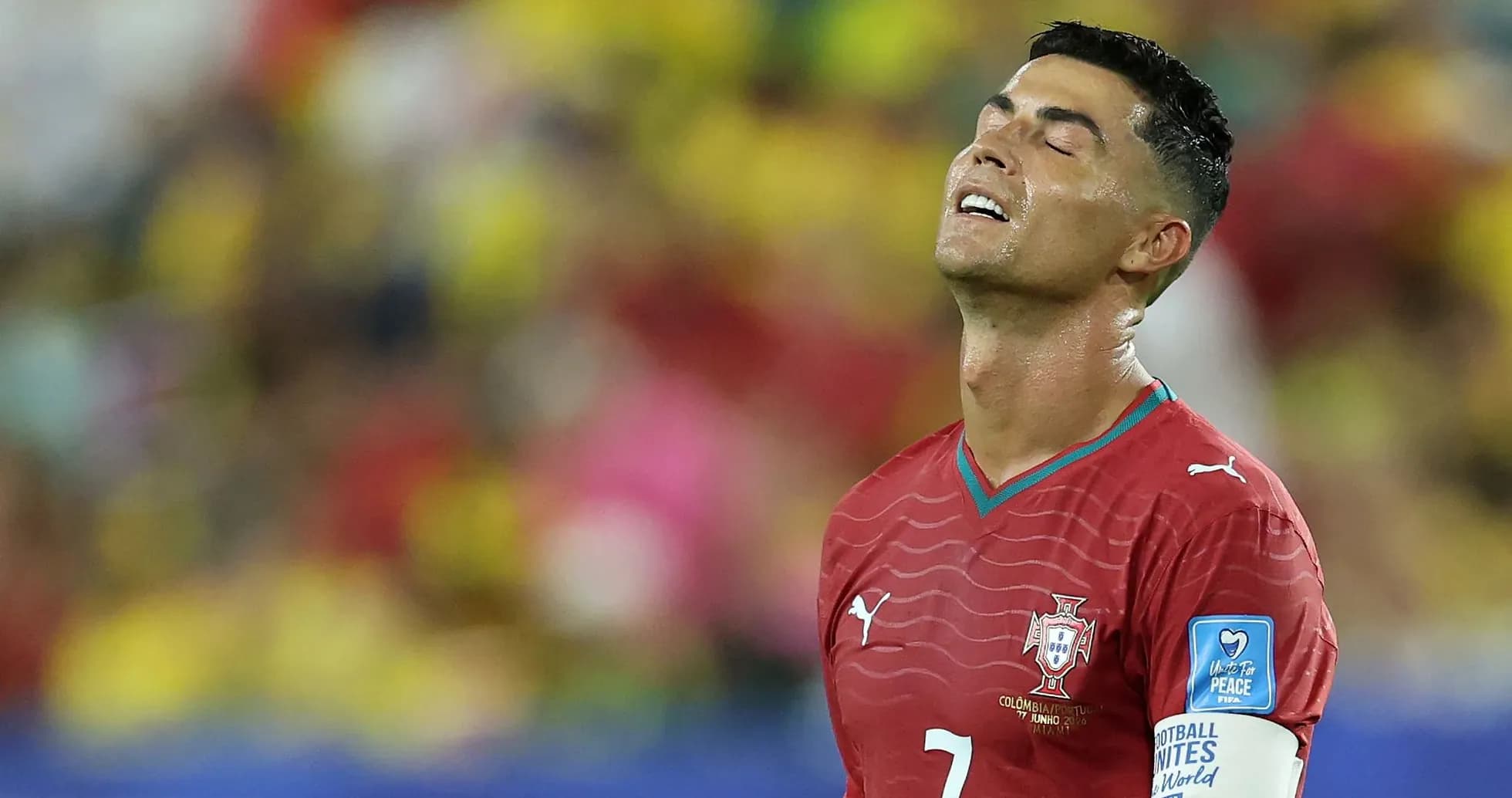
Diego Forlan has never been afraid of a hard truth in the penalty area, and he isn’t pulling any punches with Cristiano Ronaldo.
Speaking on ESPN’s La Casa del Kun, the former Manchester United forward and 2010 World Cup Golden Ball winner dissected Portugal’s attack from a striker’s eye view. His verdict: Ronaldo’s movement, or lack of it, is making life too comfortable for defenders and too cramped for his own teammates.
From Forlan’s perspective, Ronaldo’s role as a fixed No. 9 has become a double-edged sword. The 39-year-old remains lethal around the box, still a ruthless finisher when the ball drops in the right zone. But Forlan argues that by planting himself centrally and waiting for chances, Ronaldo is unintentionally strangling Portugal’s fluidity.
"I'm speaking as a striker, the problem is that Cristiano is in the center, he is who he is, he is there as a No.9, and he stays there to take advantage of the goal because he no longer goes out to look for the ball, but he ends up conditioning Portugal," Forlan explained.
Then he went deeper into the mechanics of it. The picture he painted is familiar to anyone who has watched Portugal labour against compact defences.
"It's the typical situation where we used to say, 'I'm staying here because I'm close to the goal to score,' but you don't understand that you end up hurting your team because both center backs stay there, you don't move. The center backs stay put, one becomes a reference point and the other is left out. You have no one who can get to you because you start closing down that space."
In other words, Ronaldo’s presence pins the centre-backs, but without his movement, it doesn’t unhinge them. It just creates a static duel in the middle, a traffic jam where Portugal’s creativity gets stuck.
That’s a serious issue when the squad is loaded with players who thrive on space and angles. Bruno Fernandes wants runners to feed. Bernardo Silva wants rotations and overloads. Rafael Leao wants room to accelerate and attack the channels. If the No. 9 stays nailed between the posts, all that talent can end up funneled into predictable patterns.
Forlan’s solution is not to sideline Ronaldo, but to tweak him.
With the authority of someone who has lived inside the box, he offered a direct piece of advice for his former Old Trafford teammate.
"If he moved a little to the wings, the others could get in and he could be involved," Forlan said. "That's where Portugal falters because they don't explode because everything ends up going to one side, which is actually a funnel. I wouldn't say it's a problem, it's about making him understand. Telling him: 'Move, get out of there so you can do something'."
The message is clear: Ronaldo doesn’t need to reinvent himself, just shift his reference points. Drift wide, drag a centre-back out, open a lane for a midfielder to arrive. Become a trigger for movement rather than a fixed target.
As Portugal head into the knockout rounds, that nuance becomes critical. Roberto Martinez now faces the delicate task of managing not just his captain’s minutes, but his influence on the team’s structure. Ronaldo has already shown he can still score, the instinct in front of goal remains intact. But against elite opposition, a “bottleneck” attack will be punished. Predictable patterns are easy to suffocate.
Portugal have booked their place in the round of 32 and will meet Croatia next. The stakes rise, the spaces shrink, and every attacking detail matters. Forlan’s warning hangs over the tie: if Portugal want to unleash the full force of their supporting cast, their greatest-ever player may have to stop being the static reference point and start becoming the one who tears the whole defensive shape apart.