.svg&w=384&q=75 "Pitchgist logo")
Serie A Derby: Torino and Juventus End in Dramatic 2-2 Draw
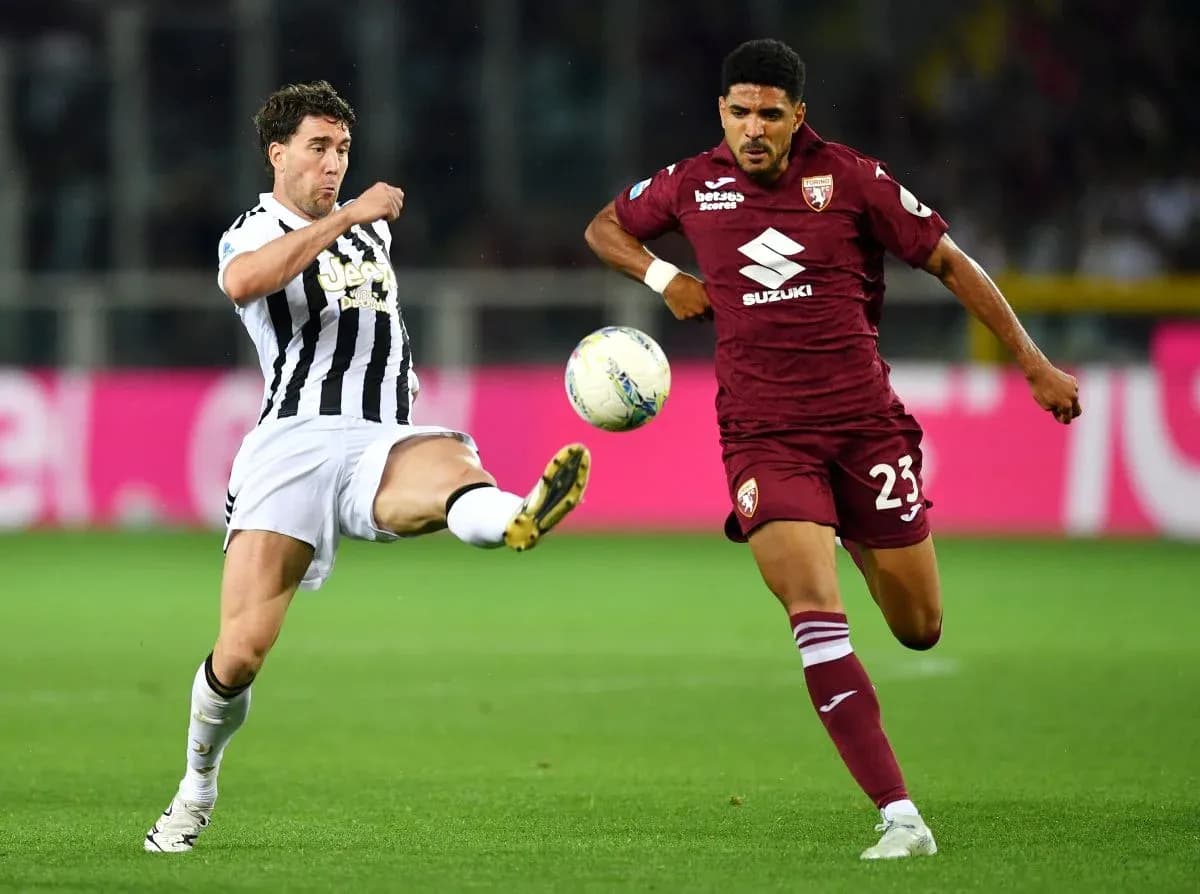
On the final evening of the Serie A season, Stadio Olimpico Grande Torino staged a derby that refused to follow the script. Torino, finishing 12th with 45 points and a goal difference of -19 (44 scored, 63 conceded in total this campaign), met a Juventus side locked into 6th on 69 points, their overall goal difference a far more serene +27 (61 for, 34 against).
Heading into this game, the numbers painted a clear hierarchy. Torino were a volatile mid-table side: 12 wins, 9 draws, 17 defeats in total, conceding an average of 1.7 goals per match overall. At home they scored 1.4 and conceded 1.5 on average, dangerous but fragile. Juventus, by contrast, built their Europa League return on control: 19 wins, 12 draws, only 7 losses in total, with a defensive record of just 0.9 goals against per game overall.
Yet over 90 minutes the derby bent those trends. Juventus led 1-0 at half-time, but Torino’s response after the break turned the evening into a 2-2 stalemate that felt more like a statement of identity than a dead-rubber draw.
Leonardo Colucci rolled out a 3-4-1-2 that leaned into Torino’s season-long preference for three at the back. Opposite him, Luciano Spalletti stayed faithful to Juventus’ 3-4-2-1, the shape they had used in 24 league matches, a framework of stability around which their season had been built.
Tactical Voids and Discipline
Both coaches arrived with notable absentees that shaped the tactical landscape. Torino were without Z. Aboukhlal (muscle injury), F. Anjorin (hip injury) and L. Marianucci (knee injury), stripping Colucci of attacking and creative rotation options. Perhaps more crucially, G. Maripan missed out through yellow-card suspension, forcing Torino to trust a different defensive trio.
That back line became S. Coco, A. Ismajli and E. Ebosse in front of A. Paleari. With Torino conceding 63 goals in total this season and suffering heavy defeats such as 1-5 at home and 6-0 away, the absence of Maripan removed a stabilising presence from an already shaky unit.
On the other side, Juventus were without Bremer, also suspended for yellow cards. Given Juventus’ defensive excellence – only 34 goals conceded in total, with just 18 on their travels – losing their primary organiser in the back three forced Spalletti to lean on F. Gatti and L. Kelly either side of P. Kalulu. It was still a strong unit, but not the first-choice spine that had underpinned so many of their 16 clean sheets overall.
Discipline was always likely to be a live wire. Torino’s season-long yellow-card profile shows a pronounced late-game surge: 21.13% of their bookings came between 76-90 minutes and another 21.13% between 91-105. Juventus, too, spike after the hour, with 23.08% of their yellows between 61-75 and 21.15% from 76-90. In a derby context, those trends translate into a predictable pattern: rising tension, increasingly risky challenges, and a real chance of chaos as legs tire and minds fray.
Key Matchups
Torino’s attacking identity has increasingly orbited around G. Simeone. In total this campaign he scored 11 league goals, from 59 shots and 28 on target, a classic penalty-box forward who lives off sharp service and half-spaces. His role in the 3-4-1-2, paired with D. Zapata and supported by N. Vlasic between the lines, asked him to constantly test the seams of Juventus’ Bremer-less back three.
Against a Juventus defence that, on their travels, conceded only 18 goals and an average of 0.9 per match overall, Simeone’s threat became the “hunter vs shield” axis of the evening. Without Bremer’s anticipation and aerial dominance, Gatti and Kelly had to manage Simeone’s movement and Zapata’s physicality almost perfectly. The fact Juventus ultimately conceded twice – against a Torino side that averaged 1.2 goals per game overall – underlined how that missing piece in their defensive puzzle altered the balance.
The midfield battle revolved around Manuel Locatelli’s capacity to dictate and disrupt. Over the season he played 36 league games, all as a starter, logging 3011 minutes with 2805 passes at 88% accuracy. He also made 102 tackles, 23 blocks and 39 interceptions, and collected 9 yellow cards. He is both metronome and enforcer.
Facing him, Torino deployed a central trio of E. Ilkhan, G. Gineitis and M. Pedersen, with R. Obrador wide and Vlasic floating ahead. Torino’s season-long midfield story has been one of effort rather than control; their overall average of 1.7 goals conceded per game speaks to a unit often overrun in transition.
Here, Locatelli’s job was twofold: protect the back three from Simeone and Zapata’s runs, and feed the creative line of J. Boga and Francisco Conceição behind D. Vlahovic. Conceição, with 5 assists and 42 key passes in total this campaign, and K. Yıldız – 10 goals, 6 assists, 76 key passes and 149 dribble attempts overall – symbolise Juventus’ new technical edge. Even starting from the bench, Yıldız’s season profile loomed over the contest: a player who has already won and missed a penalty, and who constantly occupies defenders with his 78 successful dribbles.
Statistical Prognosis and Tactical Verdict
Following this result, the numbers tell of a derby that bent probability without breaking it. Juventus, with 61 goals scored and 34 conceded in total, remained the side with the clearer xG and defensive profile across the season, especially away where they won 9 of 19 and lost only 5. Torino, by contrast, finished with just 12 wins in 38, conceding heavily but still managing 44 goals.
On paper, a Juventus win would have been the most likely outcome: a side scoring 1.6 goals per game overall and conceding 0.9, against an opponent that concedes 1.7 and scores 1.2. Yet the 2-2 draw fits the underlying volatility of Torino at home – 27 goals scored and 29 conceded at the Olimpico – and the slight softening of Juventus’ edge late in the campaign, reflected in their “DLWDD” form heading into the fixture.
Tactically, the game underlined three truths. First, Torino’s 3-4-1-2, when fed by Vlasic and powered by the Simeone–Zapata pairing, can trouble even the league’s most organised defences, especially when those defences are missing a lynchpin like Bremer. Second, Juventus’ 3-4-2-1 still generates enough attacking structure – via Locatelli’s distribution, McKennie’s vertical running and the creativity of Conceição and Boga – to create a steady stream of chances, even if their usual defensive control was diluted.
Finally, in a match where both teams carry late-game disciplinary spikes, the derby’s narrative was always likely to be written in the final quarter of an hour. The draw feels like the statistically plausible midpoint between Torino’s chaos and Juventus’ control: a night where the numbers hinted at order, but the derby demanded drama.