.svg&w=384&q=75 "Pitchgist logo")
Bologna and Inter End Serie A Season with Thrilling 3-3 Draw
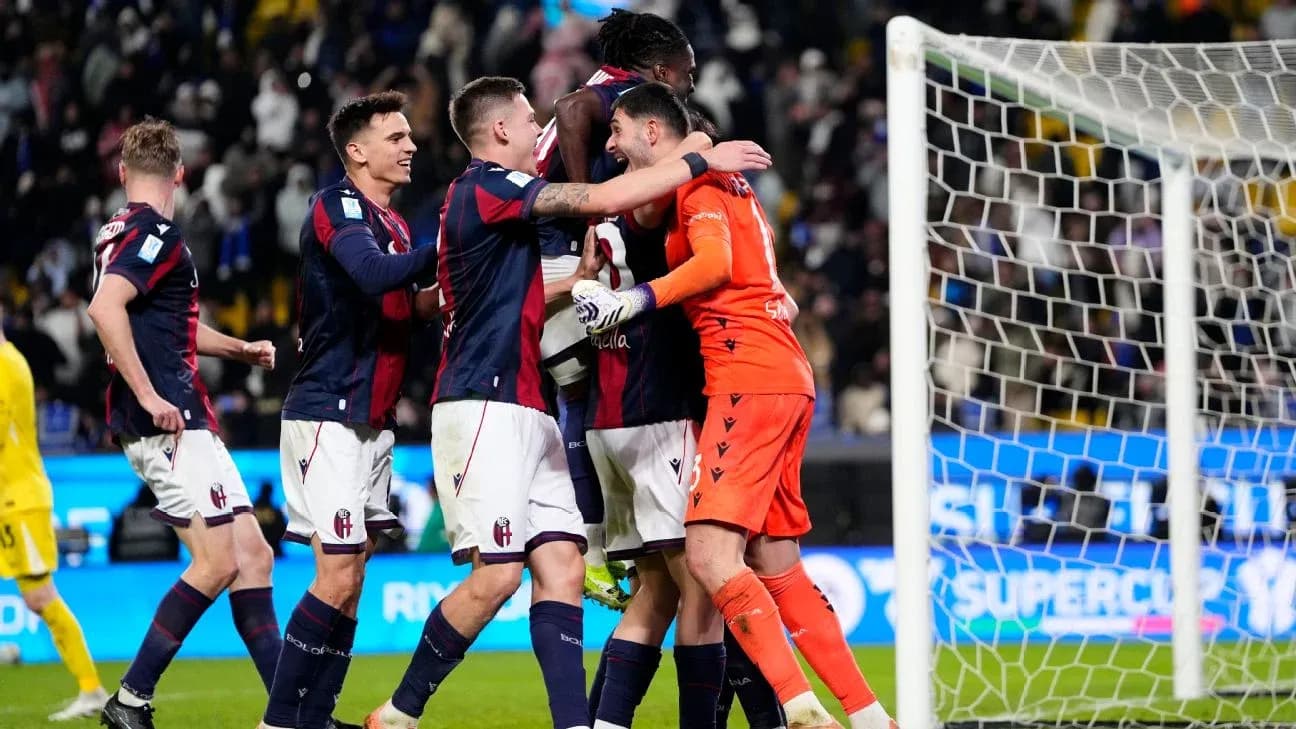
Under the late‑season sun at Stadio Renato Dall’Ara, Bologna and Inter closed the 2025 Serie A campaign with a six‑goal draw that felt more like a tactical dress rehearsal than a dead rubber. Following this result, the table underlines the gap between them – Inter finishing as champions in 1st on 87 points, Bologna in 8th on 56 – yet on the pitch a 3-3 scoreline suggested something closer to parity of ideas than of resources.
I. The Big Picture – Identity vs. Authority
Bologna’s season has been defined by asymmetry: more dangerous on their travels than at home. Overall they scored 49 and conceded 46, a goal difference of 3. At home they were cautious and streaky – 19 goals for and 23 against across 19 matches, averaging 1.0 scored and 1.2 conceded. Away, they opened up: 30 goals for and 23 against, with a sharper 1.6 goals scored on their travels.
Inter, by contrast, imposed a champion’s template everywhere. Overall they finished with 89 goals scored and 35 conceded, a goal difference of 54. At home they were devastating (50 scored, 16 conceded, 2.6 for and 0.8 against on average), but even away they sustained title‑winning levels: 39 goals for and 19 against, averaging 2.1 scored and 1.0 conceded.
The formations at kickoff told the story of two coherent projects. Vincenzo Italiano went with a 4-3-3, a nod to the more proactive variant he has used 8 times this season. Cristian Chivu stayed faithful to Inter’s season‑long 3-5-2, a structure deployed in all 38 league games, built on width, rotations and an aggressive high line.
II. Tactical Voids – Who Was Missing, What Was Lost
Both coaches had to redraw key parts of their blueprint.
Bologna were stripped of some of their most vertical and creative pieces. Riccardo Orsolini, their 10-goal man and a top‑20 scorer in Serie A, was out with a muscle injury. His season included 4 penalties scored but also 2 missed, a reminder of his high‑risk, high‑reward profile in decisive moments. Without him, Bologna lost their most natural wide threat and one‑v‑one outlet. N. Cambiaghi (muscle injury), N. Casale (calf), M. Vitik (ankle) and K. Bonifazi (inactive) further thinned the defensive rotation and reduced Italiano’s flexibility to switch into a back three mid‑game.
Inter’s absences were more about rested stars than structural crisis. H. Calhanoglu, one of Serie A’s most influential midfielders with 9 goals, 4 assists and a passing accuracy of 90%, missed out due to lacking match fitness. His set‑piece quality and deep playmaking were replaced by a more dynamic but less controlling midfield trio. D. Dumfries, M. Thuram and M. Akanji were also rested, removing Inter’s usual right‑side thrust and their first‑choice strike partner for Lautaro Martínez.
Discipline-wise, the season data framed the risk zones. Bologna’s yellow cards cluster heavily between 61-75 minutes (26.87%) and 76-90 (25.37%), a late‑game surge that speaks of fatigue and emotional defending. Inter’s bookings also spike late, with 31.25% of their yellows between 76-90 minutes. This match, played at the end of a long campaign, was always likely to become stretched and card‑prone as legs and minds tired.
III. Key Matchups – Hunter vs Shield, Engine Room Battles
Hunter vs Shield was embodied by Lautaro Martínez against a Bologna defence that, at home, has been fragile. Lautaro’s season – 17 league goals and 6 assists – has been built on volume and persistence: 69 shots, 39 on target, and 37 key passes. Up against a back four of L. De Silvestri, E. Fauske Helland, J. Lucumi and J. Miranda, he targeted the channels, especially the spaces outside the centre-backs where Bologna’s full‑backs are asked to push high.
Bologna’s “shield” is more collective than individual. Overall they concede 1.2 goals per game both at home and on their travels, but they survive through structure and rotation rather than dominant duels. Their 12 clean sheets in total (7 at home, 5 away) show they can lock games down when the block stays compact. Against Inter’s 3-5-2, that meant keeping the distances tight between R. Freuler, L. Ferguson and T. Pobega in the midfield three, preventing P. Zielinski and P. Sucic from receiving between the lines.
In the Engine Room, N. Barella became the de facto conductor for Inter. His season numbers – 8 assists, 3 goals, 72 key passes and 1761 total passes at 85% accuracy – underline how often he is the second or third last touch before a chance. Here he operated to the right of Sucic, linking with A. Diouf and the right‑sided centre‑back Y. Bisseck, trying to overload Pobega’s side and drag Bologna’s midfield out of shape.
On the flanks, F. Dimarco’s presence as left midfielder/wing‑back was a structural weapon. With 16 assists and 96 key passes this season, his left foot has been one of the league’s most reliable sources of delivery. His duel with L. De Silvestri was about more than individual defending; it dictated whether Bologna’s 4-3-3 could hold its width or be forced to collapse into a back five.
Up front, Bologna’s front three of F. Bernardeschi, S. Castro and J. Rowe offered fluidity rather than a classic reference striker. Bernardeschi’s tendency to drift inside threatened the half‑spaces around S. de Vrij, while Rowe’s position on the opposite flank pinned Carlos Augusto back, limiting his usual licence to step into midfield.
IV. Statistical Prognosis – What the Numbers Say About a 3-3
Following this result, both sides ended the season mirroring their statistical DNA. Inter, averaging 2.3 goals per game overall, found three more here despite rotating key attackers. Bologna, averaging 1.3 goals overall and 1.0 at home, over‑performed their usual home output by scoring three, a sign that Inter’s rotated back line and end‑season intensity drop opened doors.
Defensively, Inter’s season average of 0.9 goals conceded per game was stretched to the limit by Bologna’s willingness to attack in waves, especially once Inter’s midfield legs began to fade in the final third of the match. Bologna conceding three at home is not out of character given their 23 home goals against across the campaign, but the way they repeatedly punched back against the champions hints at a side that, with more home‑field conviction, could narrow the gap to the elite.
In xG terms – even without explicit values in the data – the profiles suggest a high‑event contest: Inter’s volume of goals and chances across the season, combined with Bologna’s late‑card, late‑pressure pattern, points to a game where both sides created enough to justify the 3-3. Tactically, it was a meeting of a champion’s structure and an ambitious outsider’s courage, and the draw felt like the correct equilibrium between Inter’s superior attacking machinery and Bologna’s refusal to accept their underdog script.