.svg&w=384&q=75 "Pitchgist logo")
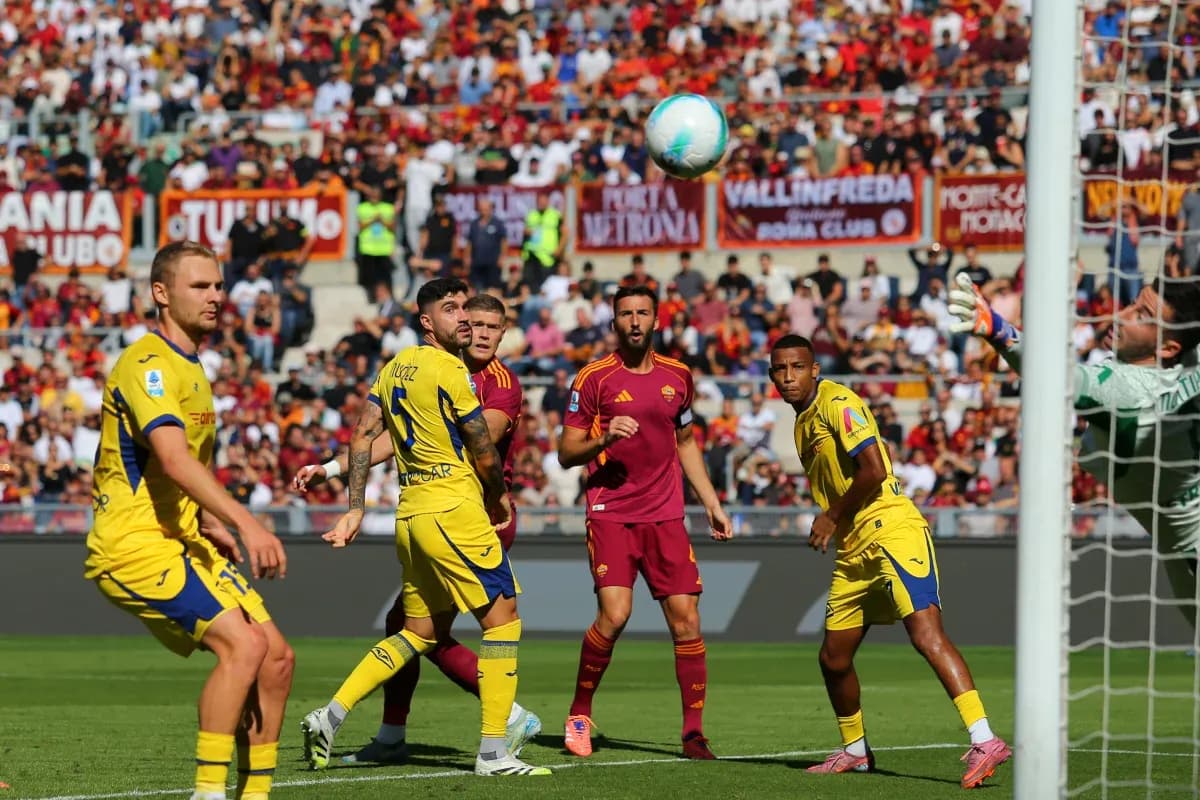
Hellas Verona vs AS Roma: Season Finale Analysis
Under the Verona dusk at Stadio Marcantonio Bentegodi, a season’s worth of imbalance crystallised into a single, stark scoreline: Hellas Verona 0–2 AS Roma. Following this result, the table tells the story with brutal clarity. Verona close the campaign 19th in Serie A, marooned on 21 points with a goal difference of -36, the product of 25 goals scored and 61 conceded. Roma, by contrast, lock in 3rd place on 73 points, their own balance sheet a positive 28 (59 for, 31 against) and a Champions League return secured.
I. The Big Picture: Structures and Season DNA
The formations on the night mirrored the clubs’ identities. Paolo Sammarco stayed loyal to Verona’s season-long template, rolling out a 3-5-2 that has been his default – 26 league games in that shape. L. Montipo anchored a back three of N. Valentini, A. Edmundsson and V. Nelsson, with wing-backs M. Frese and R. Belghali pushed high. Inside, J. Akpa Akpro, S. Lovric and A. Harroui formed a combative but technically limited midfield, asked to feed a mobile front pair of T. Suslov and K. Bowie.
Across from them, Roma arrived with the swagger of a side on a five-match winning streak, and Piero Gasperini Gian did not deviate from his preferred 3-4-2-1 – a formation he has used 30 times this season. M. Svilar sat behind a back three of M. Hermoso, D. Ghilardi and G. Mancini. The wide lanes belonged to D. Rensch and Z. Celik, with B. Cristante and N. Pisilli patrolling the centre. Ahead, a fluid trio of M. Soule and P. Dybala behind lone striker D. Malen gave Roma an attacking spine that has defined their campaign.
Roma’s season-long numbers framed this as a mismatch before a ball was kicked. Overall, they averaged 1.6 goals for per game and only 0.8 against, with 18 clean sheets in total. Verona, by contrast, stumbled through the year with 0.7 goals for per match overall and 1.6 against, failing to score in 20 of 38 fixtures. At home they managed just 12 goals in 19 games – 0.6 on average – while conceding 28.
II. Tactical Voids: Absences and Discipline
If Verona’s season has been about thin margins and thinner depth, this finale underlined it. Their most combative midfielder, R. Gagliardini, was suspended for yellow cards – a player whose 10 bookings and 73 tackles speak to the edge he brings in the middle. Without him, Sammarco’s midfield lost its primary ball-winner and organiser between the lines. The injury list – D. Mosquera, G. Orban, D. Oyegoke, J. Peci and S. Serdar – stripped away options in both boxes. G. Orban’s absence was particularly acute; his 7 league goals and direct running had been one of the few consistent threats in a side starved of end product.
Roma were not untouched by absences. E. Ferguson, E. Ndicka, L. Pellegrini, K. Tsimikas and B. Zaragoza were all missing, while Wesley Franca served a ban after a red card. Yet Gasperini Gian’s squad depth softened the blow. The spine remained intact: Mancini and Hermoso at the back, Cristante in midfield, Dybala and Soule in advanced roles, Malen up front. When you can leave A. Dovbyk and S. El Shaarawy among the substitutes, you are operating from a different tier of resource.
The disciplinary profiles of these teams foreshadowed the tone. Verona’s season card map shows a flurry of yellows between 31-60 minutes (45 cards across those ranges), a symptom of chasing games and late tackles in transition. Roma, more controlled, concentrated their yellows from 46-90 minutes, with 47 bookings in that second-half window, often as tactical fouls to manage leads.
III. Key Matchups: Hunter vs Shield, Engine Room
Hunter vs Shield was always going to revolve around D. Malen. Heading into this game he stood as one of Serie A’s most efficient forwards: 14 goals and 2 assists in 18 appearances, with 49 shots and 31 on target. He is not just volume; his penalty record – 3 scored but 1 missed – shows a player trusted in big moments but still human from the spot.
Verona’s “shield” was less an individual than a collective scramble. At home they conceded 28 goals in 19 matches, an average of 1.5 per game, and their defensive minute distribution revealed a chronic late-game fragility: 17 of their 61 goals against (29.31%) arrived between 76-90 minutes. That vulnerability dovetailed ominously with Roma’s own attacking surge in the 61-75 minute window, where 14 of their 59 goals (23.73%) were scored. It was the critical intersection: a tiring, relegation-bound back line versus a top-three attack that tends to accelerate just as Verona tend to fade.
In the engine room, the duel between Verona’s makeshift core and Roma’s structured double pivot was decisive. Without Gagliardini, Akpa Akpro became Verona’s primary disruptor. His season numbers – 44 tackles, 7 blocked shots and 23 interceptions – underline his capacity to break play, but he is less of a metronome. Opposite him, Cristante’s 1,649 passes at 86% accuracy and 52 tackles made him Roma’s stabiliser, flanked by Pisilli’s energy and the constant inside movements of Dybala and Soule.
Dybala’s season as a creator – 6 assists, 55 key passes, 54 dribble attempts with 19 successful – meant Verona’s central defenders were repeatedly forced to step out, stretching a back line already short on elite one-v-one stoppers. Soule added another layer: 6 goals, 5 assists, 46 key passes, 95 dribble attempts with 35 successes, and 19 tackles plus 9 interceptions underline his two-way influence. For a Verona side that has kept only 6 clean sheets overall, that blend of flair and work rate was always likely to be overwhelming.
IV. Statistical Prognosis and Tactical Verdict
Following this result, the numbers feel almost inevitable. Roma’s away profile – 26 goals scored and 21 conceded across 19 trips, an average of 1.4 for and 1.1 against – pointed to a side capable of controlling hostile environments without needing to blow teams away. Verona, on their travels, were marginally more competitive, but at home they were simply blunt: 11 home games without scoring, only 3 clean sheets, and just one home win all season.
Roma’s defensive structure, anchored by Mancini and Hermoso, has underpinned 18 clean sheets overall. Mancini’s 52 tackles, 14 successful blocks and 49 interceptions, combined with Hermoso’s 36 tackles and 6 blocks, form a back line that does not need to dominate the ball to feel secure. Against a Verona attack averaging 0.6 goals per home game and missing its main finisher in Orban, a shutout felt statistically favoured – and the 0-2 scoreline confirmed it.
From an Expected Goals perspective, even without explicit xG data, the patterns are clear. Roma’s consistent under-2.5 profile (only 7 of 38 league games over 2.5) and Verona’s chronic attacking anemia suggested a controlled away win rather than a rout. Roma’s superior chance quality, driven by Malen’s movement and Dybala–Soule creativity, was always likely to yield one or two high-value opportunities. Verona, reliant on low-percentage crosses from Frese and Belghali and long-range efforts from Lovric or Harroui, were swimming against the tide of probability.
In narrative terms, this match was less an upset than a closing argument. Roma’s 3rd place finish and +28 goal difference are the logical outcome of a side with clear structure, depth and defined roles. Verona’s relegation, with -36 as a grim arithmetic of 25 for and 61 against, reflects a campaign where tactical ideas were repeatedly undermined by limited firepower and late-game collapses. At Bentegodi, the squads on the teamsheet told that story before kick-off; the 0-2 simply wrote it in ink.