.svg&w=384&q=75 "Pitchgist logo")
Premier League Dominance: Arsenal's 14th Title and the Challenges Ahead
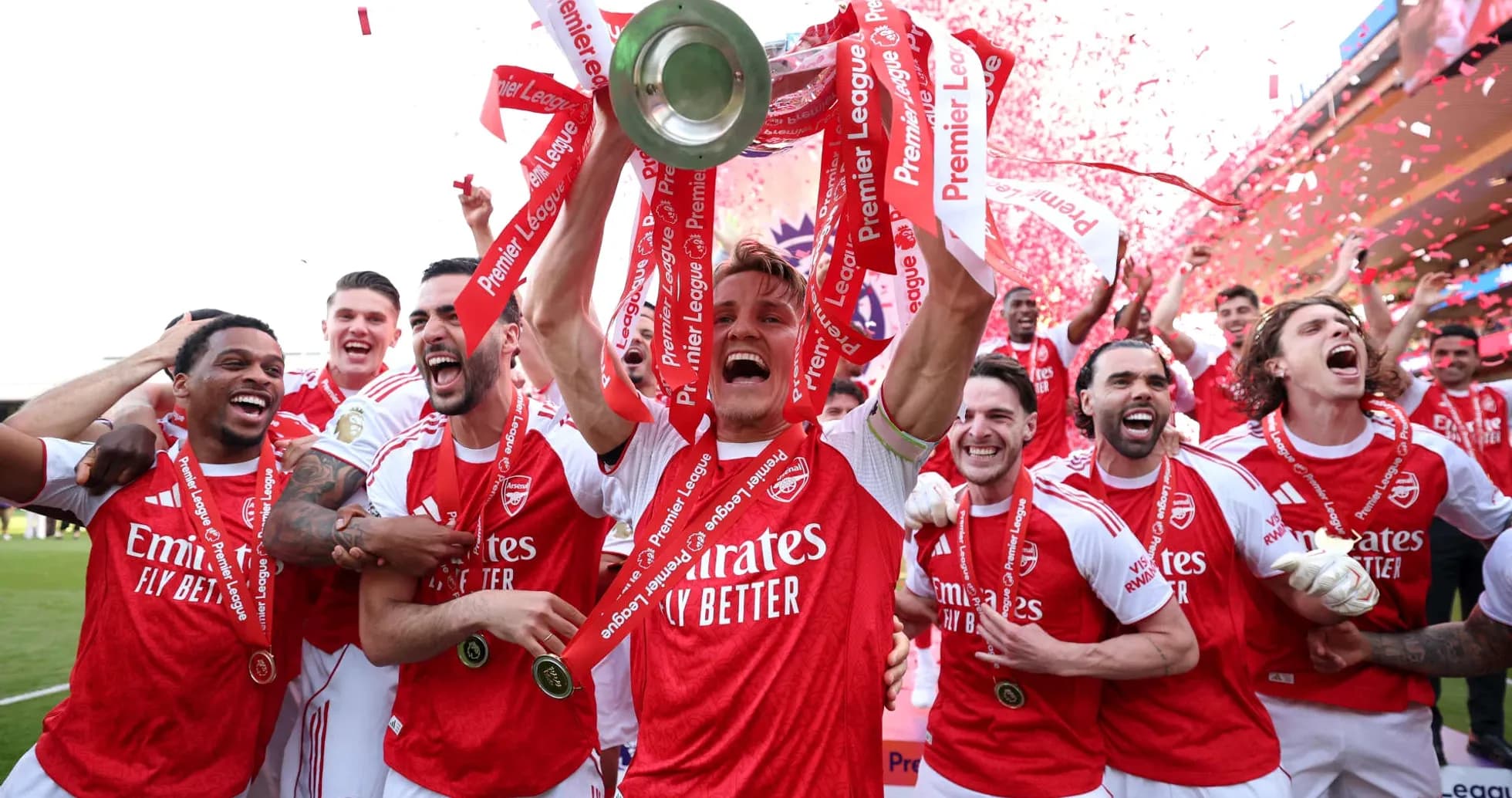
Martin Ødegaard stood on the Selhurst Park turf, Premier League trophy raised to the south London sky, and the picture told a simple story: English football at the peak of its powers. Arsenal, champions again after 22 long years, back on the summit with a 14th league title. Another new name on the trophy in a third straight season, following Liverpool in 2024-25 and Manchester City in 2023-24.
On the surface, the league has never looked healthier.
A League That Others Can’t Live With
Three different champions in three years underline what the Premier League loves to sell about itself: jeopardy, variety, genuine competition. Across Europe’s big leagues, nobody else can match it.
Spain, the nearest rival financially, is still locked in the familiar arm-wrestle between Barcelona and Real Madrid. Between them they have taken 20 of the last 22 titles. In Germany, Bayern Munich have dominated 13 of the last 14 seasons. In France, Paris Saint-Germain have been champions in eight of the last nine.
Only Italy’s Serie A offers anything close to England’s churn at the top. Juventus, Inter Milan, AC Milan and Napoli have all lifted the Scudetto in the last seven years, sharing an era that in other countries has belonged to a single superclub.
English sides are not just thriving at home. They are everywhere in Europe as well. Only a penalty shootout defeat for Arsenal against PSG in the Champions League final stopped an English clean sweep this season, after Aston Villa and Crystal Palace claimed the Europa League and Europa Conference League respectively. Chelsea, for now, still hold FIFA’s Club World Cup.
This is what the money buys. And the Premier League has more of it than anyone else.
The league’s broadcast rights, domestic and overseas, dwarf those of any rival competition. Deloitte’s latest ranking of the 30 richest clubs in the world by revenue is half-filled by English names. Not just the giants, either. AFC Bournemouth, Brentford and Brighton & Hove Albion, clubs that would once have lived in the shadows of Europe’s elite, now sit comfortably in football’s financial aristocracy.
From the outside, it looks like an empire.
Scratch at it, though, and the gloss starts to peel.
The Talent Drain No One Expected
For years, English football measured its progress by who came in. The Premier League was the final destination, the end point of every ambitious player’s journey. Now some of the best English players are heading the other way.
Harry Kane, the England captain, left to build a career abroad. Anthony Gordon’s move from Newcastle United to Barcelona last week pushed the trend into sharper focus. Six members of England’s squad for the forthcoming World Cup now play for foreign clubs.
Martin Samuel of The Times captured the unease. Once, he wrote, English football wore it as a badge of honour when Real Madrid or AC Milan came calling for a homegrown star. That was proof of status. But when almost a quarter of the national squad is based overseas, the mood shifts. It starts to feel like a drain, not a compliment. The concern deepens because the flow is not being matched in reverse by equivalent quality arriving on these shores.
The Premier League still attracts elite imports. The difference now is that England’s own elite feel increasingly comfortable leaving.
Rich League, Fragile Clubs
Even inside the money machine, the numbers do not all run in the right direction.
Despite enormous revenues, only four Premier League clubs — Newcastle, Aston Villa, Bournemouth and Liverpool — turned a profit in the most recent season with published figures. The rest lost money. Some lost plenty.
Drop below the top flight and the picture darkens. A string of clubs have gone into administration in recent years, including historic names such as Derby County and Sheffield Wednesday. These are not minnows. They are institutions, reduced to survival battles off the pitch.
To stay within financial fair play rules, some owners have turned to creative accounting. Sale-and-leaseback deals on stadiums or training grounds help massage the balance sheet. On paper, it keeps clubs on the right side of regulations designed to maintain competitive balance and prevent a handful of super-rich owners — including sovereign wealth funds — from inflating transfer fees and wages to unsustainable levels.
In reality, it underlines how precarious many operations have become. The wealth is vast, but unevenly spread and often thinly protected.
The Relegation Risk That Scares Investors
Even the super-rich are starting to feel the chill.
Tottenham Hotspur, one of the six clubs that flirted with the breakaway European Super League in 2021 before fans tore the project down, only just escaped relegation this season. The margins were that fine. West Ham United, the Premier League’s eighth-longest serving club and 20th in Deloitte’s Money League, were not so fortunate. They went down.
For investors used to the closed-shop comfort of American sports, where franchises do not fall through trapdoors, this is a jolt. The Premier League offers global reach and enormous revenue potential, but no guarantees. A bad season, a few poor decisions, and a billion-pound asset can suddenly find itself in the Championship.
Samuel pointed out that Liverpool, Manchester United, Crystal Palace, Chelsea and Newcastle are all, in different ways, effectively on the market. Prospective buyers will look at West Ham’s relegation and Tottenham’s brush with the drop and think twice. The fear is real enough that they will, in Samuel’s words, “shiver.”
You suspect the executives at Premier League headquarters did exactly that as the final table took shape.
So the image of Ødegaard lifting the trophy at Selhurst Park tells only half the story. The league at the top is brutal, compelling, and richer than ever. Beneath it lies a system straining to hold its shape — losing stars abroad, juggling the books, and trying to persuade the next wave of billionaires that English football is still worth the risk.