.svg&w=384&q=75 "Pitchgist logo")
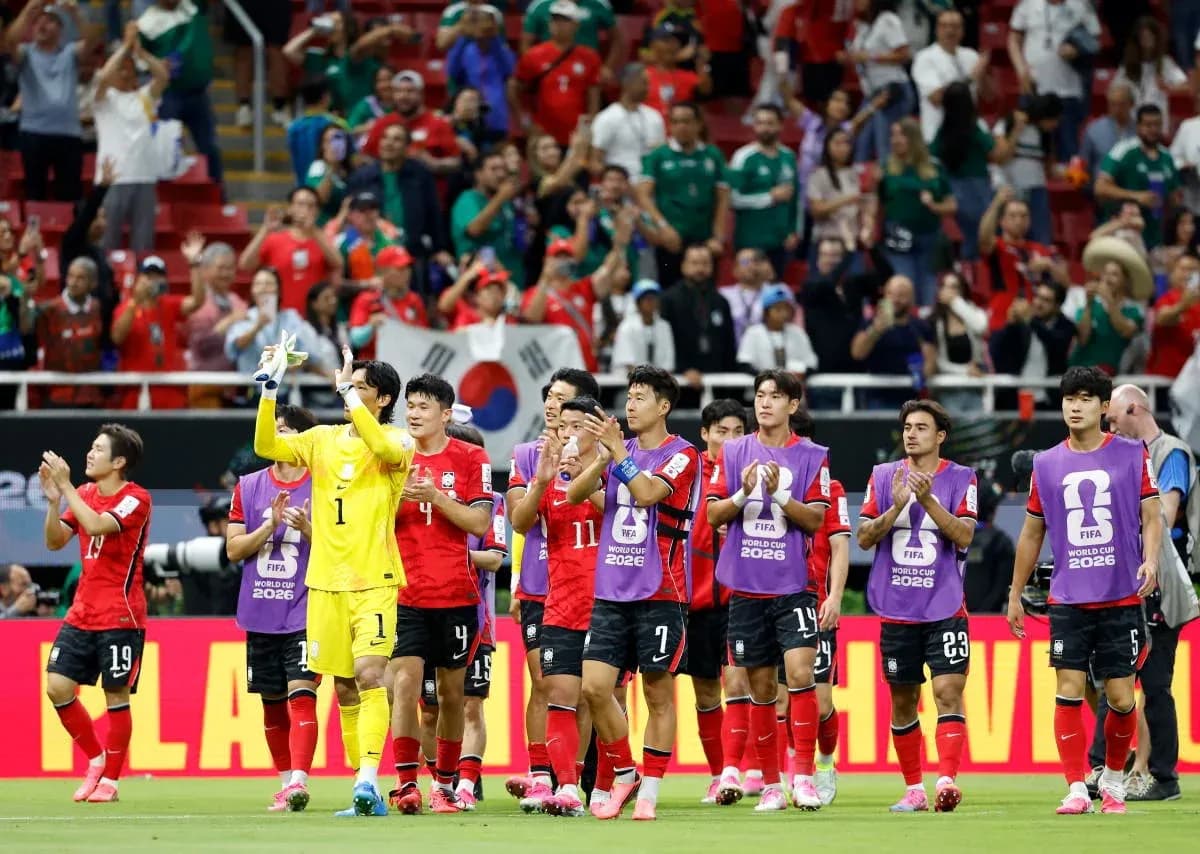
South Korea's 2–1 Victory Over Czechia: A Statement of Identity
Under the Guadalajara night at Estadio Akron, South Korea’s 2–1 victory over Czechia felt less like an opening group game and more like a statement of identity. In a World Cup Group Stage – 1 clash that finished in regular time, two teams mirroring each other in a 3‑4‑2‑1 shape produced very different versions of the same blueprint.
Following this result, South Korea sit 2nd in Group A on 3 points, with a goal difference of +1 (2 goals for, 1 against) and a perfect early record: 1 win from 1. Czechia, 3rd in the same group, are left with 0 points and a goal difference of -1 (1 goal for, 2 against), their form line an immediate “L” that sharpens the pressure for what comes next.
I. The Big Picture – Two 3‑4‑2‑1s, One Clear Winner
Both coaches doubled down on the 3‑4‑2‑1, but the personnel choices and execution told divergent stories.
Myung‑Bo Hong built his side around a back three of Gi‑Hyuk Lee, Kim Min‑jae and Han‑Beom Lee, shielded by a hard‑working central duo of Hwang In‑beom and Seung Ho Paik. Width came from Young‑woo Seol and Lee Tae‑seok, while the creative band of Kang‑in Lee and Jae‑sung Lee orbited around Son Heung‑min as the nominal striker.
Miroslav Koubek mirrored the structure: Ladislav Krejčí, Robin Hranáč and Štěpán Chaloupek formed the back line, with Vladimír Coufal and Jaroslav Zelený as wing‑backs, Tomáš Souček and Alexandr Sojka anchoring midfield, and Lukáš Provod and Pavel Šulc supporting Patrik Schick.
Seasonally, the numbers underline the narrative. At home, South Korea have played 1 fixture, winning it, scoring 2.0 goals on average and conceding 1.0. On their travels, Czechia have played 1, lost 1, scoring 1.0 and conceding 2.0. Overall, South Korea’s 2 goals for and 1 against match perfectly with the 2–1 scoreline; Czechia’s 1 for and 2 against are the mirror image. Both sides have yet to keep a clean sheet, and neither has failed to score in the tournament so far, hinting at open, risk‑embracing football from the outset.
II. Tactical Voids and Disciplinary Undercurrents
There were no listed absentees for either side, which meant both coaches had full tactical decks to play with. Yet discipline and temperament became a subtle hinge.
South Korea’s season card profile is strikingly skewed: their only recorded yellow card so far falls in the 91–105' range, accounting for 100.00% of their bookings. That late flash of indiscipline belongs to Gi‑Hyuk Lee, who not only took a yellow but also appears in the red‑card statistics, underscoring how fine his disciplinary line was in a high‑stakes context. Even without a second dismissal in this match, his presence in both yellow and red tables paints him as an aggressive, front‑foot defender who walks close to the edge.
Czechia, by contrast, show no recorded yellow or red cards across any time range so far. On paper, that suggests composure and control; in practice, it can also hint at a side that perhaps did not disrupt Korea’s rhythm often enough between the lines.
III. Key Matchups – Hunter vs Shield, Engine Room vs Enforcer
Hunter vs Shield
If there was a single figure who defined South Korea’s attacking edge, it was Hwang In‑beom. Listed among the competition’s top scorers, he has 1 goal and 1 assist in total this World Cup, taken from 3 shots (2 on target). His 8.9 rating, 81 total passes with 90% accuracy, and a key pass to match, speak of a midfielder who dictates tempo and delivers end product.
Czechia’s “shield” in response was an unusual one: Ladislav Krejčí, a defender by position but their leading scorer with 1 goal from 1 shot on target. His 43 passes at 72% accuracy and 3 tackles, along with 13 duels contested (7 won), show a player who stepped out of the back line to influence both boxes. In many ways, the duel was not just Korea’s attack versus Czechia’s defence, but Hwang’s vertical passing and late arrivals against Krejčí’s capacity to step up and meet him, or to hurt Korea on set pieces.
Engine Room – Playmaker vs Enforcer
The midfield confrontation was even more nuanced. For South Korea, Hwang In‑beom was the metronome, but he was complemented by the dribbling gravity of Kang‑in Lee. Across 97 minutes, Kang‑in completed 5 of 6 dribbles, attempted 6 in total, produced 3 key passes and hit 100% passing accuracy from 37 passes. Four fouls drawn underline how often he forced Czechia into emergency defending.
On the other side, Tomáš Souček was the nominal enforcer, but it was Vladimír Coufal who emerged as the key creative outlet. Coufal’s 1 assist, 1 key pass and 26 total passes at 65% accuracy, combined with 9 duels (2 won) and 3 fouls committed, sketch a profile of a wing‑back constantly asked to push high, cross under pressure and defend large spaces behind him. The “engine room” duel thus became Kang‑in and Hwang combining centrally and half‑wide, testing whether Souček and Sojka could screen the lanes, while Coufal tried to answer by driving Czechia upfield.
IV. Statistical Prognosis – A Game Tilted by Control, Not Chaos
Even without explicit xG values, the statistical footprint is clear. South Korea’s overall average of 2.0 goals for and 1.0 against, combined with their perfect conversion in this single fixture (2 goals from a side that also generated multiple shots and key passes through Hwang, Kang‑in and substitute Oh Hyeon‑Gyu), suggests an attack that turns territory into tangible threat.
Oh Hyeon‑Gyu’s cameo is particularly revealing for future matches: in 28 minutes he scored 1 goal from 1 shot on target, added 1 key pass and completed 6 passes at 66% accuracy, winning 3 of 4 duels. As an impact substitute, he reshapes the late‑game xG profile in Korea’s favour, especially against tiring defences.
Czechia’s numbers are more fragile. On their travels, they concede 2.0 goals on average while scoring 1.0, a negative pattern that exactly matches this 2–1 defeat. They have yet to keep a clean sheet and rely on a defender, Krejčí, as their most dangerous scorer so far. That reliance on set‑piece or secondary scoring sources, rather than sustained open‑play threat from Schick and the supporting forwards, drags their expected goal output down against organised back threes like Korea’s.
Defensively, Korea’s lack of a clean sheet and late‑game card profile show they can be stretched, but their structured 3‑4‑2‑1, anchored by Kim Min‑jae and fronted by a technically gifted trio in Hwang, Kang‑in and Son, gives them a higher baseline of control. Czechia’s more reactive interpretation of the same system, and their inability to turn possession into a second goal, leave them chasing the group now.
Following this result, the prognosis is clear: South Korea look built to manage games, create consistent chances and lean on a deep bench weapon like Oh Hyeon‑Gyu. Czechia, meanwhile, must find more open‑play punch from their forwards and tighten a defence currently conceding 2.0 goals per away game, or risk seeing Group A slip away before they can fully impose their own 3‑4‑2‑1 vision.