.svg&w=384&q=75 "Pitchgist logo")
USA Dominates Paraguay 4-1 at SoFi Stadium
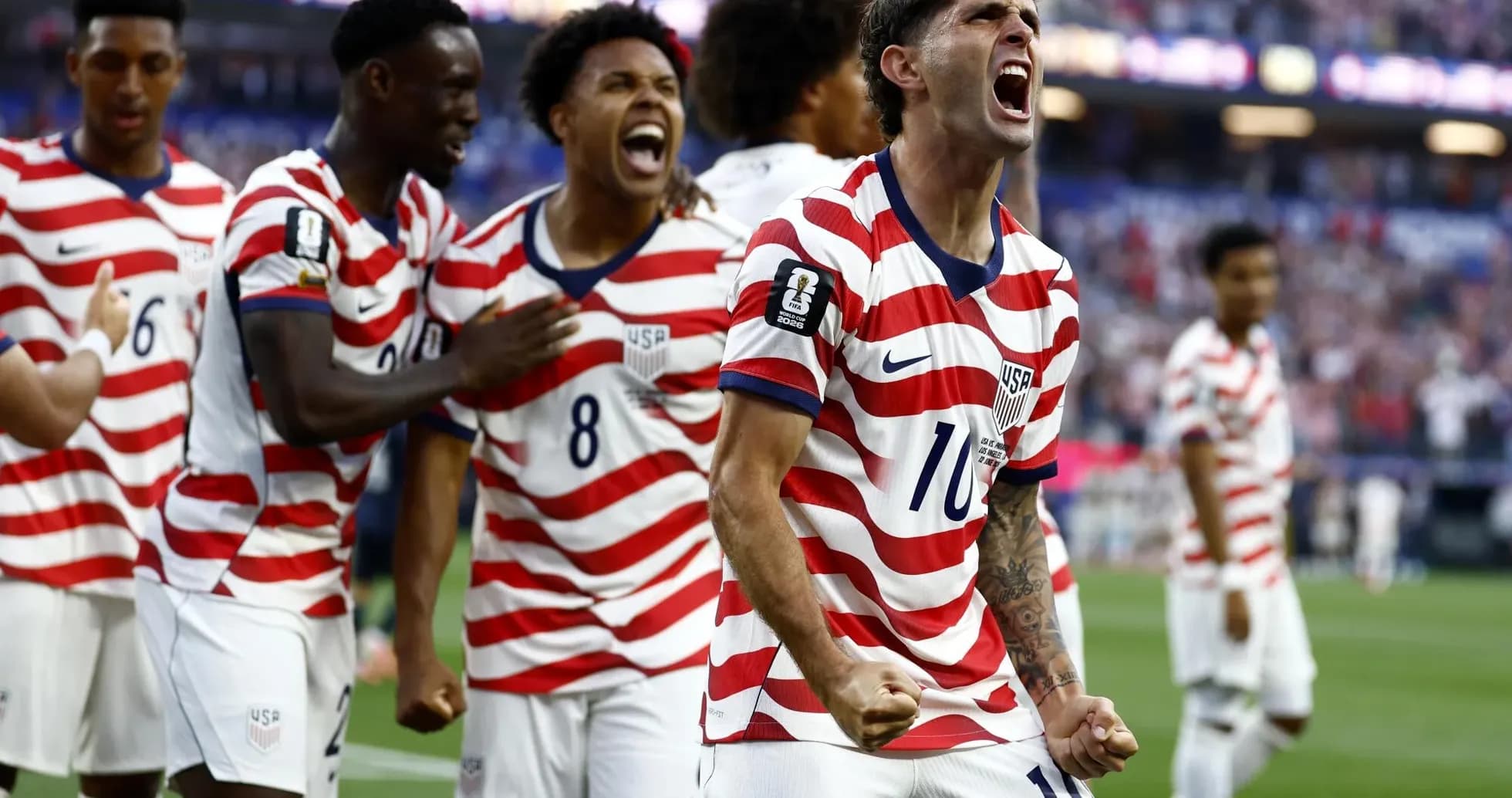
USA’s 4-1 win over Paraguay at SoFi Stadium was built on structural superiority and control rather than pure efficiency. Mauricio Pochettino’s side turned a 4-2-3-1 into a dominant, ball‑centric platform, using width and aggressive full-back positioning to pin Paraguay’s 4-4-2 deep. With 65% possession, 596 passes and 16 shots (13 inside the box), USA consistently attacked the last line, while Paraguay’s compact but reactive block never fully adjusted to the overloads between their midfield and defence.
Paraguay, under Gustavo Alfaro, defended from a 4-4-2 mid-to-low block and tried to break through Antonio Sanabria and Julio Enciso, but produced only 9 shots and 0.51 xG. Their lone goal came after structural changes and a substitution, not from a sustained attacking pattern. USA’s 3-0 half-time lead reflected a repeated exploitation of the inside channels and the left side, where Christian Pulišić drifted into pockets and combined with Folarin Balogun and the advanced full-backs.
USA’s build-up was clean and patient. Tim Ream and Chris Richards formed the first line, with Tyler Adams dropping close to them to create a three‑man base against Paraguay’s two strikers. This gave USA a constant free man in the first phase and allowed Antonee Robinson and Alexander Freeman to push high and wide. Malik Tillman and Weston McKennie operated as interior eights ahead of Adams, often forming a box in midfield with Sergiño Dest stepping inside from the right.
The first USA goal, an early own goal by Damián Bobadilla, came from precisely this territorial dominance: sustained pressure, numbers in advanced zones and forced defending in the box. Even before the scoreboard moved, Paraguay were already compressed around their area, a theme that continued all night.
In the attacking third, USA’s key pattern was the occupation of the half-spaces. Pulišić, nominally from the left, repeatedly came inside to receive between the lines, dragging Juan Cáceres or a centre-back with him and opening the lane for Robinson’s overlaps. On the right, Dest pushed high as a wide midfielder, with Freeman often providing underlaps or late runs, which later produced the assist for Giovanni Reyna’s 90+8' goal. Balogun’s brace was the natural consequence of this structure: USA funneled play into central zones after stretching Paraguay horizontally.
The second goal at 31' – Balogun finishing from a Pulišić assist – showed the timing of USA’s vertical passes once Paraguay’s midfield line was disorganised. The third, at 45+5' from another Balogun strike assisted by Tillman, came after sustained pressure and second‑phase control, with Paraguay unable to clear their lines because of USA’s rest‑defence shape: Adams anchoring transitions, supported by the two centre-backs and the far-side full-back.
Out of possession, USA were aggressive but controlled. The front four pressed Paraguay’s first line, with Balogun screening passes into midfield, Pulišić and Dest closing full-backs, and McKennie stepping up to support. Adams’ yellow card for “Roughing” at 59' reflected his role as the primary counter-pressing reference, stepping in to halt breaks when Paraguay tried to play through Diego Gómez and Andrés Cubas.
Paraguay’s 4-4-2 struggled to progress centrally. Cubas was often outnumbered against Adams, McKennie and Tillman, and when Paraguay did find Miguel Almirón between the lines, USA’s compactness limited his ability to turn. Almirón’s yellow for “Diving” at 53' underlined the frustration of a side that rarely arrived in the box with control. Their 9 shots were split almost evenly between inside and outside the box, but with only 1 on target they never truly tested Matthew Freese.
Alfaro’s substitutions were an attempt to inject dynamism and directness. Mauricio (IN) came on for Bobadilla (OUT) at 46', shifting the right side’s profile and giving Paraguay more ball-carrying from midfield. Later, Alex Arce (IN) for Sanabria (OUT) at 62' aimed to provide a more physical reference up front. The payoff arrived at 73', when Mauricio scored from an Enciso assist – a rare moment where Paraguay managed to connect wide play with a late midfield runner.
However, the flurry of late Paraguay changes – Ramón Sosa (IN) for Almirón (OUT), Gustavo Velázquez (IN) for Cáceres (OUT), and Alejandro Romero (Kaku) (IN) for Diego Gómez (OUT) – did more to freshen legs than to change the underlying pattern. USA’s structure remained intact, and with Giovanni Reyna (IN) replacing Tillman at 82', Pochettino added fresh creativity between the lines. Reyna’s 90+8' goal, assisted by Freeman, was emblematic: full-back high and aggressive, substitute playmaker arriving in the box, and Paraguay’s block stretched and tired.
Defensively, USA allowed just 1 shot on goal, with Freese making 1 save. That low volume was a function of collective control more than individual heroics. The back four’s spacing was consistent, with Robinson and Freeman recovering quickly on transitions and Adams screening passes into Arce and Enciso. Paraguay’s own goalkeeper, Orlando Gill, faced 6 shots on goal and made 3 saves, but the -1.16 goals prevented figure for Paraguay underlines that the 4 goals conceded were in line with, or slightly above, the underlying shot quality USA generated.
Statistically, the match was a clear territorial and technical win for USA. Their 596 passes, 508 accurate at 85%, contrasted sharply with Paraguay’s 320 passes at 72% accuracy. USA’s 13 shots inside the box versus Paraguay’s 4 reflected how consistently Pochettino’s side arrived in prime scoring zones. The xG numbers – 1.27 for USA and 0.51 for Paraguay – suggest that USA slightly overperformed their finishing, particularly through Balogun’s clinical first-half brace, while Paraguay’s single goal broadly matched their limited threat.
Discipline also told a story of pressure and strain. Paraguay collected 5 yellow cards – Juan Cáceres (“Tripping”), Almirón (“Diving”), Diego Gómez (“Holding”), Arce (“Roughing”), and Junior Alonso (“Holding”) – compared to USA’s single booking for Adams. That imbalance mirrored the game’s flow: Paraguay defending deeper for longer, repeatedly forced into last-ditch or cynical interventions as USA circulated the ball and attacked the gaps.
In tactical terms, USA combined a stable 4-2-3-1 base with flexible roles for their attacking midfielders, high full-backs, and a secure rest-defence, translating structural control into a commanding 4-1 scoreline and a near-ideal start to their World Cup group campaign.