.svg&w=384&q=75 "Pitchgist logo")
Portugal's Dilemma: Ronaldo's Impact on the Team
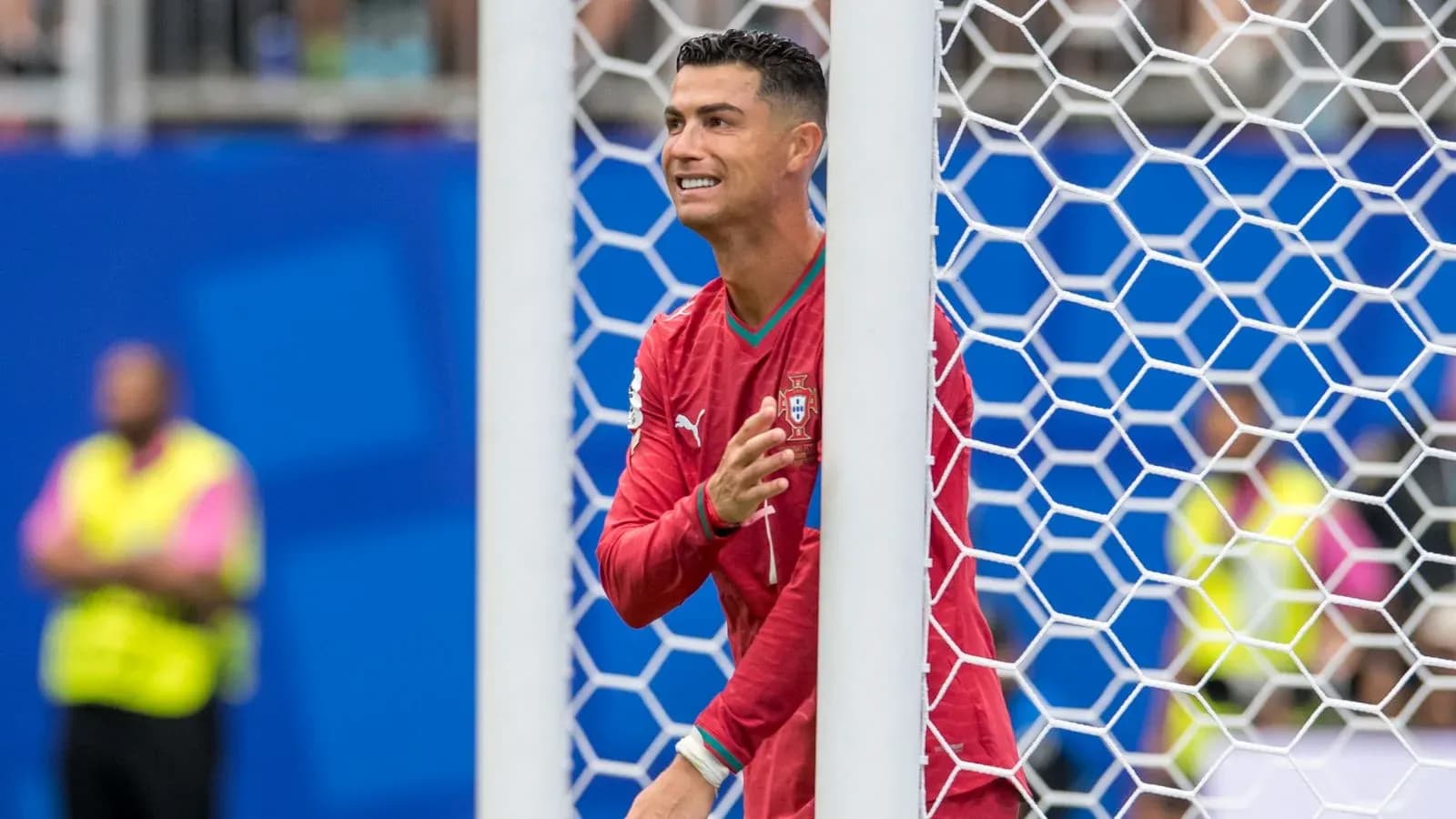
At some point, every great player reaches the moment their country has been dreading. For Portugal, that moment may have arrived in Houston.
Cristiano Ronaldo, 41 years old and carrying the captain’s armband into a record-extending sixth World Cup, walked out against DR Congo with the usual noise swirling around him. Kylian Mbappé had scored twice the night before. Erling Haaland too. Lionel Messi, the eternal measuring stick, had gone one better with a hat-trick.
Ronaldo’s answer? Twenty-nine touches. Three shots. No goals. A scowl. And a flat 0-0 that left Portugal meandering rather than marching.
Once again, he was the story — just not the one he used to write.
His goalless streak in major international tournaments now stands at 10 games. Messi, in the same span of appearances, has nine goals. The contrast is brutal, and it’s no longer just about perception or nostalgia. The numbers are starting to shout.
Against DR Congo, only Bernardo Silva — withdrawn at half-time — had fewer touches among Portugal’s starters. Ronaldo drifted on the fringes of the game, a legend orbiting the action rather than dictating it.
Roberto Martinez, though, wasn’t ready to point the finger at his captain.
“It makes no sense to get the best goalscorer in world football out in a game that you need goals,” he insisted. For Martinez, Ronaldo’s presence in the box, his gravity on defenders, his ability to open space for others, still justifies the selection. “When you look for goals, you need to have Cristiano.”
It’s a familiar defence, and not without logic. But it clashes with the reality in front of everyone’s eyes.
A Star Surrounded by Stars – So Where’s the Supply?
This is not a Portugal short on creativity. Martinez has Bernardo Silva, Bruno Fernandes, Pedro Neto, Vitinha, João Neves, João Cancelo, Nuno Mendes. A cast most nations would build a team around, not question.
So are they failing Ronaldo? Or is the problem more complicated?
Look at the data from the last 10 competitive internationals for Ronaldo, Messi, Mbappé and Harry Kane. Only Kane has taken fewer shots than Ronaldo’s 30 in that stretch. Ronaldo’s expected goals (xG) sits at 5.36. Kane’s is 7.15. Mbappé’s is 8.76. Messi’s xG isn’t available, but the picture is already clear enough.
The quality of chances falling to Ronaldo has dipped. That much is obvious. Across those 10 games, while he was on the pitch, Portugal generated a team xG of 12.76. England, with Kane, produced 16.39. France, with Mbappé, 21.99.
Per 90 minutes, that works out to 1.32 for Portugal, 1.34 for England, 1.72 for France. Portugal are not creating at the same volume as France, but they’re not starved either. They’re in the same bracket as England.
Drill down further and the picture tightens. Ronaldo’s xG from chances assisted by team-mates over this barren run is 2.55. Kane’s equivalent is 3.2. Mbappé’s explodes to 5.78.
So yes, Ronaldo is living off thinner rations than Mbappé. He isn’t being spoon-fed tap-ins. For a player who once thrived on relentless service, that matters. It explains part of the drought.
But only part.
The Finisher Who Stopped Finishing
The other part is harsher. It’s about what Ronaldo does with the chances he still gets.
Fernandes, Silva, Neves and the rest would fairly argue they’ve created enough for at least a few of those to go in. If Ronaldo had tucked away one or two more of the big chances, the debate around his place wouldn’t be this loud, this emotional, this unavoidable.
The numbers again strip away sentiment. Look at post-shot xG — a measure of shot quality after the ball leaves the boot. Kane and Mbappé are still bending games their way. Kane is overperforming his post-shot xG by 2.05. Mbappé by 2.25.
Ronaldo? He’s at -2.8.
That means he has scored nearly three goals fewer than expected based on the positions he’s shot from and how he’s struck the ball. For a career built on ruthless precision, that’s a stark decline. The edge that once separated him from almost everyone on the planet has dulled.
The issue is not just about finishing either. It’s about involvement.
Ronaldo’s touch map and heatmap against DR Congo underline how little he knitted himself into Portugal’s play — and how restricted his movement has become. Most of his actions came in isolated pockets on the left, zones where Neto and Mendes should have been stretching and hurting the opposition.
Messi drops deep and dictates tempo. Kane drifts into midfield, links play, turns provider. Mbappé roams across the front line, dragging defenders into places they don’t want to go. Ronaldo, at this stage, does none of that. He stays high, he stays narrow, and he waits.
When the goals are flowing, you live with that. You build around it. When they dry up, the trade-off becomes painful.
Martinez’s Dilemma and a Golden Generation on the Clock
This is the crux of Martinez’s problem. He cannot rip up his creative structure to serve one man, no matter how decorated. Yet he also refuses to drop that man because of everything he has been — and, in his eyes, still can be — inside the penalty area.
So Portugal exist in a kind of tactical limbo. The team is packed with peak-age talent, a genuine golden generation in terms of depth and quality, but shackled to a version of Ronaldo that no longer dominates tournaments the way his reputation suggests.
The conversation Portugal must have is not about what Ronaldo has done. That story is written, gilded, unshakeable. It is about what he is now, and what he allows this team to be.
If Martinez continues to bet on the past, this World Cup risks becoming another chapter of “what if” for a group of players capable of so much more. The question is no longer whether Ronaldo deserves respect.
It’s whether Portugal can afford to keep building everything around him while time, and the goals, slip away.