.svg&w=384&q=75 "Pitchgist logo")
Declan Rice's Importance to England and the Emergence of Reece James
Aaron Cresswell calls Declan Rice “a freak of nature”. It sounds like dressing-room hyperbole, the sort of line tossed out with a grin and a shrug. Then you look at the numbers.
Since the start of the 2020‑21 season, Rice has played 360 games. Three hundred and sixty. Deep European runs with West Ham, every England camp that mattered, the full-blooded tilt at the Premier League and Champions League with Arsenal. Season after season, competition after competition, he has been the constant.
On Wednesday night in England’s wild 4-2 win over Croatia, the constant finally flickered.
England’s anchor looks human
This was Rice’s 63rd appearance of the 2025‑26 campaign. It showed. The 27‑year‑old, usually England’s metronome and shield, looked strangely off-key in a first half that veered towards chaos.
The midfield shape was wrong from the opening minutes. Too much grass between Rice and Elliot Anderson. Too much room for Luka Modric to pull strings. Rice, so often the one who holds his ground and holds his nerve, kept dropping too deep, then being dragged out of position. England’s structure bent with him.
Thomas Tuchel can fix a system. He has made a career out of it. The tactical gaps between Rice and Anderson are coachable, the distances tweakable before Ghana arrive on Tuesday. What he cannot so easily mend is fatigue.
That fear came into sharp focus in the 72nd minute.
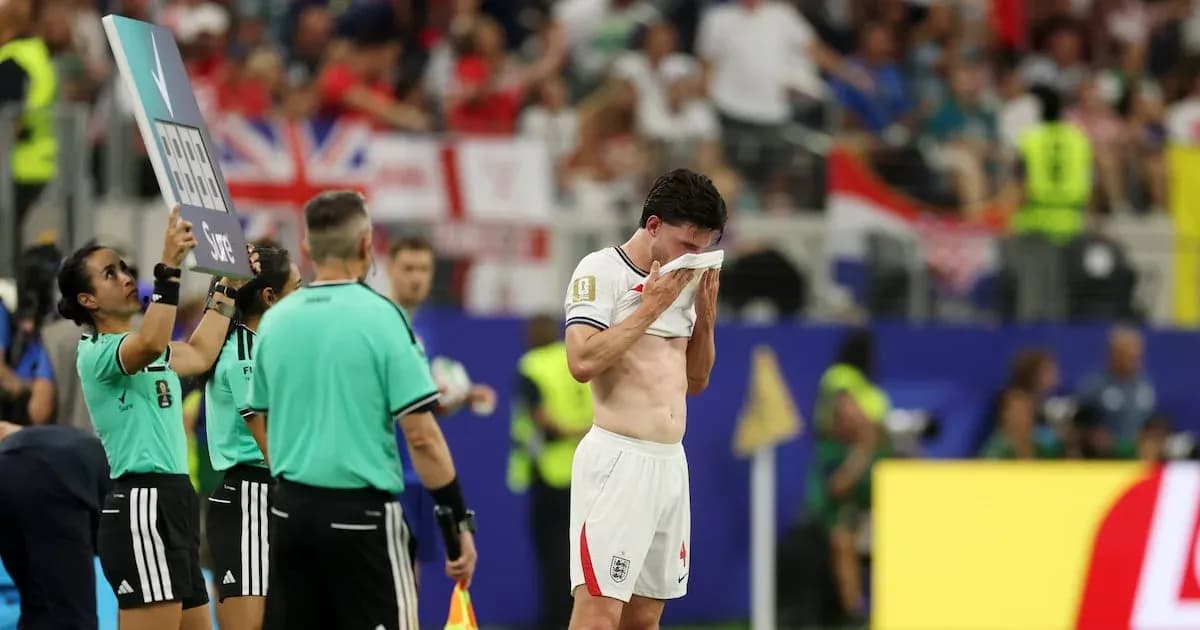
With England 3-2 up and Croatia surging, Tuchel did something that almost never happens: he took Rice off. This is usually the moment when Rice tightens his grip on a game, when his ball-winning and calm under pressure become non-negotiable. Instead, England’s vice‑captain walked to the touchline, feeling his lower back and upper hamstring.
Tuchel called it precautionary. Rice insisted he would be ready for Ghana. The words were reassuring. The picture was not.
No like-for-like, no easy answers
This is the problem. England without Rice rarely look like the same side. Over the past six years, whenever he has been absent, the midfield has lost its balance and bite. Tuchel’s squad list underlines the issue: there is no true replacement.
Kobbie Mainoo is a joy on the ball, smooth in tight spaces, brave in possession. But he does not yet have Rice’s frame, his aerial presence, his set‑piece threat. Jordan Henderson brings experience, but at 36 he was not even turned to when the tempo spiked against Croatia. If Tuchel did not trust him in that storm, when will he?
So the head coach improvised. When Rice went off, Jude Bellingham dropped deeper. For eight uneasy minutes, England flirted with disaster. Croatia poured through the middle, and an equaliser felt close. Tuchel abandoned the experiment.
Only then did a more convincing solution emerge.
Djed Spence came on for Bellingham, and Reece James stepped out of right back into midfield, a role he has quietly grown into at Chelsea over the last 18 months. The shift immediately made more sense. England had a physical presence screening the defence again, someone who could tackle, pass and see the whole pitch.
If Rice’s minutes need to be rationed, James might be the man who saves England’s tournament.
Reece James, the unexpected “6”
This is not a whim. James played in midfield during his loan at Wigan in 2018‑19. He has built his reputation as a right back and right wing back, but under Enzo Maresca at Chelsea he was pushed inside with increasing regularity. The early scepticism – Tuchel’s included – has faded in the face of performances.
The turning point came last year, when Chelsea beat Paris Saint‑Germain in the Club World Cup final. James, used in midfield, did not just cope; he controlled. Maresca stuck with the idea and was rewarded again when Chelsea dismantled Barcelona 3-0 last November. James partnered Moisés Caicedo that night, bossed the centre of the pitch and, five days later, dominated Rice himself when Arsenal went to Stamford Bridge.
So when Tuchel named his World Cup squad and left out Adam Wharton and Alex Scott, he had a clear line of justification: “Reece James can play in the 6 because he does on a high level for Chelsea.” It was not a throwaway line. It was a strategic pillar.
Tuchel has built this England group around versatility. If James moves into midfield, he has cover at right back. Spence can play there. So can Ezri Konsa and Jarell Quansah. One possible reshuffle would see Konsa tuck in as a third centre back alongside John Stones and Marc Guéhi, with Nico O’Reilly released from left back to surge forward.
On paper, it works. On grass, it depends on one thing: whether James’s body holds.
A solution with its own risk
James’s talent has never been in doubt. His fitness has. A long history of hamstring injuries shadows every selection. The latest setback came in March, costing him almost two months. Chelsea have had to manage his minutes with care. England must do the same.
Complications are already piling up. Tino Livramento’s calf injury forced Tuchel to draft in Trevoh Chalobah. The season has taken a heavy toll across the squad. James is first choice at right back, but he cannot start every game there and simultaneously soak up the strain of covering Rice in midfield.
Tuchel knew this World Cup would be a race against the clock as much as a test of tactics. The early camp in Florida, the sun, the conditioning work – all of it was designed to get legs and lungs ready for a brutal month. Rice arrived late after Arsenal’s Champions League final, already at the edge of his physical limits, and simply kept going.
At some point, the body sends a bill.
If England go all the way to the final and Rice plays every match without a proper rest, he will finish the season on 70 appearances for club and country. Seventy. For a player who covers more ground than most, who is asked to be both destroyer and distributor, the demands are extreme.
Tuchel cannot wish that away. He has to plan around it.
Rice remains England’s heartbeat, the player they least want to be without. But the sight of him walking off against Croatia, feeling for his back and hamstring, was a warning. If England are serious about lasting the distance, the head coach will need more than faith in a freak of nature. He will need a fully formed Plan B – and he may have just found it in the man wearing No 2.