.svg&w=384&q=75 "Pitchgist logo")
Parma's Tactical Triumph: Season Finale Insights
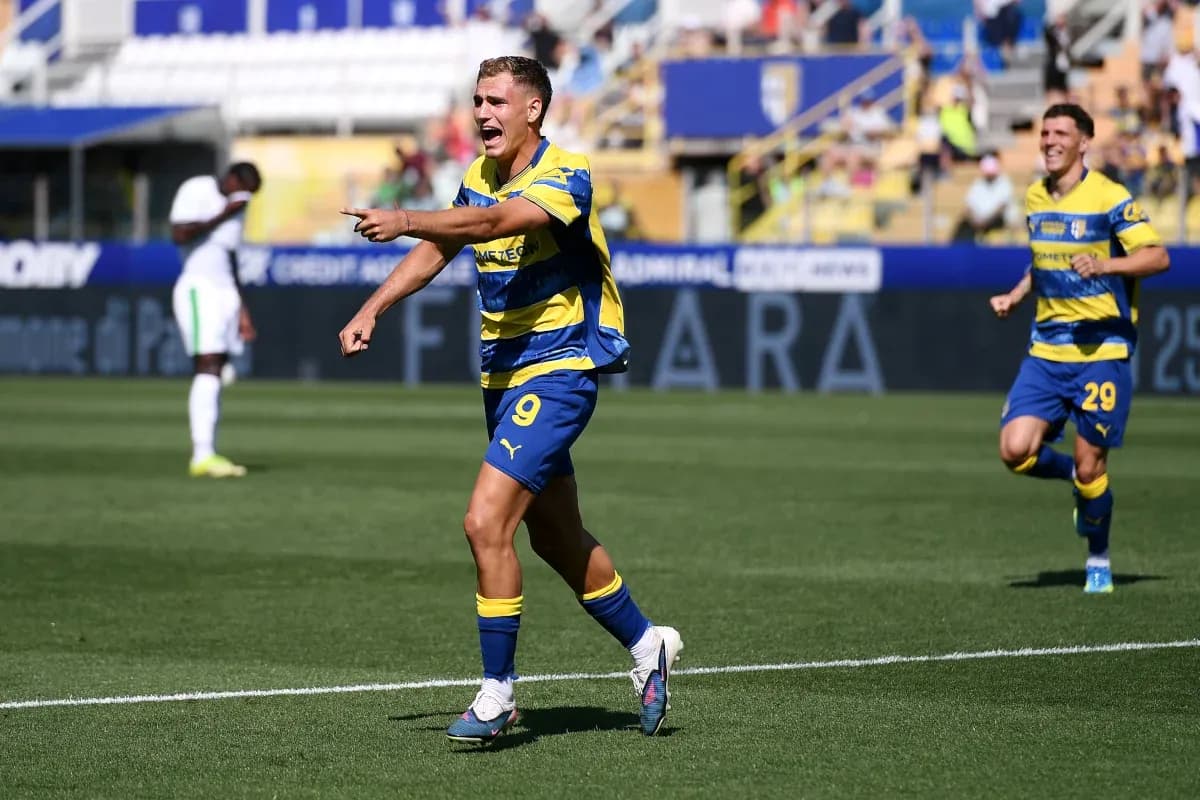
Stadio Ennio Tardini felt like a fitting stage for a season’s epilogue that doubled as a tactical manifesto. Following this result, Parma’s 1–0 win over Sassuolo in the final round of the 2025 Serie A campaign crystallised who these sides have been across 38 games – and who they might become.
Parma finish 13th on 45 points, their overall goal difference locked at -18 after scoring 28 and conceding 46. Sassuolo close in 11th with 49 points and a goal difference of -4, having produced 46 goals and allowed 50. On paper, the visitors brought the heavier attacking artillery; on the grass, Carlos Cuesta’s structure and discipline smothered that edge.
I. The Big Picture: Structures and Seasonal DNA
Cuesta doubled down on Parma’s season-long identity, rolling out the 3-5-2 that has been his default – used in 19 league matches. E. Corvi stood behind a back three of L. Valenti, M. Troilo and A. Circati, with a hardworking midfield five: E. Valeri and S. Britschgi as wing-backs, C. Ordonez, H. Nicolussi Caviglia and M. Keita inside, and a bruising front pair of Mateo Pellegrino and D. Mikolajewski.
This was a system built to protect a side that, overall, has averaged only 0.7 goals for per game while conceding 1.2. At home, Parma have been cautious and often blunt – 16 goals scored at Stadio Ennio Tardini (0.8 per game) against 25 conceded (1.3 per game). Clean sheets at home (5) have been hard-earned, and this one fits the pattern: control space first, risk second.
Fabio Grosso’s Sassuolo arrived in their almost permanent 4-3-3 – the shape they have used 36 times this season. S. Turati was shielded by a back four of W. Coulibaly, T. Macchioni, J. Idzes and U. Garcia. In midfield, L. Lipani and I. Kone flanked K. Thorstvedt, while the front three of D. Berardi, A. Pinamonti and A. Laurienté carried the bulk of the attacking threat.
Sassuolo’s season has been defined by attacking ambition and defensive frailty. Overall, they have scored 46 (1.2 per game) and conceded 50 (1.3 per game). On their travels, they have produced 21 goals (1.1 per game) and shipped 24 (1.3 per game), a profile of a side that always leaves the back door slightly ajar.
II. Tactical Voids: Absences and Discipline
Both squads came into this fixture carrying scars. Parma were without a creative cluster: A. Bernabé (muscle injury), B. Cremaschi (knee), N. Elphege (thigh), M. Frigan (knee), J. Ondrejka (leg), G. Oristanio (knee) and G. Strefezza (ankle). For a team that already struggles to score, losing so many technically-minded players forced Cuesta to lean even more on structure, set-pieces and the direct presence of Pellegrino.
Sassuolo’s absentees were heavily defensive and rotational: D. Bakola, F. Cande, E. Pieragnolo and S. Walukiewicz all sidelined by knee or leg injuries, while F. Romagna and A. Vranckx were listed as inactive. D. Boloca’s muscle injury removed another midfield option. The result was a back line short on depth and a bench that, while rich in attacking alternatives like L. Moro, A. Fadera and M. Nzola, lacked a like-for-like defensive organiser.
Disciplinary tendencies framed the risk profile. Parma’s season-long yellow card timings show pronounced spikes between 46–60 minutes and 76–90 minutes, both at 21.21%. They live on a knife-edge in the second half, and Troilo himself epitomises that edge: across the season he has collected 7 yellows, 1 yellow-red and 1 straight red, even as he blocked 18 shots and made 18 interceptions. His presence in the back three gave Parma aggression, but always with a hint of volatility.
Sassuolo, meanwhile, are notorious late in games. A huge 28.92% of their yellow cards arrive between 76–90 minutes, with another 14.46% between 91–105 minutes. This is a side that pushes until the end and often pays for it. Nemanja Matić, one of Serie A’s top red-carded players this season, embodies that combative streak – 7 yellows and 1 red, with 43 tackles and 10 blocks – even though he started this one on the bench.
III. Key Matchups: Hunter vs Shield, Engine Room vs Enforcer
The headline duel was always going to be “Hunter vs Shield”: Sassuolo’s front line against Parma’s low-scoring but stubborn defensive block.
Andrea Pinamonti, with 9 league goals and 3 assists, arrived as Sassuolo’s joint top scorer. Across the campaign he has taken 57 shots, 30 on target, and drawn 33 fouls, a penalty-box forward who lives off service and half-spaces. But Parma’s back three, anchored by Troilo and Valenti, were built precisely to suffocate that profile. Troilo’s season numbers – 27 tackles, 18 blocks, 18 interceptions, and 89 duels won from 152 – speak of a defender who steps out aggressively and wins first contact. In this match, the trio compressed the central lane, forcing Pinamonti to drift or drop, where his penalty-box instincts were dulled.
On the flanks, the duel between Armand Laurienté and Parma’s wing-back unit was decisive. Laurienté has been one of Serie A’s premier creators, with 9 assists and 7 goals, 54 key passes and 80 dribble attempts (29 successful). Yet Parma’s 3-5-2 allows their wing-backs, particularly E. Valeri, to double up with outside centre-backs. By narrowing the pitch and forcing Laurienté to receive deeper, Parma turned a vertical winger into a wide playmaker, reducing the number of times he could attack the box at speed.
In midfield, the “Engine Room” battle pitted Sassuolo’s dual creators – Berardi and Thorstvedt – against Parma’s more workmanlike trio. Berardi’s 8 goals and 4 assists, backed by 33 key passes and 35 shots, usually make him the primary chance generator. Thorstvedt adds 4 goals, 4 assists, 32 interceptions and 13 blocks, a rare blend of physical presence and technical quality. But H. Nicolussi Caviglia and M. Keita, with C. Ordonez as the third runner, crowded the central channels, denying Thorstvedt time to turn and forcing Berardi to drift wide and deeper to pick up possession.
This is where Parma’s discipline told. They have kept 13 clean sheets overall this season, 5 at home, despite conceding more than a goal per game. That suggests a team that, when the game-state demands it, can drop into a compact shell and close out matches. This 1–0 was a textbook example: once ahead, the midfield five flattened, the wing-backs dropped to form a back five, and Sassuolo were repeatedly funneled into low-percentage crosses and long-range efforts.
IV. Statistical Prognosis and Tactical Verdict
Across the season, Expected Goals models would likely have favoured Sassuolo’s attack: 46 goals scored at an average of 1.2 per game, with multiple high-volume shooters and creators, versus Parma’s meagre 28 at 0.7 per game. But defensive solidity and game-state management have their own xG gravity, and Parma’s numbers reveal why this narrow win was no accident.
At home, Parma’s attack has been modest – 16 goals – yet their 5 clean sheets at Stadio Ennio Tardini show a capacity to turn matches into low-event battles. Their penalty record is perfect this season, with 2 scored from 2 and none missed, underscoring a ruthlessness in rare high-value moments. In a match like this, where one chance can define the narrative, that edge matters.
Sassuolo, on their travels, have the opposite profile: 21 goals scored, 24 conceded, only 4 away clean sheets and 6 away games where they failed to score. They live by the sword and often die by it. Even their penalty record – 2 scored from 2, no misses – cannot compensate when the defensive structure concedes so many shots in dangerous zones.
Following this result, the tactical verdict is clear. Parma’s 3-5-2, anchored by Troilo’s combative defending and Pellegrino’s tireless front-line work, has proven capable of dragging superior attacking units into attritional contests and emerging with just enough. Sassuolo’s 4-3-3, powered by Laurienté, Berardi and Pinamonti, remains one of Serie A’s most watchable attacks, but until the back four and midfield screen can reduce that 1.3 goals against per game, they will continue to live in the volatile middle of the table.
At Stadio Ennio Tardini, order beat chaos. A single goal, a clean sheet, and a final-day performance that mirrored an entire season’s tactical truths.