.svg&w=384&q=75 "Pitchgist logo")
Napoli vs Bologna: Tactical Analysis of a 2-3 Defeat
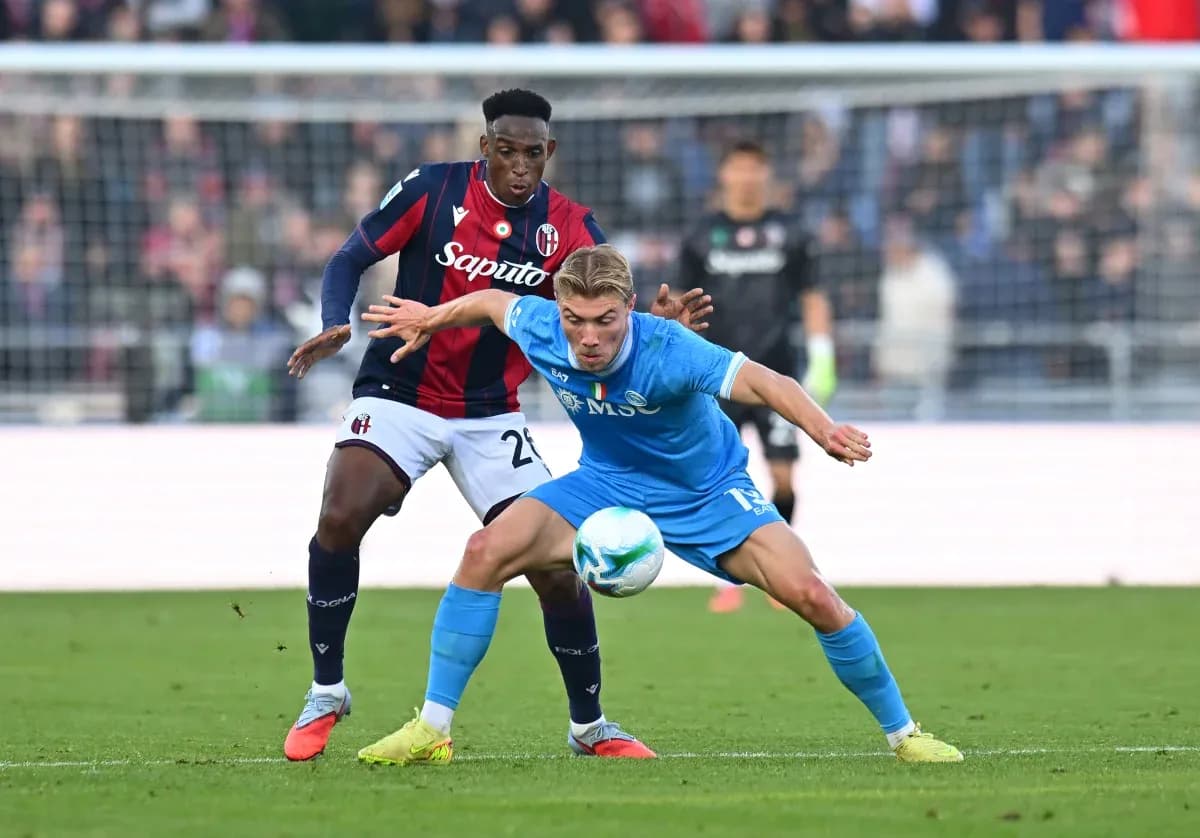
Napoli’s 3-4-2-1 against Bologna’s 4-3-3 at Stadio Diego Armando Maradona produced a tactically volatile 2-3 defeat for the hosts, where structural control rarely aligned with penalty-box efficiency. Napoli edged possession 52% to 48%, generated more total shots (14 to 10) and corners (7 to 1), yet the xG profile — 0.75 for Napoli versus 1.32 for Bologna — underlined how Vincenzo Italiano’s side engineered clearer, higher-value situations despite spending longer without the ball.
Bologna’s plan was built on a compact 4-3-3 mid-block, with R. Freuler anchoring in front of J. Lucumí and E. Fauske Helland, and the full-backs Joao Mario and J. Miranda ready to jump aggressively once Napoli’s first pass into midfield was telegraphed. The opening goal on 10 minutes from Federico Bernardeschi, assisted by J. Miranda, encapsulated this: Bologna regained and attacked quickly into the wide channel, isolating Napoli’s outside centre-backs and exploiting the space behind wing-backs M. Politano and M. Gutierrez. With Napoli’s back three stretched horizontally, the visitors repeatedly sought early diagonals and cut-backs rather than speculative shots, which is consistent with creating 1.32 xG from only 10 attempts.
Antonio Conte’s 3-4-2-1 relied on S. Lobotka and S. McTominay to control central zones while Politano and Gutierrez provided width. However, the distances between Napoli’s double pivot and the front three (Giovane, Alisson Santos, R. Hojlund) were often too large in the first half, leaving Hojlund isolated and forcing low-percentage efforts from outside or crowded areas — a key reason why 11 of their 14 shots came inside the box but still only amounted to 0.75 xG. The shots profile suggests many were from poor angles or under pressure rather than clear one-on-ones.
The critical tactical moment in the first half came around the penalty incident. At 33 minutes, VAR confirmed a penalty for Bologna following Juan Miranda’s involvement, and R. Orsolini converted at 34 minutes. This sequence highlighted a recurring issue in Napoli’s defensive structure: the wing-back stepping late to pressure the ball, the wide centre-back dragged out, and the remaining two centre-backs exposed in large gaps. Bologna’s front three — Bernardeschi, S. Castro and Orsolini — consistently occupied all three lanes, pinning the back line and making every defensive rotation costly.
Napoli’s response before the interval was more about individual timing than structural change. At 45 minutes, G. Di Lorenzo stepped into a more advanced pocket and scored a Normal Goal, reducing the deficit to 1-2. His willingness to underlap into the right half-space compensated for the earlier disconnect between midfield and attack, and signalled the pattern that would dominate early in the second half: centre-backs stepping in to overload midfield.
Disciplinary Profile
The disciplinary profile reinforced Bologna’s combative approach. The card log, in order, was:
- 38' João Mário (Bologna) — Foul
- 47' Federico Bernardeschi (Bologna) — Foul
- 58' Eivind Helland (Bologna) — Foul
- 69' Jhon Lucumí (Bologna) — Foul
- 84' Matteo Politano (Napoli) — Foul
Totals: Napoli 1 yellow card, Bologna 4 yellow cards, overall 5. All four Bologna bookings were direct consequences of aggressive engagements in wide or half-space zones as they tried to disrupt Napoli’s progression. Politano’s late booking reflected Napoli’s own need to counter-press after committing numbers forward.
The second half opened with Napoli structurally higher and more compact between the lines. Immediately after the restart, at 48 minutes, Alisson Santos equalised with a Normal Goal, assisted by R. Hojlund. The move illustrated a clearer offensive pattern: Hojlund dropping between Bologna’s lines to link, with Alisson Santos attacking the space beyond the right-sided centre-back. This was one of the few moments Napoli converted positional superiority into a truly dangerous final action.
From there, substitutions became central to the tactical story. For Bologna, N. Zortea (IN) came on for Joao Mario (OUT) at 64', adding fresher legs and defensive stability on the right. Later, N. Moro (IN) for T. Pobega (OUT) and S. Sohm (IN) for L. Ferguson (OUT) at 81' shifted Bologna’s midfield towards more energy and ball-winning, while T. Heggem (IN) for E. Fauske Helland (OUT) at 82' refreshed the back line. Crucially, J. Rowe (IN) replaced F. Bernardeschi (OUT) at 73', providing vertical running and a direct threat in transition that would decide the match.
Conte’s changes were more attacking but did not significantly alter the xG trend. E. Elmas (IN) for Giovane (OUT) and B. Gilmour (IN) for S. Lobotka (OUT) at 76' aimed to add creativity and forward passing from deeper zones, while L. Spinazzola (IN) for M. Politano (OUT) at 85' and P. Mazzocchi (IN) for M. Gutierrez (OUT) at 87' were designed to inject late width and crossing threat. Despite these moves, Napoli’s shot quality did not markedly improve; they continued to circulate well — 484 passes, 425 accurate (88%) — but struggled to access high-value central zones inside the box.
In goal, V. Milinkovic-Savic’s numbers are telling. With only 1 recorded save and goals prevented at -0.82, Napoli’s goalkeeper underperformed relative to the quality of chances faced, aligning with Bologna’s 3 goals from 1.32 xG. At the other end, M. Pessina made 3 saves for Bologna, with goals prevented at -0.82 as well, suggesting that while he conceded twice from relatively modest Napoli xG, his defence restricted the hosts to largely manageable efforts.
The decisive tactical sequence arrived at 90 minutes, when J. Rowe scored Bologna’s third with a Normal Goal. It came after a phase where Napoli had committed wing-backs and at least one centre-back high, leaving transition spaces that Rowe, with fresh legs, could exploit. Bologna’s lower volume of shots (10) but higher xG underlines the effectiveness of this strategy: fewer attacks, but into exposed, high-value zones.
Statistically, Napoli’s overall form in possession — more of the ball, more shots, higher pass completion — contrasted sharply with their defensive index on the night: poor management of wide overloads, slow rest-defence organisation after losing the ball, and sub-optimal goalkeeping. Bologna, with fewer passes (458, 386 accurate, 84%) and more fouls (12), accepted a reactive role but maximised the clarity of their chances. The 2-3 scoreline, read through xG and goals prevented, is consistent with a game where Bologna’s tactical clarity in transition and penalty-box occupation outweighed Napoli’s territorial control.