.svg&w=384&q=75 "Pitchgist logo")
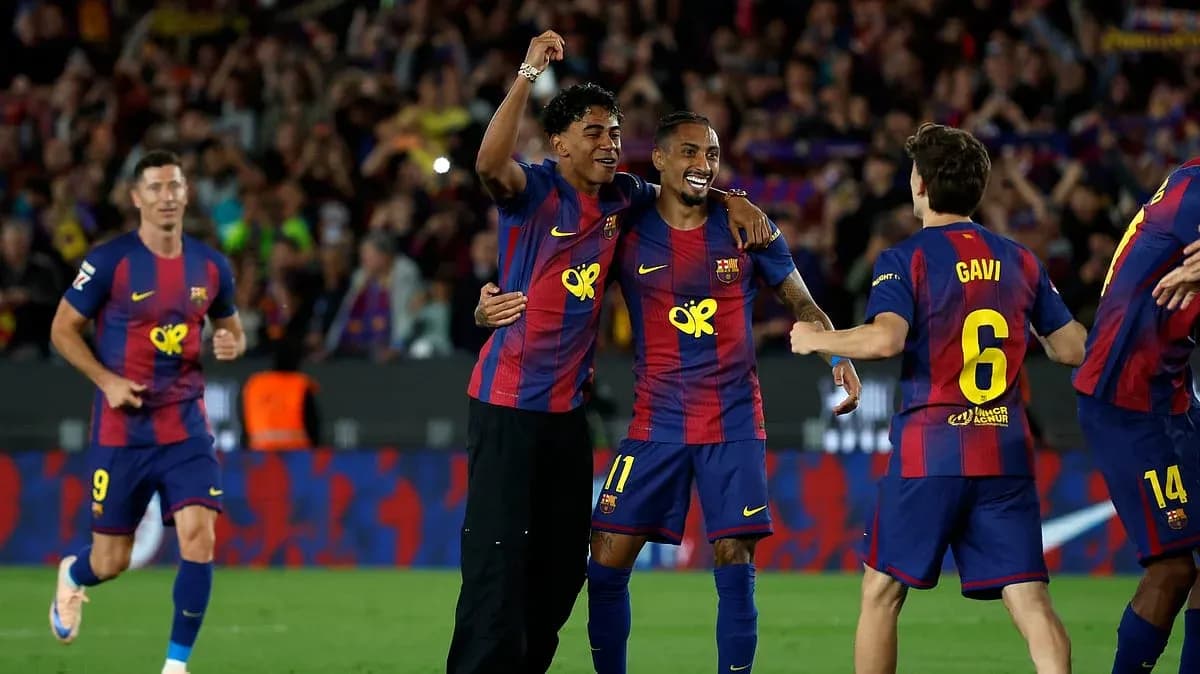
Barcelona Triumphs Over Real Madrid in Clásico Showdown
On a warm May evening at Camp Nou, the league’s grand narrative narrowed into something brutally simple: first against second, Barcelona against Real Madrid, and a title race that could be settled by details in both penalty areas. By the final whistle, the scoreboard read 2–0 to Barcelona, a result that did more than crown a clásico; it confirmed the seasonal DNA of both sides.
Following this result, Barcelona’s campaign profile remains ferociously clear. Overall in La Liga they have played 35 matches, winning 30, drawing 1 and losing 4, with 91 goals for and 31 against. The goal difference of 60 is not an abstract number; it is the imprint of a team that attacks in waves and concedes in carefully rationed moments. At home, they are perfect: 18 wins from 18, 54 goals scored and only 9 conceded, averaging 3.0 goals for and 0.5 against at Camp Nou. Real Madrid arrive as the only side close enough to see them, second with 77 points, 24 wins, 5 draws and 6 defeats. Overall they have scored 70 and conceded 33, a goal difference of 37. On their travels they have been strong but not untouchable: 10 wins, 4 draws and 4 defeats, with 31 goals scored and 19 conceded, averaging 1.7 goals for and 1.1 against away.
I. The Big Picture: Structures and Stakes
Both coaches mirrored each other on the board. Hansi Flick and Alvaro Arbeloa sent their teams out in a 4-2-3-1, but the shapes were drawn with very different intentions.
Barcelona’s line of four – J. Cancelo, G. Martin, P. Cubarsi and E. Garcia in front of goalkeeper J. Garcia – was less a flat back line than a launchpad. Ahead of them, the double pivot of Gavi and Pedri set the game’s tempo, with Fermín and Dani Olmo knitting the half-spaces and M. Rashford drifting inside from the right to support Ferran Torres as the nominal lone forward. It was a structure built to suffocate Madrid’s first pass and then attack the exposed seams.
Real Madrid’s 4-2-3-1 had a more conservative undertone. T. Courtois sat behind a back four of F. Garcia, A. Rudiger, R. Asencio and T. Alexander-Arnold. E. Camavinga and A. Tchouameni formed a protective screen, while B. Diaz, J. Bellingham and Vinicius Junior operated behind G. Garcia. On paper it was balanced; in practice, absences and context pushed it towards caution.
Heading into this game, both sides had shown defensive solidity over the season: Barcelona and Real Madrid each conceded an overall average of 0.9 goals per match. The difference, especially at Camp Nou, lay in offensive volume and control.
II. Tactical Voids: Absences and Discipline
This clásico was shaped as much by who was missing as by who started. Barcelona were without A. Christensen (knee injury) and Lamine Yamal (thigh injury). The former’s absence placed extra responsibility on the young axis of P. Cubarsi and E. Garcia; the latter removed one of La Liga’s most electric one-v-one threats and its leading creator, with Lamine Yamal having produced 16 goals and 11 assists overall in the league.
Real Madrid’s voids were deeper and more structural. D. Carvajal, D. Ceballos, Eder Militao, A. Guler, K. Mbappe, F. Mendy, Rodrygo and F. Valverde all missed the fixture. That list strips Arbeloa of his first-choice right-back, a senior central defender, a primary ball-progressor between the lines, the league’s leading scorer Kylian Mbappé (24 league goals and 8 penalties scored, with 1 missed), plus the vertical running and transitional menace of Valverde and Rodrygo. It is not simply a loss of talent; it is a loss of mechanisms.
Disciplinary trends added another layer of risk. Barcelona’s yellow-card distribution shows a spike between 46–60 minutes (27.59%) and again in the 76–90 window (20.69%), periods where their aggression in the press can tip into recklessness. Real Madrid’s yellows are more spread, with a notable 22.06% between 61–75 minutes and 17.65% from 76–90. Red cards for Madrid have tended to arrive late – 28.57% of their reds between 91–105 minutes – hinting at a team whose emotional temperature can rise dangerously in closing stages. Yet in this match, the control of Barcelona’s early lead and their grip on territory suppressed the game’s volatility.
III. Key Matchups: Hunter vs Shield, Engine Room vs Enforcer
The most intriguing “Hunter vs Shield” duel was not just Ferran Torres against Madrid’s back line, but Barcelona’s collective attacking machinery against an away defence conceding 1.1 goals on their travels. Ferran entered as one of the league’s sharper finishers, with 16 goals overall from 56 shots and 36 on target, supported from the bench by R. Lewandowski (13 goals overall, though with 1 penalty scored and 2 missed). Around them, Raphinha’s 11 goals and 3 assists overall, plus Dani Olmo’s 7 goals and 8 assists, gave Flick layers of finishing and creation even beyond the starting XI.
For Madrid, the theoretical hunter was absent. Mbappé’s 24 league goals and 4 assists overall, plus 8 penalties scored from 9 attempts, have been the spine of their attacking output. Without him, the burden fell on Vinicius Junior, whose 15 goals and 5 assists overall are underpinned by relentless volume – 72 shots, 45 on target, and 189 dribble attempts with 86 successes. In a hostile Camp Nou, he became both outlet and battering ram, but with G. Garcia leading the line instead of Mbappé, Barcelona could compress space more aggressively around the Brazilian without fearing the same penalty-box ruthlessness.
In the “Engine Room”, the duel between Pedri and Madrid’s double pivot was decisive. Pedri’s season – 2 goals, 8 assists overall, 1908 passes with 59 key passes and 91% accuracy – is a study in control. Alongside Gavi, he faced Camavinga and Tchouameni, a pairing built for duels and interceptions rather than pure orchestration. With A. Guler and F. Valverde both missing, Madrid lacked a natural third midfielder to bridge build-up and attack. That absence allowed Fermín and Dani Olmo to step into pockets between the lines, turning Barcelona’s 4-2-3-1 into a 2-3-5 in settled possession and pinning Madrid’s block deep.
IV. Statistical Prognosis and Tactical Verdict
From a statistical lens, Barcelona’s 2–0 win sits neatly within expectation. At home they average 3.0 goals scored and 0.5 conceded; Real Madrid away average 1.7 scored and 1.1 conceded. A clean sheet for a side with 10 home clean sheets already this season, against a Madrid team that has failed to score in 2 away matches overall, is not an anomaly but a continuation of trend.
Barcelona’s penalty profile – 7 taken, 7 scored overall – underlines a ruthless edge from the spot, while Real Madrid’s perfect 12 from 12 overall suggests both sides normally convert high-quality chances. The absence of penalties here points instead to territorial dominance and defensive discipline, rather than a chaotic, box-heavy contest.
Tactically, the match crystallised the intersection of offensive peaks and defensive weaknesses. Barcelona’s aggressive surges after half-time, reflected in their season-long yellow-card spike between 46–60 minutes, aligned with a Madrid side whose defensive averages away from home are solid but not elite. With no Mbappé to stretch them vertically and no Valverde to carry transitions, Madrid could not consistently threaten the spaces behind Cancelo and Rashford. The result was a game played mostly on Barcelona’s terms: high on Madrid’s half, heavy on Barcelona’s midfield touches, light on clear Madrid chances.
Following this result, the league table and the eye test tell the same story. Barcelona’s squad, even shorn of Lamine Yamal and Christensen, had more balance, more depth and more clarity of roles. Real Madrid’s injuries ripped through the spine of Arbeloa’s plan, turning a title-defining clásico into an exercise in survival. The 2–0 scoreline is not just a snapshot of 90 minutes; it is the tactical and statistical endpoint of two seasons heading in different directions.