.svg&w=384&q=75 "Pitchgist logo")
Manchester City Dominates Brentford 3–0 in Premier League
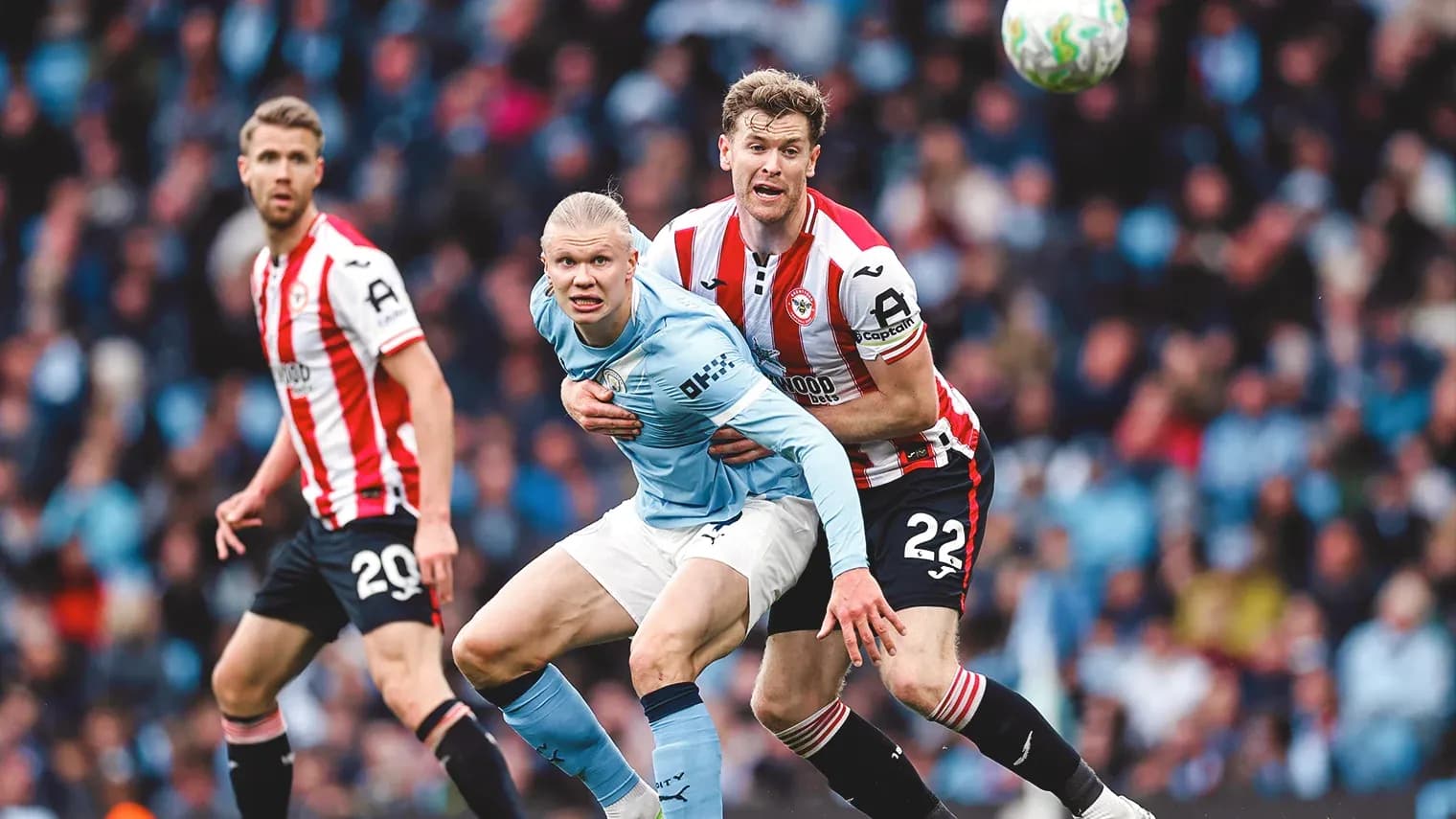
Manchester City’s 3–0 win over Brentford at the Etihad Stadium in Premier League Round 36 was a controlled, data-backed domination rather than a chaotic rout. Pep Guardiola’s side needed patience after a goalless first half, but once Jérémy Doku broke the deadlock on 60 minutes, the underlying territorial and shot-volume superiority translated into the scoreboard. Erling Haaland added a second on 75’, and substitute Omar Marmoush finished the job at 90+2’, reflecting an xG profile (2.98 vs 0.24) that had long tilted towards the hosts. Brentford, under Keith Andrews, defended in numbers but generated too little threat to justify their risk-averse approach.
Executive Summary
City controlled 59% of the ball, out-shot Brentford 25–4 and forced Caoimhin Kelleher into seven saves, while Gianluigi Donnarumma was required to make only two. The pattern was clear: City’s structure and circulation pinned Brentford deep, with the visitors’ main defensive success coming in the first half when they managed to keep the game at 0–0 through compactness and last-ditch blocks. Once City’s rotations clicked after the interval, Brentford’s low-volume attack and limited progression were ruthlessly exposed.
Scoring Sequence & Disciplinary Log
Disciplinary log (chronological, exact reasons):
- 36' Bernardo Silva (Manchester City) — Argument
- 74' Nico O’Reilly (Manchester City) — Foul
- 80' Kristoffer Ajer (Brentford) — Foul
- 88' Matheus Nunes (Manchester City) — Argument
- 88' Jordan Henderson (Brentford) — Argument
- 90+5' Omar Marmoush (Manchester City) — Time wasting
Card totals are therefore: Manchester City: 4, Brentford: 2, Total: 6.
The first half was tight on the scoreboard but tense in midfield. The only card before the break came on 36', when Bernardo Silva was booked for “Argument”, a signal of City’s frustration at Brentford’s stubborn block and stop-start rhythm.
The game’s tactical lock finally opened on 60'. Doku, already a persistent one-v-one outlet, scored a “Normal Goal” to make it 1–0, capitalising on the accumulated territorial pressure. Immediately after the breakthrough, Guardiola reshaped his attacking line: at 60', Omar Marmoush (IN) came on for Rayan Cherki (OUT), and Phil Foden (IN) came on for Tijjani Reijnders (OUT), adding fresh verticality and an extra line-breaking passer.
Brentford responded on 61' with Vitaly Janelt (IN) for Aaron Hickey (OUT), slightly rebalancing their midfield. On 68', Dango Ouattara (IN) replaced Mikkel Damsgaard (OUT) to add direct pace in transition, but by then City were in control.
City’s second arrived at 75', shortly after Nico O’Reilly had been booked for “Foul” on 74'. Haaland struck a “Normal Goal” to make it 2–0, converting City’s box occupation into a decisive cushion. Andrews then introduced Jordan Henderson (IN) for Yehor Yarmoliuk (OUT) on 79', seeking more composure on the ball.
The final phase grew scrappier. Kristoffer Ajer was booked for “Foul” on 80', then a double “Argument” booking on 88' saw Matheus Nunes and Jordan Henderson both cautioned as tempers flared. At 90+2', Marmoush sealed the 3–0 with a “Normal Goal”, assisted by Haaland, a transition-style strike that punished Brentford’s late push. Marmoush then drew a final yellow for “Time wasting” at 90+5', underlining City’s game-management posture in stoppage time. The last substitution saw Savinho (IN) come on for Doku (OUT) at 90'.
Halftime score: 0–0. Full-time: 3–0 to Manchester City.
Tactical Breakdown & Personnel
City’s structure was recognisably Guardiola but with some personnel twists. Gianluigi Donnarumma in goal had a relatively quiet afternoon, making 2 saves against Brentford’s 2 shots on target. His “goals prevented” figure of 1.5 suggests that while the volume was low, at least one of those chances carried real danger, and his interventions preserved the clean sheet.
In front of him, Matheus Nunes, Marc Guéhi, Nathan Aké and Nico O’Reilly formed a back four on the teamsheet, though Nunes’ card for “Argument” at 88' hints at his involvement in higher, more contested zones as City compressed the pitch. O’Reilly’s booking for “Foul” on 74' came as Brentford tried to spring transitions, indicating City’s defenders were holding a high line and engaging aggressively to stop counters at source.
Tijjani Reijnders and Bernardo Silva anchored the midfield circulation. Bernardo’s early “Argument” card reflected his central role in trying to accelerate the tempo and his frustration with Brentford’s disruption. With 463 total passes at 86% accuracy, City’s midfield and back line executed the positional play blueprint: long possession phases, lateral recycling, and constant probing for half-space entries.
The attacking line blended dribbling, movement and penalty-box presence. Antoine Semenyo and Rayan Cherki operated as hybrid midfield-forwards, with Jérémy Doku as the primary wide threat and Erling Haaland as the focal striker. Doku’s opener was the logical outcome of City’s 15 shots inside the box and 10 shots from outside; his ability to isolate defenders widened Brentford’s back line and created cutback lanes. Haaland’s goal on 75' came from classic central occupation, exploiting the cumulative stress on Brentford’s centre-backs.
Guardiola’s substitutions were tactically sharp. Phil Foden added an extra creative node between the lines, while Omar Marmoush introduced depth running and a counter-attacking outlet. Marmoush’s goal at 90+2' and later yellow for “Time wasting” show his dual role: first to kill the contest, then to help run down the clock. Savinho’s late introduction for Doku maintained City’s ability to threaten on the break even as they protected the lead.
For Brentford, Caoimhin Kelleher’s 7 saves and 1.5 goals prevented underline how exposed he was by the shot volume: City had 25 total shots to Brentford’s 4, including 10 on target versus just 2. The back line of Michael Kayode, Kristoffer Ajer, Nathan Collins and Keane Lewis-Potter was pinned deep for long stretches. Ajer’s yellow for “Foul” at 80' came as he tried to halt one of many City surges.
Keith Andrews’ midfield—Yehor Yarmoliuk, Mathias Jensen, Aaron Hickey and Mikkel Damsgaard—struggled to progress the ball consistently, completing 320 passes at 76% accuracy. The introduction of Vitaly Janelt and Jordan Henderson was an attempt to stabilise possession and add leadership, but Brentford’s xG of 0.24 shows they rarely converted those touches into genuine threat. Kevin Schade and Igor Thiago were largely isolated; City’s defensive index, reflected in low shots conceded and Donnarumma’s minimal workload, was strong.
The Statistical Verdict
The numbers align cleanly with the eye test of City dominance. An xG of 2.98 against 0.24 and a 3–0 scoreline indicate that City not only created more but also finished at roughly expectation. Their 59% possession and 463 passes at 86% accuracy contrasted with Brentford’s 41% and 320 passes at 76%, underscoring a clear superiority in ball control and structure.
Defensively, City’s overall form was proactive: only 4 shots conceded, 2 on target, and just 8 fouls committed despite sustained pressing. Brentford, by contrast, committed 14 fouls, reflecting the strain of defending 25 shots and facing 10 corner kicks. Goalkeeper reality was decisive: Donnarumma’s 2 saves complemented a well-protected box, while Kelleher’s 7 saves and 1.5 goals prevented kept the scoreline from becoming heavier.
Discipline-wise, the card count—Manchester City 4 yellows, Brentford 2—mirrors a match where the side in control could afford controlled aggression, while the under-pressure team resorted more often to tactical fouls and arguments as the game slipped away.