.svg&w=384&q=75 "Pitchgist logo")
Liverpool and Chelsea Draw 1–1 in Tactical Battle
Liverpool and Chelsea shared a 1–1 draw at Anfield in Premier League Round 36, a match that quickly settled into a tactical arm-wrestle rather than an end-to-end shootout. Liverpool struck early through Ryan Gravenberch, but Chelsea recovered their structure and equalised via Enzo Fernández before half-time. From there, both sides largely cancelled each other out: Liverpool pressed aggressively without converting territory into clear chances, while Chelsea controlled marginally more of the ball and threatened sporadically, including a disallowed Cole Palmer strike. The final numbers – low xG on both sides and identical saves – underline a contest defined by organisation, pressing traps and midfield control more than penalty-box chaos.
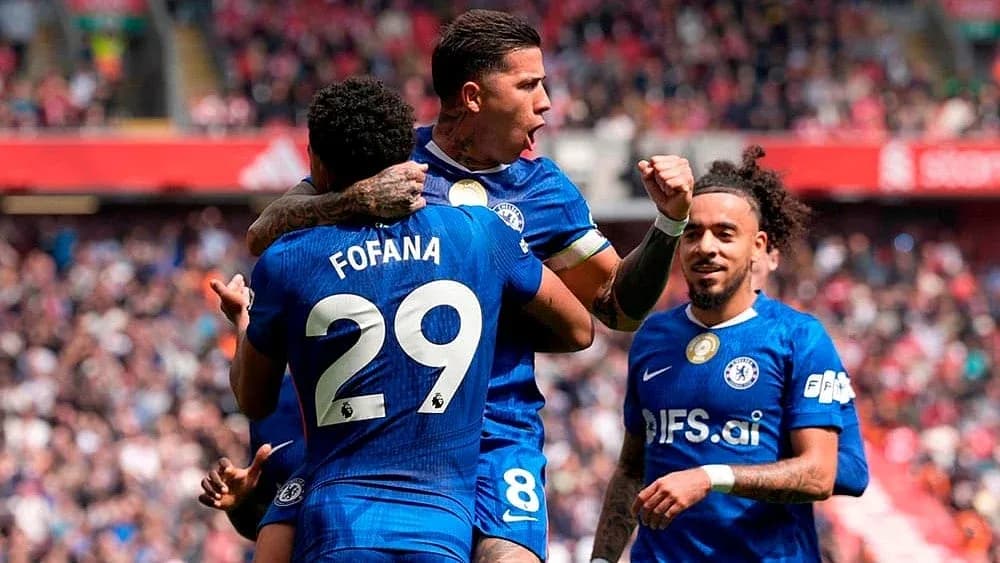
The scoring opened on 6 minutes when Ryan Gravenberch finished a Liverpool move, assisted by Rio Ngumoha, giving the hosts an immediate platform to press higher and compress Chelsea in their own half. Chelsea responded on 35 minutes, Enzo Fernández scoring without an assist, a key moment that reset the tactical balance and calmed Chelsea’s early turbulence.
Second Half
The second half’s pivotal attacking flash came at 50 minutes: Cole Palmer had the ball in the net for Chelsea, but VAR intervened and the goal was cancelled. That decision preserved parity and forced Chelsea to stay patient in their build-up rather than tilt fully into transition football.
From 63 minutes onward, the match became increasingly about fresh legs and discipline. At 63', Andrey Santos (OUT) made way as Reece James (IN) came on for Chelsea, adding more thrust down the right. Jorrel Hato’s yellow card at 67' (Foul) signalled Chelsea’s struggle to contain Liverpool’s attempts to break lines. Immediately after, at 67', Rio Ngumoha (OUT) was replaced by Alexander Isak (IN) for Liverpool, a clear shift towards a more orthodox forward presence to pin Chelsea’s centre-backs.
Enzo Fernández collected a yellow card at 73' (Foul), reflecting his combative role in Chelsea’s midfield screen. Liverpool then double-changed at 77': Cody Gakpo (OUT) was replaced by Federico Chiesa (IN), and Ibrahima Konaté (OUT) made way for Joe Gomez (IN), suggesting an attempt by Arne Slot to refresh both the forward line’s running power and the defensive distribution.
The final phase was increasingly scrappy. Marc Cucurella saw yellow at 83' (Foul) as Chelsea tried to break Liverpool’s rhythm in wide areas. Joe Gomez was booked at 88' (Argument), a rare card not directly tied to a challenge, underlining rising emotional temperature rather than tactical breakdown. Two late Chelsea infringements rounded out the disciplinary story: Moisés Caicedo at 89' (Handball) and Alexis Mac Allister at 90+4' (Persistent fouling), both symptomatic of midfielders operating at the edge of risk to disrupt any last attacks.
Tactical Overview
Tactically, Liverpool’s structure was built around a back four of Curtis Jones, Ibrahima Konaté, Virgil van Dijk and Miloš Kerkez in front of Giorgi Mamardashvili. With 48% possession and 473 passes at 84% accuracy, Liverpool were not a pure possession side here; instead, they leaned into pressing and verticality. Jeremie Frimpong, Dominik Szoboszlai, Alexis Mac Allister, Ryan Gravenberch and Rio Ngumoha formed a highly mobile midfield band behind Cody Gakpo, with Frimpong and Ngumoha key to stretching Chelsea’s defensive block.
Liverpool generated 8 total shots (5 inside the box), but only 3 on target and an xG of 0.56. That modest shot profile shows that, despite advanced positions and energetic pressing, they struggled to create repeated high-quality chances. The introduction of Alexander Isak and Federico Chiesa was a logical attempt to add penalty-box presence and one‑v‑one threat, yet the underlying pattern – Chelsea’s compact central block and disciplined last line – remained largely intact.
Defensively, Liverpool committed 17 fouls and took 2 yellow cards, both in midfield/defensive contexts (Joe Gomez – Argument; Alexis Mac Allister – Persistent fouling). Mamardashvili made 2 saves, matching his opposite number, and the negative goals-prevented figure (-0.49) suggests he conceded slightly more than the model expected from the quality of Chelsea’s shots, although the overall volume of chances remained low.
Chelsea, under Calum McFarlane, set up with a back four of Malo Gusto, Wesley Fofana, Levi Colwill and Jorrel Hato, shielded by Andrey Santos and Moisés Caicedo, with Cole Palmer, Enzo Fernández and Marc Cucurella supporting João Pedro. Their 52% possession and 515 passes at 87% accuracy reflect a more controlled, circulation-heavy approach, looking to move Liverpool’s press side to side before finding Palmer between the lines or Cucurella in advanced wide positions.
Chelsea recorded 6 shots (4 inside the box), 3 on target and an xG of 0.5 – nearly identical to Liverpool’s output. The disallowed Palmer goal at 50' was emblematic of their best attacking sequences: structured possession, then a vertical burst into space. The switch to Reece James on 63' gave Chelsea extra width and crossing threat, though it did not significantly alter the shot volume.
Discipline was more of an issue for Chelsea: 17 fouls, 4 yellow cards – Jorrel Hato (Foul), Enzo Fernández (Foul), Marc Cucurella (Foul), Moisés Caicedo (Handball). The spread of bookings across their back line and double pivot indicates that much of their defensive work involved last-ditch or risk-heavy interventions to stop Liverpool’s counters and direct runs.
In goal, Filip Jørgensen also made 2 saves and posted the same negative goals-prevented value (-0.49). With both keepers facing limited but relatively efficient shooting, the numbers reinforce that neither side consistently carved the other open; instead, each converted roughly what their small xG tally suggested.
Match Statistics
Statistically, the match reads as a finely balanced tactical contest. Liverpool’s 5 corners to Chelsea’s 2 show slightly more territorial pressure, but Chelsea’s superior passing accuracy and marginal possession edge underline their comfort in controlled build-up. Both teams were flagged offside twice, reflecting high defensive lines and aggressive runs in behind.
Overall form-wise, both sides demonstrated strong organisational levels, with neither collapsing after conceding. Defensively, the indices are near-par: similar xG conceded, identical saves, and mirrored foul counts. The 1–1 scoreline, backed by 0.56 vs 0.5 xG, captures the essence of the game: two well-structured teams, each able to impose their idea in phases, but neither able to create enough separation in chance quality to deserve more than a point.