.svg&w=384&q=75 "Pitchgist logo")
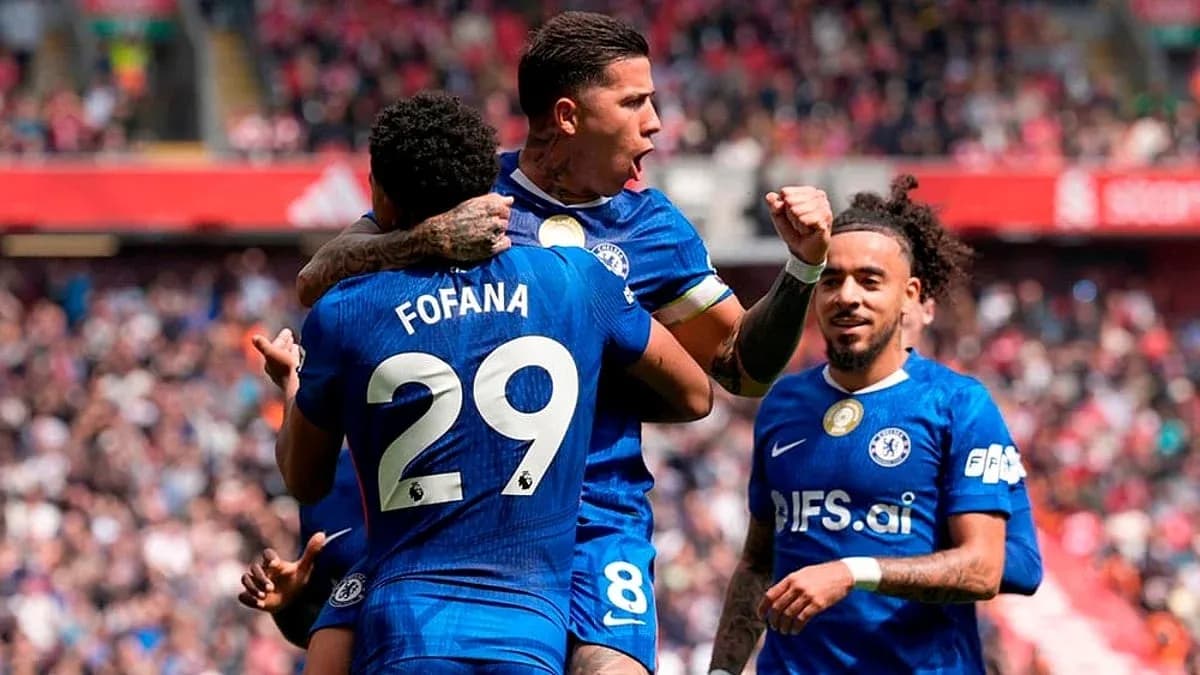
Liverpool and Chelsea Battle to a 1-1 Draw at Anfield
Anfield under a grey May sky felt less like a coronation stage and more like a chessboard. Following this result, Liverpool’s 1-1 draw with Chelsea in Round 36 of the Premier League preserved fourth place for the hosts and ninth for the visitors, but the story of the afternoon was how two reshaped squads tried to impose their seasonal identities on a knife-edge contest.
Liverpool came in as a home force: 10 wins from 18 at Anfield, with 33 goals for and 19 against. Overall this campaign, they have scored 60 and conceded 48, a goal difference of 12 built more on volume than control. Chelsea, by contrast, arrived as one of the league’s more dangerous travellers. On their travels they have scored 31 and conceded 25 in 18 matches, part of a total 55 for and 49 against, a goal difference of 6 that speaks to a side that can both hurt and be hurt.
I. The Big Picture: Structure without a safety net
Both teams are structurally 4-2-3-1 sides this season — Liverpool have used it in 32 league matches, Chelsea in 31 — and the lineups at Anfield echoed that template even without explicit formation data. Arne Slot’s selection was notable from the back forward: Giorgi Mamardashvili in goal, a back line of Curtis Jones, Ibrahima Konaté, Virgil van Dijk and Miloš Kerkez, with a fluid midfield band of Ryan Gravenberch, Alexis Mac Allister, Jeremie Frimpong, Dominik Szoboszlai and Rio Ngumoha behind Cody Gakpo.
Across from them, Calum McFarlane trusted Filip Jørgensen in goal, with a back four of Malo Gusto, Wesley Fofana, Levi Colwill and Jorrel Hato. The engine room of Andrey Santos and Moisés Caicedo sat beneath a creative line of Cole Palmer, Enzo Fernández and Marc Cucurella, servicing João Pedro as the lone forward.
The result — 1-1 at half-time and 1-1 at full-time — underlined how evenly matched these iterations are when both lean into their season-long habits: Liverpool’s high-tempo, risk-tolerant attack; Chelsea’s willingness to trade blows, especially away.
II. Tactical Voids: Absences shaping the script
The absentees list told its own tactical story. Liverpool were without Alisson, S. Bajcetic, C. Bradley, H. Ekitike, Wataru Endo, G. Leoni, Mohamed Salah and F. Wirtz. That is a spine ripped out: the first-choice goalkeeper, the primary right-back cover, a ball-winning midfielder, a penalty-box striker and the league’s seventh-ranked assist provider in Salah, who has 7 goals and 6 assists in 25 league appearances. Ekitike, with 11 goals and 4 assists in total this season, was also unavailable, denying Slot a direct penalty-box reference.
In response, Mamardashvili’s selection signalled a willingness to build from deeper, while Jones as a nominal defender and Frimpong as a listed midfielder suggested an asymmetrical back line with aggressive wide rotations. Without Salah’s gravity on the right and Ekitike’s finishing, Liverpool leaned more on Szoboszlai’s all-action profile and Gakpo’s multi-role presence to generate threat between the lines.
Chelsea’s voids were different but equally influential: J. Derry, an unnamed hamstring absentee, A. Garnacho, J. Gittens, M. Mudryk (suspended), P. Neto and Robert Sánchez were all missing. The suspension of Mudryk and the absence of Neto stripped McFarlane of pure wide chaos; Sánchez’s concussion removed a high-volume goalkeeper (44 goals conceded, 91 saves in 33 appearances) and handed responsibility to Jørgensen.
Disciplinary history also loomed over the contest. Chelsea’s Caicedo leads the league’s yellow-card chart with 11 and has already seen red once; Enzo Fernández has 9 yellows. Liverpool’s Szoboszlai has 8 yellows and 1 red. Both teams carry a late-game disciplinary edge: Chelsea’s yellow-card distribution peaks between 76-90 minutes at 23.60%, while Liverpool’s own peak is similarly late, at 31.48% in the 76-90 range. That undercurrent of risk was always going to shape how aggressively either side could press in the final quarter of an hour.
III. Key Matchups: Hunter vs Shield, Engine vs Enforcer
The headline duel was João Pedro against Liverpool’s defence. Pedro’s league line — 15 goals and 5 assists in 34 appearances, with 50 shots and 28 on target — marks him as one of the division’s most efficient forwards. He is also Chelsea’s creative hub, with 29 key passes and 71 dribbles attempted, 37 successful. Against a Liverpool back line that, overall, concedes an average of 1.3 goals per match and 1.1 at home, his movement between Van Dijk and Konaté was the central “Hunter vs Shield” narrative.
Van Dijk and Konaté were tasked not just with defending the box, but with tracking a forward who drops, drifts and draws contact — Pedro has been fouled 54 times and won 3 penalties this season. Liverpool’s season-long discipline in the box, including a perfect 1-from-1 record from the penalty spot with no misses, demanded composure in duels.
In midfield, the “Engine Room” battle pitted Szoboszlai and Mac Allister against Caicedo and Enzo. Szoboszlai’s numbers are those of a modern conductor-enforcer hybrid: 6 goals, 5 assists, 68 key passes, 52 tackles and 8 blocked shots, but also that single missed penalty this campaign, a reminder that not every high-leverage moment has gone his way. His counterpart Caicedo is Chelsea’s destroyer and distributor in one: 87 tackles, 14 blocks, 56 interceptions and 1,940 completed passes at 91% accuracy, plus 3 goals and 1 assist.
Enzo’s presence as a dual creator-finisher — 9 goals, 3 assists, 65 key passes — meant Chelsea could form a double pivot that both screens and launches. Against a Liverpool side averaging 1.8 goals at home and 1.7 in total, Chelsea’s midfield had to decide when to step up and when to form a protective shell in front of their back four.
IV. Statistical Prognosis: Margins, xG shadows and defensive resolve
There is no explicit xG data in the snapshot, but the season profiles offer a proxy. Liverpool’s attack, at 1.7 goals per match in total and 1.8 at Anfield, normally does enough to win when the defence holds near its home average of 1.1 conceded. Chelsea’s away numbers — 1.7 scored, 1.4 conceded — describe a side comfortable in open, chance-trading games.
A 1-1 draw fits the intersection of those curves almost perfectly: Liverpool slightly under their home scoring average, Chelsea right on their away attacking trend, both defences bending but not breaking. Clean-sheet records — Liverpool with 10 in total, Chelsea with 9 — hinted that once each side found a goal, the game would tilt towards caution rather than chaos.
Following this result, the tactical verdict is of two teams whose structural ideas are clear and whose absences forced them into nuanced adaptations rather than wholesale change. Liverpool’s depth allowed them to approximate their usual 4-2-3-1 fluency even without Salah and Ekitike, leaning heavily on Szoboszlai and Gakpo. Chelsea, deprived of wide runners and their first-choice keeper, doubled down on central control through Caicedo, Enzo and Pedro.
In narrative terms, Anfield witnessed a stalemate that felt less like two blunt attacks cancelling each other out, and more like two carefully tuned systems meeting at their statistical midpoint — a draw that, in the cold light of the season’s numbers, always looked the likeliest outcome.