.svg&w=384&q=75 "Pitchgist logo")
Lecce Edges Genoa 1–0 in Tense Serie A Finale
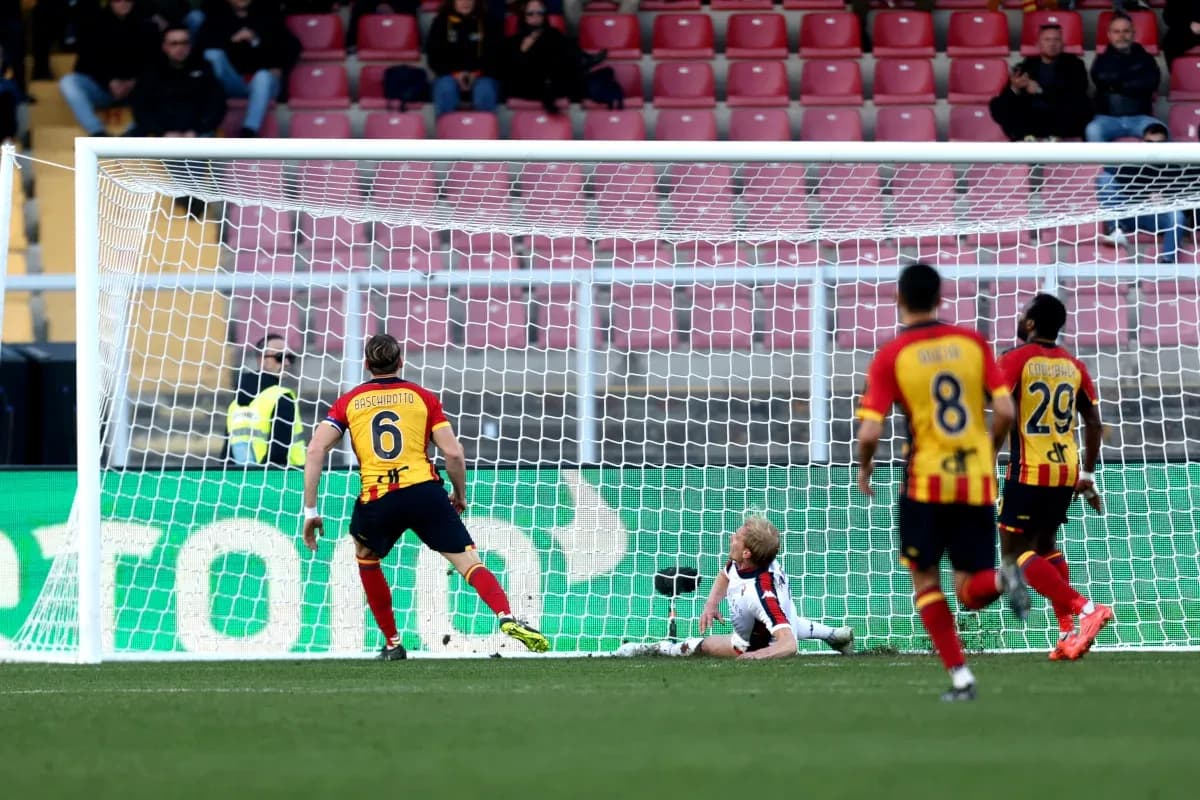
Under the floodlights of Via del Mare, Lecce edged Genoa 1–0 in a tense Serie A finale that felt less like a dead rubber and more like a referendum on two survival stories. Following this result, Lecce close their 2025 campaign in 17th place on 38 points, clinging on with a goal difference of -22 (28 scored, 50 conceded). Genoa finish just ahead in 16th on 41 points, their own goal difference at -10 (41 for, 51 against).
The scoreline mirrored Lecce’s season-long identity: low-scoring, attritional, and defined by narrow margins. At home they have averaged just 0.7 goals for and 1.3 against, and the 1–0 here slotted neatly into that pattern. Genoa, meanwhile, arrived with a slightly sharper overall attack (1.1 goals for in total) but a similarly porous defence (1.3 goals against in total). This was always likely to be a game decided by whoever managed to impose their structure first.
Eusebio Di Francesco doubled down on Lecce’s familiar 4-2-3-1, the system they have used 22 times this season, and it gave the hosts a recognisable skeleton: Wladimiro Falcone in goal, a back four anchored by Danilo Veiga and A. Gallo on the flanks, with J. Siebert and Tiago Gabriel inside. In front, Ylber Ramadani and O. Ngom formed the double pivot, freeing a line of three – S. Pierotti, L. Coulibaly, Lameck Banda – behind lone forward W. Cheddira.
Daniele De Rossi answered with a 3-5-1-1, one of many shapes Genoa have cycled through this season, but here tailored to protect a stretched squad. N. Leali sat behind a back three of A. Marcandalli, S. Otoa and N. Zatterstrom, with wing-backs S. Sabelli and A. Martin flanking a central trio of M. Frendrup, Amorim and P. Masini. M. E. Ellertsson supported L. Colombo up front.
Tactical Voids and Absences
Both sides were reshaped by who was not there as much as who was. Lecce were again without M. Berisha (thigh injury) and R. Sottil (back injury), trimming Di Francesco’s creative options from the bench and pushing more responsibility onto Banda and Coulibaly to carry the ball between lines.
Genoa’s absentees were brutal and structural. T. Baldanzi (illness), M. Cornet (muscle injury), J. Ekhator (foot injury), C. Ekuban (injury), Junior Messias (muscle injury), R. Malinovskyi (inactive), J. Onana (injury), L. Ostigard (knock) and Vitinha (suspended for yellow cards) stripped De Rossi of his primary chance-creation hubs and one of his key penalty-box threats. Without Malinovskyi’s long-range threat and set-piece delivery, Genoa’s attack lost variety; without Vitinha, Colombo had to shoulder more of the central reference work alone.
Over the season, discipline has shaped both squads’ personalities. Lecce’s card profile shows a pronounced late-game spike: 30.43% of their yellow cards arrive between 76–90 minutes, with another 13.04% from 91–105. Genoa’s bookings peak slightly earlier, with 25.40% between 61–75 minutes. This match, tight and nervy, was always likely to tilt in the final half-hour, precisely when tempers and legs fray for both sides.
Key Matchups
Hunter vs Shield
With no top-scorer table available, the attacking burden for Lecce clearly gravitated towards Banda and Cheddira. Banda’s league output – 5 goals and 4 assists in 32 appearances – underlines why Di Francesco trusted him from the left. His direct dribbling (87 attempts, 34 successful) and 24 key passes make him the natural “hunter” in this side.
His duel was not just against Genoa’s back three but specifically against their away defensive profile: on their travels, Genoa concede 1.3 goals per game, only marginally better than Lecce’s home record. The task for Marcandalli and Zatterstrom was to contain Banda’s inside cuts while Otoa tracked Cheddira’s runs in behind. With Genoa lacking the calming outlet of Malinovskyi, any turnover in their half risked immediate exposure to Banda’s pace.
On the other side, Genoa’s “hunter” role fell to Colombo, supported by Ellertsson. They were up against a Lecce defence that, at home, concedes 1.3 goals per game and has failed to keep a clean sheet in 14 of 19 matches. Yet Lecce’s defensive resilience is less about volume and more about key individuals: Veiga and Ramadani in particular.
Veiga’s numbers tell a story of a full-back who relishes confrontation: 98 tackles, 14 successful blocks and 31 interceptions over the campaign, plus 403 duels with 216 won. When Lecce were forced back into a low block, Veiga effectively became a fifth defender, stepping out aggressively to shut down crosses and half-spaces. His ability to block shots was crucial in denying Genoa’s forwards clean looks at Falcone’s goal.
Engine Room
In midfield, the game revolved around Ramadani versus Frendrup and Amorim. Ramadani has been Lecce’s metronome and enforcer: 1445 passes with 80% accuracy, 91 tackles, 11 blocked shots and 46 interceptions across 3214 minutes. He also ranks among the league’s most-booked, with 10 yellow cards, and his willingness to foul intelligently was key to disrupting Genoa’s rare surges in transition.
Opposite him, Frendrup and Amorim were tasked with giving Genoa a platform despite the absence of Malinovskyi. Their challenge was twofold: bypass Ramadani’s screen and prevent Coulibaly from stepping into pockets between the lines. When Lecce were able to connect Ramadani’s first pass to Ngom and then into Coulibaly or Pierotti, Genoa’s midfield line was forced to retreat, leaving Colombo isolated and their wing-backs pinned deep.
Statistical Prognosis and Tactical Verdict
Following this result, the numbers reinforce the narrative of two teams whose survival was built on grit rather than fluency. Lecce close the season with 10 wins, 8 draws and 20 defeats in total, scoring just 28 and conceding 50. Genoa’s final ledger reads 10 wins, 11 draws and 17 losses, with 41 scored and 51 conceded. The goal differences – -22 for Lecce and -10 for Genoa – are stark but honest.
In xG terms, this match would likely have been low-margin: Lecce’s total scoring rate of 0.7 per game and Genoa’s away rate of 1.0 suggest a narrow spread of chances. Lecce’s clean-sheet count of 10 in total hints at a side that, when the structure holds, can suffocate games. Genoa’s 9 clean sheets overall tell a similar story, but their greater attacking ambition away from home often leaves them exposed.
Tactically, Lecce’s 4-2-3-1 was vindicated. The double pivot screened effectively, the full-backs chose their moments to advance, and Banda provided the decisive incision. Genoa’s 3-5-1-1, shorn of key creative pieces, could not generate sustained pressure; the system defended zones but lacked the individual quality to unpick Lecce’s block.
The late-game discipline patterns mattered too. With Lecce so prone to late yellows (30.43% between 76–90 minutes) and Genoa spiking between 61–75 minutes (25.40%), the final half-hour was a test of composure. Lecce managed to ride that storm without a collapse, leaning on Ramadani’s game management and Veiga’s defensive timing.
In the end, the 1–0 is both a snapshot and a summary: Lecce, fragile but fiercely organised, doing just enough; Genoa, stretched by absences and tactical flux, unable to turn possession into penetration. The underlying metrics suggest that unless both squads add more cutting edge to their modest xG profiles and tighten defensive lapses, next season may bring another year of living on the edge. But on this night at Via del Mare, structure, discipline and one moment of attacking clarity were enough to tip the balance.