.svg&w=384&q=75 "Pitchgist logo")
Lazio Ends Serie A Season with 2–1 Victory Over Pisa
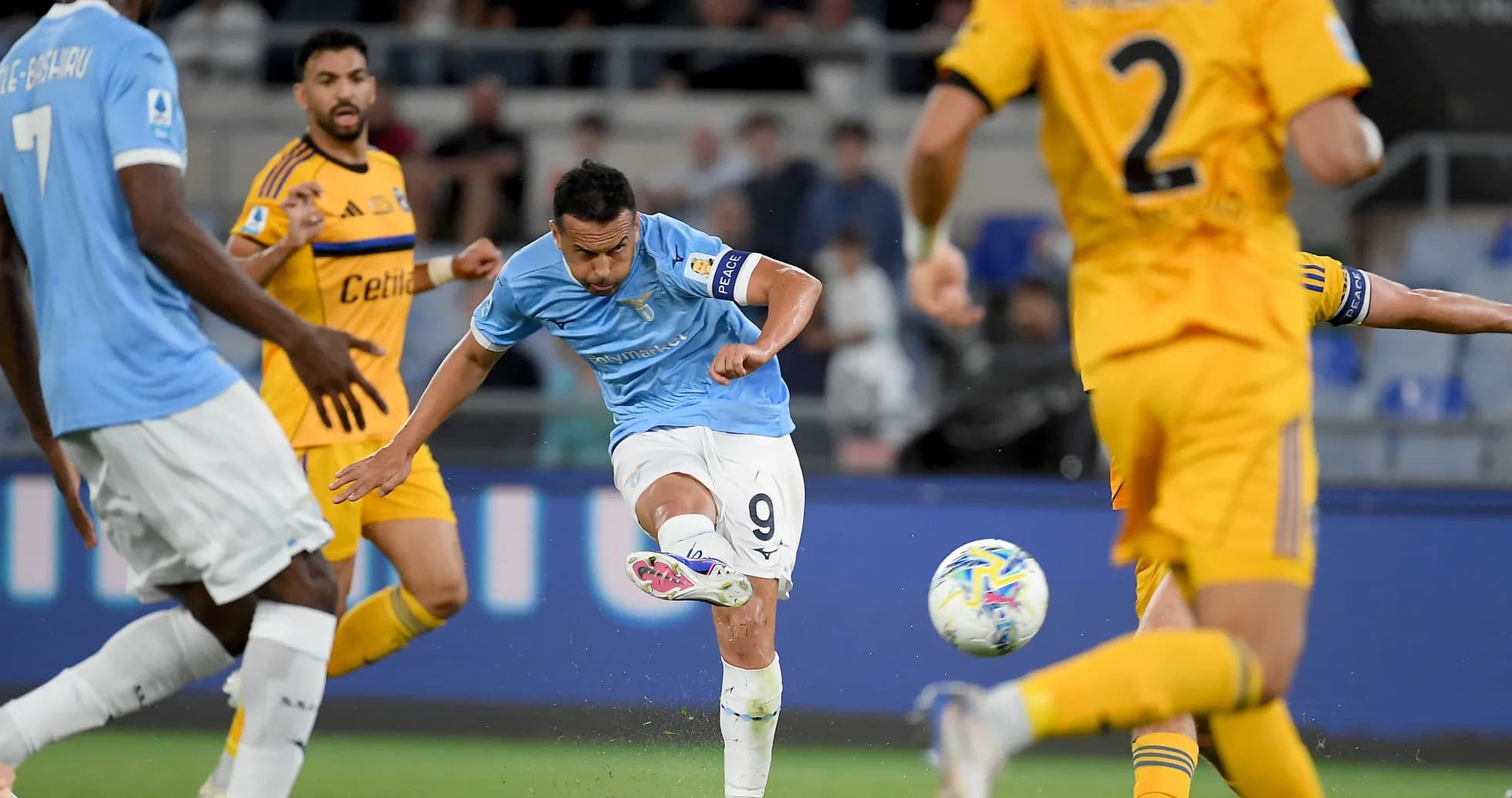
The curtain fell on Lazio’s Serie A season at the Stadio Olimpico with a 2–1 win over Pisa, a result that neatly encapsulated the campaign’s hierarchy as much as the evening’s tactical story. Following this result, Lazio closed the league in 9th place on 54 points, with a narrow overall goal difference of +1 (41 scored, 40 conceded). Pisa, already condemned to relegation, remained 20th with 18 points and a stark overall goal difference of -45 (26 scored, 71 conceded).
I. The Big Picture – A Finale in Sky Blue
The match, finished in regular time under the watch of referee Maria Sole Ferrieri Caputi, was played on familiar tactical rails. Maurizio Sarri once again trusted his preferred 4‑3‑3, a shape Lazio used in 36 of their 38 league games. Across the season at home, Lazio averaged 1.4 goals scored and 1.3 conceded, and the first half here followed that pattern: open, tilted towards their front three, but never fully secure.
Opposite, Oscar Hiljemark’s Pisa lined up in a 3‑5‑2, the system that has been their most-used structure (21 league games). On their travels, Pisa’s season-long averages told the story of a side permanently under siege: 0.9 away goals for against 2.4 conceded. A 2–1 defeat in Rome almost felt like a respectable closing note compared to the 5–0 and 3–0 collapses that had scarred their year.
The scoreboard split—2–1 to Lazio both at half-time and full-time—reflected a game where the home side’s superior structure and individual quality edged a Pisa team that nonetheless carried sporadic threat through its front two.
II. Tactical Voids – The Missing Pieces
Both managers walked into this finale with key absences that shaped their choices.
For Lazio, the spine was altered. First-choice goalkeeper I. Provedel was out with a shoulder injury, pushing A. Furlanetto into the XI between the posts. Ahead of him, A. Romagnoli—ever-present in the disciplinary charts with one red card this season—anchored the back line, but Sarri had to do without the creativity and incision of M. Zaccagni, sidelined by a knee injury, and the control of N. Rovella, suspended after a red card. N. Tavares and K. Taylor were also unavailable due to yellow-card suspensions, further thinning rotation options, particularly in wide and midfield zones. The result was a front line of Pedro, T. Noslin and M. Cancellieri, a trio more about movement and combination than pure explosiveness.
Pisa’s list of absentees was just as telling. A. Caracciolo, their defensive warhorse and one of Serie A’s leading yellow-card collectors with 10 bookings, missed out through suspension. His 24 blocked shots and 50 interceptions over the campaign had been a rare bright spot in an otherwise porous rearguard; without him, the back three of A. Calabresi, S. Canestrelli and R. Bozhinov lacked their most authoritative organiser. Further upfield, M. Marin (knee injury), M. Tramoni and F. Coppola (muscle injuries), and D. Denoon (ankle injury) stripped Hiljemark of midfield variety, while Lorran was left out by coach’s decision. It forced Pisa into a more functional, almost survivalist version of their 3‑5‑2, leaning on work rate rather than nuance.
Disciplinary tendencies also hung over the contest. Lazio’s season-long card distribution showed a clear late-game spike: 25.64% of their yellow cards and 55.56% of their reds arrived between 76–90 minutes. Pisa mirrored that late volatility in yellows—also 25.64% in the 76–90 window—while their reds tended to arrive earlier, with 40.00% between 31–45 minutes. It meant the final quarter of an hour was always likely to be tense, stretched, and one mistake away from chaos.
III. Key Matchups – Hunter vs Shield, Engine Room vs Enforcer
Without official top-scorer data, the “Hunter vs Shield” battle was defined more by profiles than numbers. Lazio’s “hunters” were the fluid front three: Pedro drifting inside from the left, Noslin operating as a mobile reference point, and Cancellieri attacking the right half-space. Their task was to probe a Pisa defence that, on their travels, had shipped 45 goals in 19 games—an away average of 2.4 conceded that framed this as an uphill battle for the visitors from the outset.
In that context, the absence of Caracciolo was enormous. Over the season he had embodied Pisa’s “Shield”: 71 tackles, 24 successful blocks, 50 interceptions, and 261 duels contested, 139 of them won. Stripped of that anchor, Canestrelli and Bozhinov were forced to step up as emergency leaders, but the gaps between the back three and the midfield line of S. Angori, I. Vural, E. Akinsanmiro, M. Aebischer and M. Leris were too often exposed by Lazio’s rotations.
The “Engine Room” duel pitted Lazio’s midfield trio of F. Dele‑Bashiru, T. Basic and R. Belahyane against Pisa’s more industrious band. Basic acted as the metronome, dropping alongside Romagnoli and Mario Gila to build, while Dele‑Bashiru’s surges from the right interior channel repeatedly forced Pisa’s midfield to turn and chase. Belahyane, on the left, offered balance and short combinations to free Pedro between the lines.
For Pisa, Aebischer was the closest thing to a conductor. His season numbers—1530 passes with 34 key passes and 65 tackles—illustrate a player asked to both build and break. Here he tried to connect the double act of S. Moreo and F. Stojilkovic to the midfield, but too often he was pinned deep, forced into firefighting duties rather than orchestrating transitions.
IV. Statistical Prognosis – xG in Disguise
There is no explicit xG data in the snapshot, but the season-long trends allow a reasonable reading of the expected balance. At home, Lazio’s overall goal profile—1.4 scored and 1.3 conceded per game—suggests a side that regularly creates enough to win but rarely kills matches off. Pisa’s away record—0 wins, 8 draws, 11 losses, with 17 scored and 45 conceded—paints the picture of a team that typically allows multiple high-quality chances.
Overlaying those patterns onto this 2–1 result, the statistical prognosis aligns neatly with the scoreboard. Lazio, with 6 home clean sheets and only 5 home defeats all season, were always likely to generate the bulk of the danger, especially against a Pisa side that failed to score in 9 away games and conceded in volume. The absence of Provedel marginally raised Lazio’s defensive risk, which helps explain Pisa finding a goal rather than being shut out, but the structural superiority of Sarri’s 4‑3‑3, combined with Pisa’s depleted back line, tilted the underlying chance creation heavily towards the hosts.
Following this result, the campaign closes with Lazio’s numbers confirming what the eye saw at the Olimpico: a side not ruthless enough to climb into the elite, but organised and incisive enough to dispatch a relegated Pisa whose defensive frailties, especially away, were simply too great to survive.