.svg&w=384&q=75 "Pitchgist logo")
Juventus Defeats Lecce 1–0: Tactical Analysis of Serie A Match
Lecce 0–1 Juventus at Stadio Ettore Giardiniero – Via del Mare was a study in territorial control and defensive management from the visitors. In a Serie A Round 36 fixture, Luciano Spalletti’s side converted an explosive start into a platform for 90 minutes of structured dominance, while Eusebio Di Francesco’s Lecce were forced into a reactive, low-possession game, looking for isolated transitions that never truly destabilised Juventus. The 1–0 scoreline reflects a match where Juventus’ control without the ball was almost as important as their work with it.
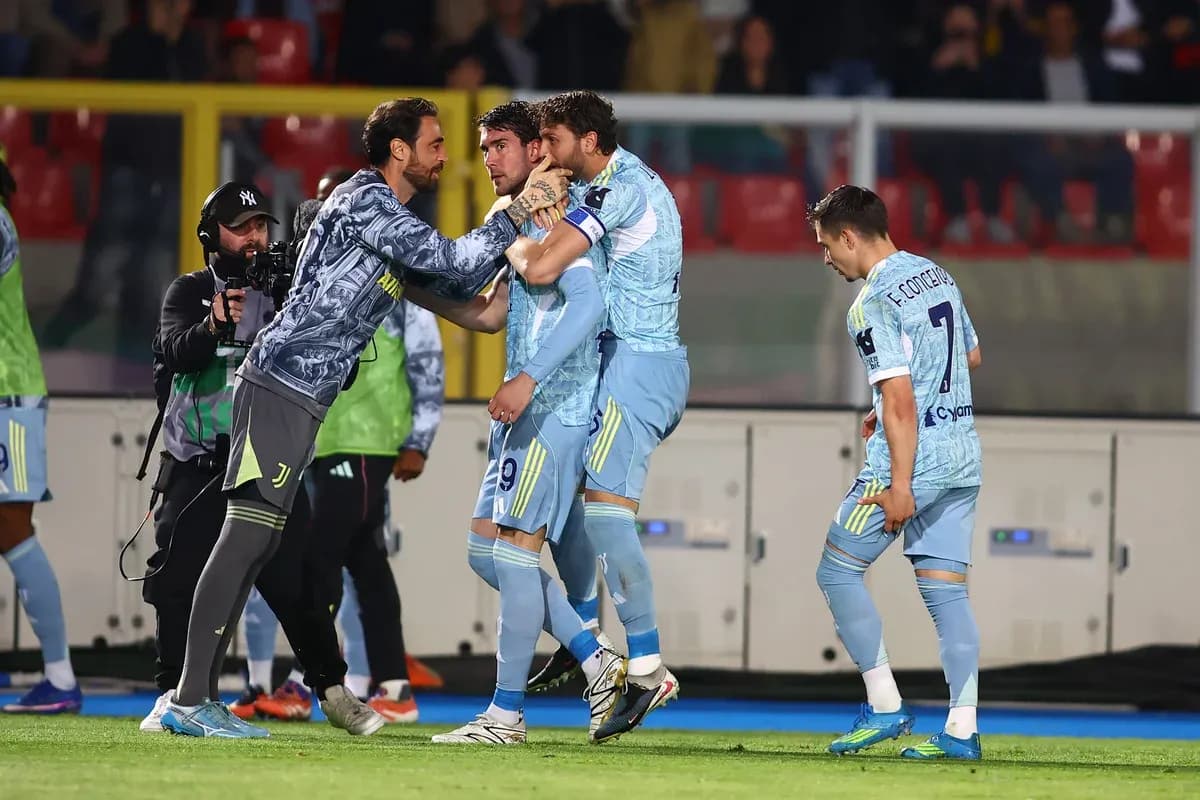
The only goal arrived immediately: at 1', D. Vlahovic finished a move assisted by A. Cambiaso, a normal goal that defined the contest. From there, Juventus thought they had twice extended their lead after the break, only for technology to intervene. At 50', a Juventus goal involving Dušan Vlahović was checked and cancelled by VAR. Again at 61', Pierre Kalulu saw another Juventus goal ruled out after a further VAR intervention. Both episodes underlined Juventus’ attacking threat and territorial pressure but kept Lecce alive on the scoreboard.
Disciplinary Incidents
Disciplinary incidents were minimal but instructive. The card log, in chronological order, is:
- 80' Francisco Conceição (Juventus) — Foul
- 82' Gaby Jean (Lecce) — Argument
That produces exact totals of: Lecce: 1 yellow, Juventus: 1 yellow, Total: 2 cards.
Substitution Patterns
The substitution pattern reflected how the tactical battle evolved. Di Francesco’s Lecce, in a 4-2-3-1, made four changes to inject energy and attacking width:
- 62' O. Ngom (OUT) — G. Jean (IN)
- 70' D. Veiga (OUT) — T. J. Helgason (IN)
- 76' W. Cheddira (OUT) — F. Camarda (IN)
- 76' L. Banda (OUT) — K. Ndri (IN)
Spalletti, also starting in a 4-2-3-1, used five substitutions to manage intensity and protect the lead:
- 77' D. Vlahovic (OUT) — E. Holm (IN)
- 83' A. Cambiaso (OUT) — J. David (IN)
- 83' K. Yildiz (OUT) — J. Boga (IN)
- 83' F. Conceicao (OUT) — E. Zhegrova (IN)
- 86' W. McKennie (OUT) — F. Gatti (IN)
By halftime, Juventus led 1–0, and despite the VAR-cancelled strikes in the second half, that scoreline held to full time.
Tactical Analysis
Tactically, Lecce’s 4-2-3-1 was designed to be compact and vertically opportunistic rather than expansive. With Y. Ramadani and O. Ngom as a double pivot ahead of a back four of D. Veiga, J. Siebert, Tiago Gabriel and A. Gallo, Lecce tried to close central lanes into T. Koopmeiners and M. Locatelli. However, their 35% possession and just 267 total passes (73% accuracy) show how rarely they were able to string sequences together. The structure often flattened into a 4-4-1-1 without the ball, with L. Banda and S. Pierotti dropping deep, leaving W. Cheddira isolated against Juventus’ centre-backs.
Juventus’ own 4-2-3-1 functioned more like a flexible 2-3-5 in settled possession. Full-backs P. Kalulu and A. Cambiaso pushed high and wide, allowing K. Yildiz and Francisco Conceição to drift into half-spaces. Locatelli anchored the midfield with Koopmeiners stepping higher, often forming a box with W. McKennie and the two wide attacking midfielders. This positional play underpinned their 65% possession and 501 passes at 86% accuracy, suffocating Lecce’s attempts to counter.
The goal at 1' was emblematic of this approach: early width from Cambiaso and an aggressive starting position from Vlahovic caught Lecce’s back line not yet fully organised. From then on, Juventus used the lead to dictate tempo, but remained aggressive in the final third. Their shot profile – 15 total shots, 14 from inside the box and only 1 from outside – shows a clear emphasis on working high-quality chances through structured occupation of the penalty area.
Lecce, by contrast, generated 8 shots, 6 inside the box and 2 from distance. Their xG of 0.88 indicates they carved out a few promising situations, but not enough volume or sustained pressure. Much of their attacking hope rested on transition runs from Banda and late arrivals from L. Coulibaly, but Juventus’ rest defence, anchored by Bremer and L. Kelly, was generally well positioned to intercept or delay.
Goalkeeper Performance
In goal, W. Falcone was central to keeping Lecce in the game. His 5 saves, combined with Juventus’ xG of 2.16 and a goals-prevented value of 0.64, underline how often he was exposed by the volume and quality of Juventus’ box entries. At the other end, M. Di Gregorio made 3 saves, with Lecce’s xG at 0.88 and the same 0.64 goals prevented figure, indicating that while Juventus conceded a few decent looks, their overall defensive structure limited the number of clear, repeatable threats.
Disciplinary Pattern
The disciplinary pattern also tells a tactical story. Juventus committed 18 fouls to Lecce’s 7, a typical profile of a team pressing higher and breaking up transitions early. Francisco Conceição’s yellow at 80' for “Foul” fits this narrative: a wide player engaging aggressively to stop a late Lecce surge. Gaby Jean’s booking at 82' for “Argument” reflects Lecce’s growing frustration as they chased an equaliser with limited possession and few clear chances.
Statistical Summary
Statistically, Juventus’ superiority is clear: more possession (65% to 35%), more total shots (15 to 8), more corners (7 to 1), and a significantly higher xG (2.16 to 0.88). Their passing volume and accuracy allowed them to control where the game was played, pinning Lecce deep and forcing Di Francesco’s side into low-block defending for long spells. Lecce’s relatively low foul count and single yellow card suggest they tried to defend positionally rather than through persistent physical disruption.
In the end, the 1–0 scoreline slightly flatters Lecce relative to the underlying numbers. Juventus created enough to win by a wider margin, but VAR interventions and W. Falcone’s shot-stopping kept the game alive. From a tactical standpoint, though, Juventus’ 4-2-3-1 structure, their dominance of central spaces, and their control of both tempo and territory made this a controlled away performance, while Lecce’s plan never quite evolved from containment into sustained attacking threat.