.svg&w=384&q=75 "Pitchgist logo")
AC Milan vs Atalanta: Tactical Analysis of a 3-2 Contest
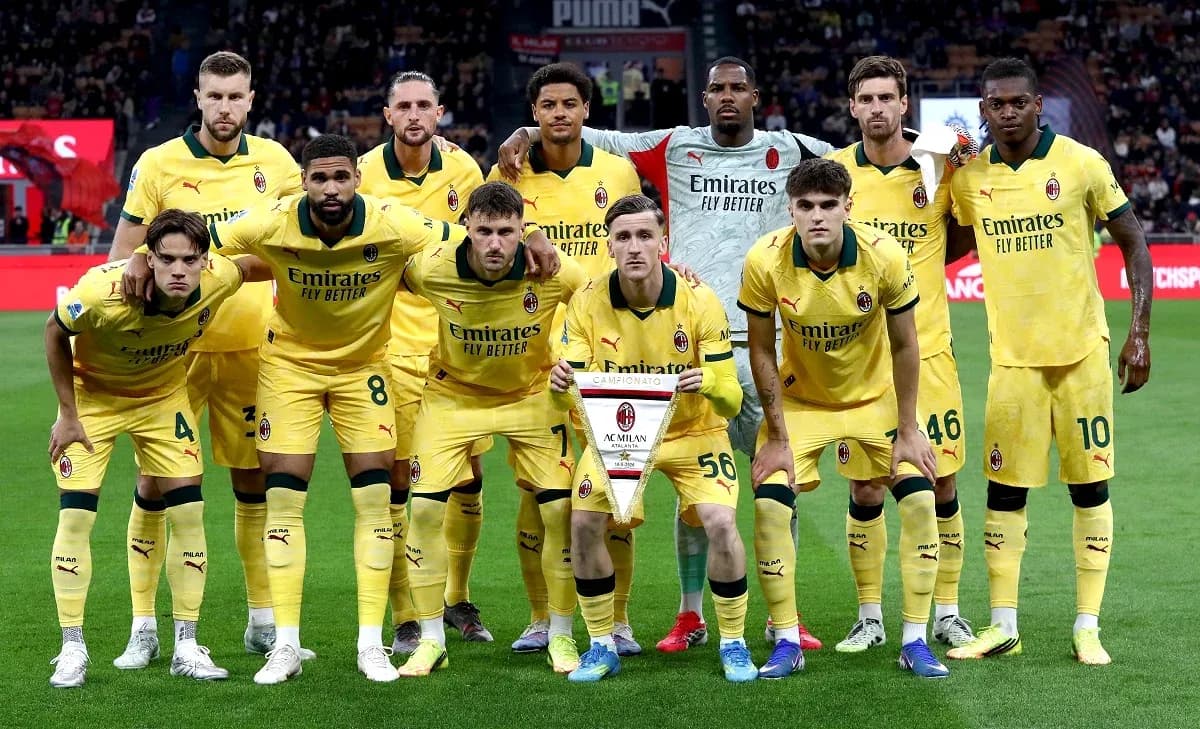
AC Milan’s 3-5-2 against Atalanta’s 3-4-2-1 produced a tactically rich contest where structure and efficiency mattered more than volume of attacks. The home side dominated possession (57% to 43%) and shot volume (20–9 in total shots, 9–5 on target), yet Atalanta’s compactness, transitions, and penalty-box clarity underpinned a 3-2 away win at Stadio Giuseppe Meazza.
Milan’s back three of Koni De Winter, Matteo Gabbia, and Strahinja Pavlovic were asked to build patiently, with Mike Maignan acting as the first distributor. The passing data underlines the approach: 541 total passes with 478 accurate (88%) points to a controlled, short-to-medium build-up. The double pivot of Samuele Ricci and Adrien Rabiot was central to that plan, Ricci as the primary organizer and Rabiot stepping higher to connect with Ruben Loftus-Cheek and the wing-backs Alexis Saelemaekers and Davide Bartesaghi.
However, Atalanta’s 3-4-2-1 was set up to punish any structural looseness. The front three of Charles De Ketelaere and Giacomo Raspadori operating off Nikola Krstovic pressed selectively rather than constantly, focusing on pressing triggers when the ball went wide or into Milan’s half-spaces. With 411 passes and 330 accurate (80%), Atalanta accepted less control but maximized verticality. Ederson and Marten De Roon were crucial: De Roon screening and shuttling laterally, Ederson breaking lines with forward runs and passes, exemplified by his involvement as a scorer and provider.
The early pattern saw Milan trying to progress through Ricci between the lines, while the wing-backs stayed relatively high to pin Atalanta’s wide midfielders Davide Zappacosta and Nicola Zalewski. Yet Atalanta’s first two goals exposed Milan’s defensive spacing in transition and wide coverage. Ederson’s opener at 7' came from Atalanta’s willingness to commit numbers quickly after regains, exploiting the gaps left when Milan’s midfield line was stretched. Zappacosta’s goal on 29', assisted by Krstovic, highlighted how Atalanta’s wing-back could arrive high and free when Milan’s far-side coverage lagged behind ball circulation.
Milan’s 0-2 deficit at half-time reflected a structural imbalance: plenty of ball but insufficient rest defense. With only eight fouls committed overall, Milan did not break Atalanta’s transitions often enough. Rafael Leão’s yellow card at 34' for “Foul” came from one of the few moments Milan tried to halt a break with physicality, but as a whole the home side were too clean in defensive transition relative to the threat.
Second Half Adjustments
Massimiliano Allegri’s in-game management after the break was an aggressive attempt to tilt the structure. The substitution at 46' of Loftus-Cheek (OUT) for Christopher Nkunku (IN) shifted Milan towards a more attacking 3-4-1-2/3-3-4 hybrid, with Nkunku offering vertical runs and penalty-box presence. Yet Atalanta struck again on 51', Raspadori finishing from an Ederson assist, a sequence that underlined Atalanta’s superior efficiency: three goals from just five shots on target and an expected goals figure of 1.08.
The subsequent triple substitution at 58' – De Winter (OUT) for Zeno Athekame (IN), Santiago Gimenez (OUT) for Niclas Füllkrug (IN), and Leão (OUT) for Youssouf Fofana (IN) – represented a structural gamble. Allegri effectively rebalanced his back line and refreshed his front two, aiming for more penalty-box occupation and more energy in midfield. Fofana’s introduction in particular suggested a desire for greater two-way presence in the middle, compensating for Loftus-Cheek’s earlier withdrawal.
On the opposite bench, Raffaele Palladino’s substitutions were primarily about maintaining defensive intensity and managing the wide zones. Zappacosta (OUT) for Raoul Bellanova (IN) at 55' and later De Ketelaere (OUT) for Mario Pasalic (IN) at 63' signaled a shift towards greater defensive security and ball retention in the second line, with Pasalic adding an extra layer of tactical discipline without sacrificing too much counterattacking threat. The null-outgoing substitution at 63' for H. Ahanor (IN) further deepened the defensive resources, reinforcing the back line for the closing phase.
The disciplinary profile of the match also reflected the tactical dynamics. Milan collected four yellow cards – Rafael Leão for “Foul” (34'), Adrien Rabiot for “Argument” (89'), Pervis Estupiñán for “Foul” (89'), and Alexis Saelemaekers for “Argument” (90') – with the late bookings illustrating rising frustration as they chased the game. Atalanta’s three yellows – Isak Hien for “Argument” (70'), Raoul Bellanova for “Foul” (90+6'), and Nikola Krstovic for “Time wasting” (90+5') – were typical of a side protecting a lead, alternating between emotional flashpoints and deliberate game management.
Late Game Developments
Milan’s late surge was structurally coherent. With Estupiñán (IN) replacing Bartesaghi (OUT) at 80', the left flank gained more thrust. Pavlovic’s 88' goal, assisted by Ricci, came from sustained pressure and superior field position, an example of how Milan’s three-at-the-back allowed a defender to attack the box when Atalanta were pinned deep. Nkunku’s 90' penalty further underlined Milan’s territorial dominance in the final phase. Yet, despite generating 1.94 xG and forcing Marco Carnesecchi into eight saves, Milan’s finishing and early defensive structure left them chasing a margin that their late tactical corrections could not fully erase.
From a statistical verdict, the contrast is stark: Milan’s higher xG (1.94 vs 1.08), more shots, and better passing accuracy highlight a side that controlled the ball and territory but paid for early structural vulnerabilities and transition defense. Atalanta, with fewer chances but equal “goals prevented” (1.1) to Milan, combined penalty-box efficiency with a disciplined 3-4-2-1 block and well-timed substitutions. The 3-2 scoreline, with Atalanta ahead 2-0 at half-time and 3-0 before Milan’s late response, reflects a match where tactical execution in the first hour outweighed late statistical dominance.