.svg&w=384&q=75 "Pitchgist logo")
HNK Hajduk Split's Tactical Mastery in 2-0 Win Over Pafos
HNK Hajduk Split’s 2-0 win over Pafos at Stadion Poljud in the UEFA Europa League 2nd Qualifying Round was a classic example of efficiency over volume. Despite having less of the ball (45% to Pafos’ 55%) and taking fewer shots (8 to 14), Hajduk controlled the key zones, managed momentum after half-time, and turned a compact 4-2-3-1 into a ruthlessly effective platform for transitions and wide overloads.
First Half
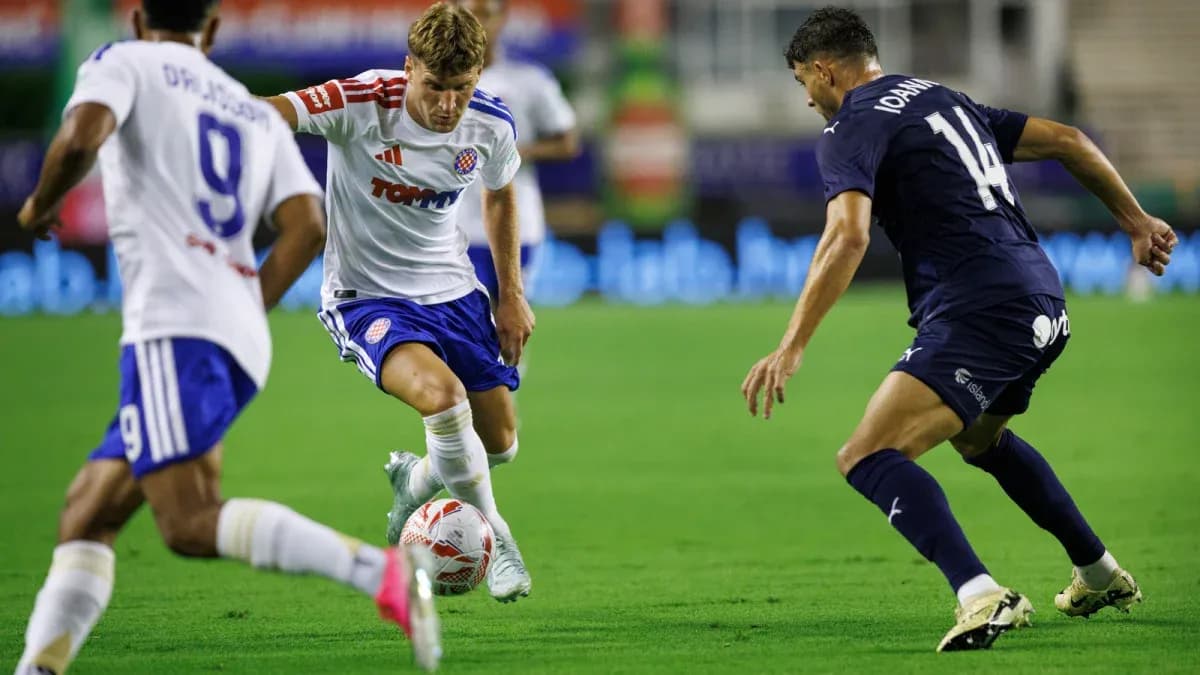
The first half, goalless at 0-0, was shaped more by structure than by chances. Hajduk’s 4-2-3-1 had a clear double pivot of R. Pukstas and Adrion Pajaziti screening the back four, with R. Brajkovic and D. de Almeida operating between the lines and wide, and D. Melnjak advancing from left-back to create asymmetry. Pafos, in a 3-4-3, tried to impose themselves through possession, building with a back three of S. Mmaee, David Luiz and D. Goldar, and wing-backs Jaja and N. Ioannou pushing high to pin Hajduk’s full-backs.
However, Pafos’ 55% possession was often sterile. Their 14 total shots and 11 shots off goal underline a tendency to be forced into low-quality attempts from distance or rushed efforts under pressure. Hajduk’s back four, with D. Maresic and A. Van Hoorenbeeck central, stayed narrow and compact, while S. Hrgovic and M. Acapandie held disciplined starting positions to prevent clean entries into the half-spaces. The early yellow card at 4' for Adrion Pajaziti (HNK Hajduk Split) — “Foul” — signalled Hajduk’s willingness to disrupt Pafos’ rhythm in midfield rather than allow them to settle into comfortable circulation.
Second Half
The game’s tactical hinge arrived immediately after the interval. At 55', Nikolas Ioannou (Pafos) was booked for “Foul”, a moment that encapsulated Pafos’ growing frustration as they tried to force play down the left. Just one minute later, at 56', the breakthrough came: M. Sego (HNK Hajduk Split) struck for 1-0. There was no registered assist, but the pattern was clear — Hajduk springing quickly once they recovered the ball, exploiting the spaces left by Pafos’ high wing-backs and the wide gaps either side of I. Sunjic and Pepe in midfield.
Pafos responded with structural changes rather than a change of approach. At 63', Bruno (IN) came on for D. Goldar (OUT), and A. Brito (IN) replaced Pepe (OUT), indicating a desire for more progressive passing and aggression in the right channel. Yet within a minute, the game tilted further away from them. At 64', Alexandre Brito (Pafos) was shown a yellow card — “Professional foul” — as he tried to halt another transition, and from that same minute D. Melnjak (HNK Hajduk Split) scored for 2-0, assisted by M. Acapandie. The left-back’s goal, fed by the right-back, perfectly illustrated Hajduk’s full-backs joining attacks in staggered fashion: one advancing to deliver, the other arriving to finish at the far side.
From a tactical lens, the 2-0 cushion allowed Hajduk to shift from proactive to reactive control. Pafos made a double substitution at 74', with D. Quina (IN) for V. Dragomir (OUT) and Guga (IN) for I. Sunjic (OUT), aiming to add creativity and vertical passing. But by then, Hajduk’s game-state management took over. On 77', three changes consolidated their shape: M. Livaja (IN) for M. Sego (OUT) refreshed the forward line with a more back-to-goal profile to hold possession; A. del Moral (IN) for D. de Almeida (OUT) added fresh legs and tactical discipline in the attacking midfield band; and M. Skelin (IN) for D. Maresic (OUT) kept the back line physically robust.
At 83', A. Guram (IN) replaced D. Melnjak (OUT), effectively locking down the left flank with a more conservative profile. The subsequent yellow cards for Adam Huram (HNK Hajduk Split) at 87' — “Foul” — and Alberto del Moral (HNK Hajduk Split) at 88' — “Professional foul” — reflect a deliberate, if risky, tactical choice: stopping Pafos’ late counters at source rather than allowing them to run into open space. The final change at 90+2', with R. Raci (IN) for S. Hrgovic (OUT), added further defensive security to see out the final moments.
Discipline and Statistics
Discipline across the match underlined the different pressures on each side. HNK Hajduk Split finished with three yellow cards (Adrion Pajaziti — “Foul” at 4'; Adam Huram — “Foul” at 87'; Alberto del Moral — “Professional foul” at 88'), while Pafos collected two (Nikolas Ioannou — “Foul” at 55'; Alexandre Brito — “Professional foul” at 64'). The timing and nature of Hajduk’s bookings were heavily game-management oriented in the final phase, whereas Pafos’ cautions came as they struggled to handle transitions and Hajduk’s runners.
Statistically, the match paints a picture of a side perfectly comfortable without territorial dominance. HNK Hajduk Split produced 8 total shots, with 6 shots off goal, 2 shots on goal and 0 blocked shots. Crucially, both of their shots on goal ended up in the net, a 100% conversion rate on target that underscores the clinical edge of their attacking patterns and the quality of their chance selection. Their 8 corner kicks also show how effectively they forced Pafos back and generated set-piece pressure, even without high shot volume.
Pafos, by contrast, generated 14 total shots, with 11 shots off goal, 3 shots on goal and 0 blocked shots. The high number of off-target efforts points to structural issues in their final-third spacing: forwards Lele and Biel often received the ball under pressure, with insufficient support between the lines, leading to rushed or low-percentage attempts. Their 7 corner kicks and majority possession suggest territorial presence, but Hajduk’s compact 4-2-3-1 and aggressive midfield screening meant many of those attacks ended in speculative efforts rather than clear chances.
Both teams recorded 0 free kicks in the statistics, which in this dataset context simply removes that metric from tactical interpretation. There were no red cards, so neither side had to adapt to numerical inferiority.
In sum, HNK Hajduk Split’s 2-0 victory was built on structural clarity, ruthless efficiency in front of goal, and intelligent in-game management once ahead. Pafos’ higher possession and shot count did not translate into scoreboard pressure, as their 3 shots on goal lacked the precision and support patterns required to break down a disciplined, well-drilled Hajduk block.