.svg&w=384&q=75 "Pitchgist logo")
Maccabi Tel Aviv Dominates Sheriff Tiraspol in 5-0 Victory
Sheriff Tiraspol’s 0-5 home defeat to Maccabi Tel Aviv at Sheriff Stadium was defined by a structural mismatch between two nominally similar 3-5-2 systems. On paper, both coaches – Victor Mihailov for Sheriff and Ronny Deila for Maccabi – mirrored each other, but in practice Maccabi’s version was far more fluid, aggressive and technically secure, turning 69% possession and a 19–10 shot advantage into total territorial control.
Sheriff’s 3-5-2 was built around a back three of Rai, Soumaila Magassouba and Baye Assane Ciss, with Mota and A. Pergjoni as nominal wing-backs and a central trio of D. Klas, Sapata and Danila Forov. Ahead of them, J. Asprilla Moreno and L. Jaures-Ulrich were asked to stretch Maccabi’s back line. The idea was clear: a compact central block, then fast vertical transitions once the ball was recovered. However, with only 31% of the ball and no recorded free-kick count advantage, Sheriff were almost permanently defending, and their wing-backs were pinned deep by Maccabi’s wide threats.
Maccabi’s 3-5-2, anchored by the back three of I. Ben Hamo, M. Camara and R. Shlomo, functioned more like a 3-2-5 in possession. R. Revivo and Sagiv Jehezkel pushed high from the defensive line, effectively forming a front five alongside S. Abu Farkhi and the advanced midfielders. The central trio of I. Sissokho, I. Shahar and I. Noy controlled rhythm and second balls, constantly recycling possession and forcing Sheriff’s midfield to defend facing their own goal. That dominance is reflected in the 12 shots on goal Maccabi generated versus Sheriff’s 6, and the total shot volume of 19–10.
First Half
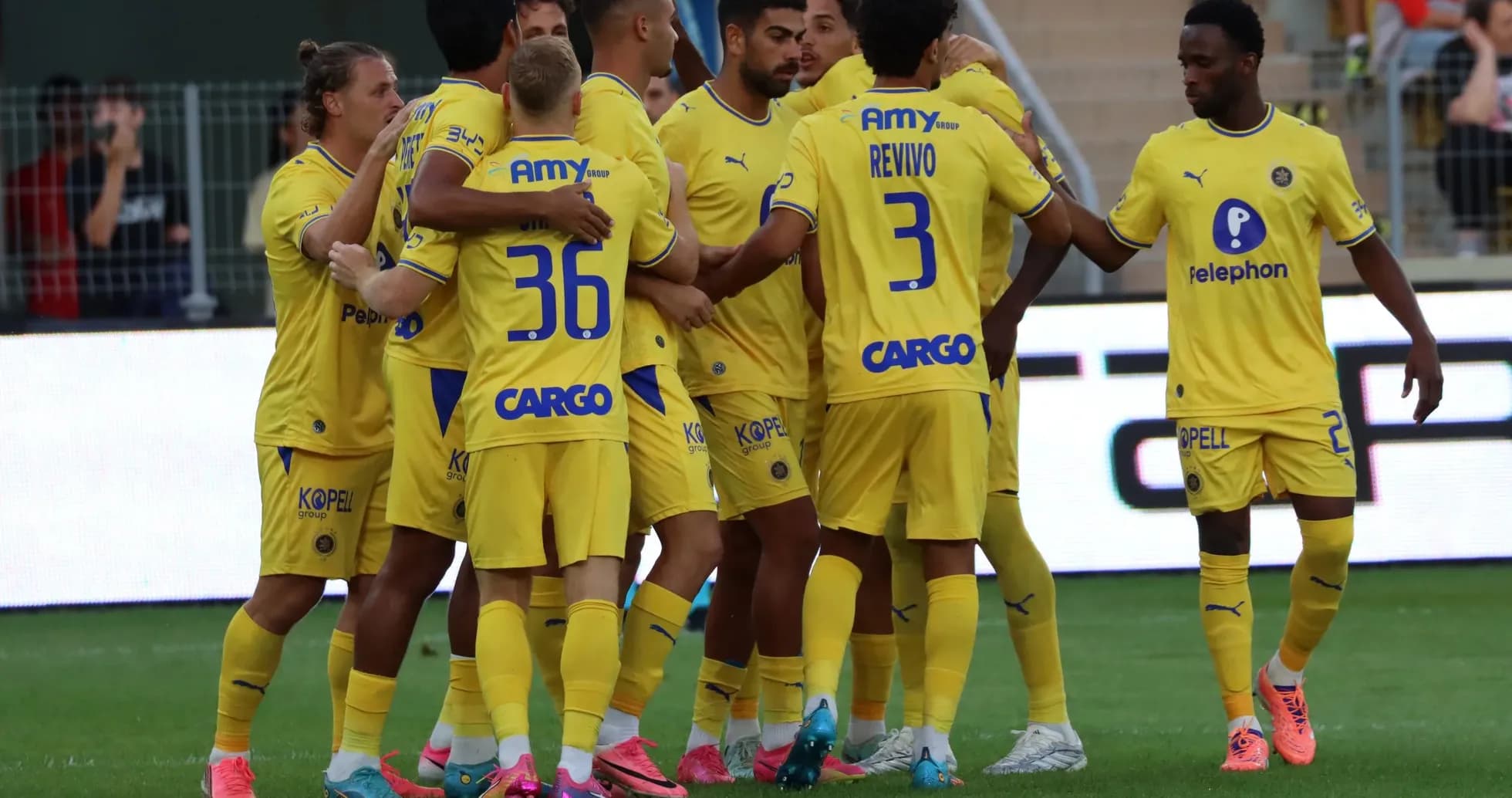
The early goal at 5', when S. Abu Farkhi finished from an I. Shahar assist, underlined a recurring tactical pattern: Maccabi exploiting the half-spaces around Sheriff’s wide centre-backs. Sheriff’s back three were repeatedly dragged out by the high positioning of Jehezkel and Revivo, and the central midfielders were too deep to apply pressure on the ball. When D. Peretz arrived from midfield to score Maccabi’s second at 29' from a Revivo assist, it was again a late run that Sheriff’s narrow block failed to track.
Mihailov’s double change at half-time – V. Fratea (IN) for Sapata (OUT) and B. Fomba (IN) for B. Ciss (OUT) – was an attempt to add legs and physicality on the flanks and in the back line. But with the structure unchanged, the issues persisted. Jehezkel’s goal at 53', again supplied by Revivo, came from Maccabi overloading Sheriff’s right side, isolating Mota and forcing the outside centre-back into wide defending he was uncomfortable with.
The flurry of Sheriff yellow cards – to Baye Assane Ciss, Miguel Mota, Soumaila Magassouba, Mamoutou Ouedraogo and Danila Forov – speaks to a team defending in emergency mode, constantly late into duels as they chased Maccabi’s circulation. Even without specific reasons listed, the volume (five yellows to Sheriff versus one to Maccabi) aligns with the visual pattern of a side overrun in midfield and resorting to reactive challenges.
Second Half
Sheriff’s substitutions on 66' – M. Ouedraogo (IN) for Mota (OUT) and S. Kone (IN) for A. Pergjoni (OUT) – further reshaped the wing corridors, but by then Maccabi had complete control of the tempo. When S. Abu Farkhi converted a penalty at 74' to make it four, and I. Sissokho added a fifth at 78', they were the logical outcome of sustained pressure rather than isolated moments. Sheriff’s final change, J. Modelo (IN) for L. Jaures-Ulrich (OUT) at 80', was damage limitation rather than a genuine tactical pivot.
On the Maccabi side, Deila managed the game intelligently once the contest was effectively decided. On 64', he refreshed all three central lanes at once: K. Belic (IN) for I. Shahar (OUT), H. Varela (IN) for S. Jehezkel (OUT) and O. Davida (IN) for I. Noy (OUT). Later, D. Glazer (IN) entered at 72', and T. Asante (IN) replaced I. Ben Hamo (OUT) at 80'. These changes maintained intensity in the press and ensured that the 3-5-2 shape never sagged into passive defending, even at 3-0 and beyond.
Although individual goalkeeper statistics are not provided, the team shooting data allows a clear inference about territorial dynamics. Maccabi’s 12 shots on goal from 19 total attempts show a high proportion of efforts testing the goalkeeper, indicating that their attacks progressed into high-quality central zones. Sheriff’s 6 shots on goal from 10 total were largely sporadic counters and isolated breaks rather than sustained pressure; the lack of blocked shots for either team suggests that most attempts reached the goal frame rather than being smothered by defenders, another sign of the open lanes Maccabi were able to create in the final third.
Set-piece dynamics slightly favored Maccabi as well, with 5 corner kicks to Sheriff’s 4. But the real dividing line was open-play control: with nearly 70% of the ball, Maccabi’s 3-5-2 acted as a possession platform, their back three rarely under direct pressure and their midfield constantly offering angles. Sheriff’s 3-5-2, by contrast, collapsed into a 5-3-2 for long stretches, with the front two isolated and the midfield screen unable to step out to contest passes into the half-spaces.
In statistical terms, the 0-5 scoreline is fully supported by the underlying numbers. Maccabi out-shot Sheriff 19–10, more than doubled them in shots on goal (12–6), dominated possession 69% to 31%, and incurred only one yellow card compared to Sheriff’s five. The lack of recorded red cards or blocked shots emphasizes that this was less about chaotic, box-heavy defending and more about a systematic inability from Sheriff to disrupt Maccabi’s structured, multi-lane attacking patterns. From a tactical standpoint, it was a comprehensive demonstration of how a well-drilled 3-5-2 can dismantle a mirror shape that lacks comparable cohesion and ball security.