.svg&w=384&q=75 "Pitchgist logo")
Beşiktaş Dominates FC Midtjylland in UEFA Europa League
Beşiktaş’s 1-0 win over FC Midtjylland at Tüpraş Stadyumu was a clinic in territorial control and structured dominance, even if the scoreline stayed narrow. In this UEFA Europa League 2nd Qualifying Round tie, Vincenzo Italiano’s 4-1-4-1 imposed itself from the opening minutes, pinning Mike Tullberg’s 4-3-3 deep and turning the game into a half-court attack. The numbers underline the imbalance: Beşiktaş had 75% possession, 28 total shots to Midtjylland’s 5, and an enormous passing volume advantage (685 passes to 237), yet had to protect a single-goal lead for over an hour after O. Kokcu’s first-half strike.
Structurally, Beşiktaş’s 4-1-4-1 functioned almost like a 2-3-5 in sustained possession. The back four of M. Murillo, T. Djalo, E. Topcu and R. Yilmaz were rarely stretched defensively and could hold a high line, with S. Ozcan anchoring in front as the single pivot. His role was pivotal in circulation: Beşiktaş completed 606 accurate passes from 685 total, reflecting clean progression through the thirds. With 15 shots inside the box and 13 from outside, the hosts varied their shot profile, patiently working central overloads around the edge of the area and then attacking the half-spaces.
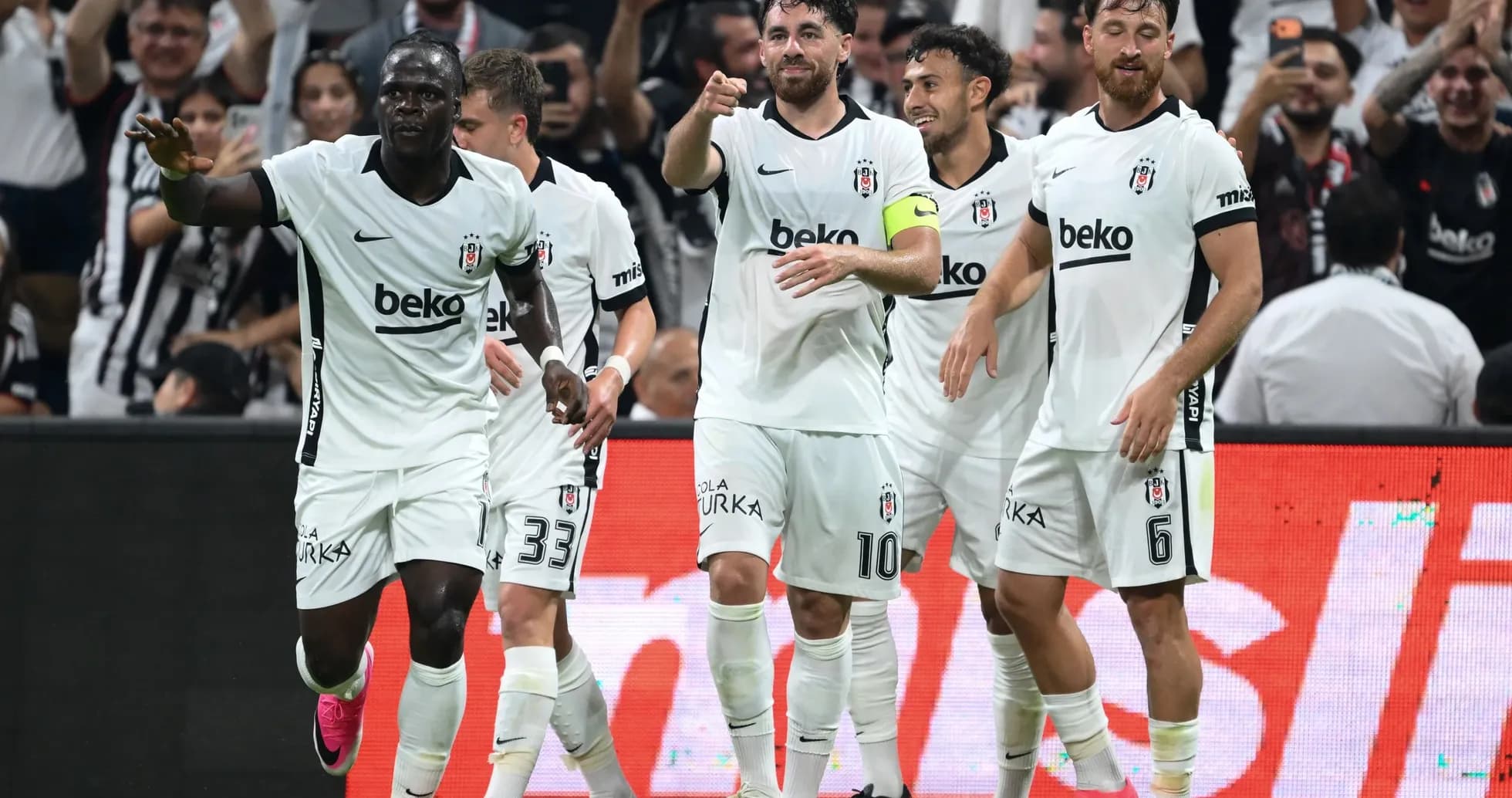
The advanced midfield line of V. Cerny, J. Olaitan, O. Kokcu and I. Fakili constantly rotated between the lines. Cerny, starting nominally on the right, was crucial as a creative outlet, providing the assist for Kokcu’s 26th-minute goal. That combination typified Beşiktaş’s plan: stretch the pitch horizontally with wide positioning, then attack the interior channel with late runs from Kokcu and Olaitan. Oh Hyeon-Gyu, as the lone forward, occupied both centre-backs, creating the space for those second-line arrivals rather than simply acting as the primary finisher.
The early red card to Friday Etim on 15 minutes fundamentally reshaped Midtjylland’s tactical posture. Reduced to ten, Tullberg’s side had to abandon most of their 4-3-3’s pressing intentions and drop into a deep, compact block. With only 25% possession and a mere 237 total passes (146 accurate), they simply could not build sustained attacks. Their 5 total shots, with only 3 inside the box and 2 from range, show how rarely they escaped pressure. Instead, the game became about survival, defensive organization, and transitional hope rather than structured attacking play.
In that context, the goalkeeping performances were defined more by concentration than volume. A. Nubel (Beşiktaş) faced just 1 shot on goal and made 1 save, reflecting how thoroughly his outfield teammates controlled territory and limited Midtjylland’s access to the penalty area. E. Olafsson (FC Midtjylland), by contrast, was under siege: Beşiktaş produced 7 shots on goal, and Olafsson made 6 saves to keep the scoreline respectable. His shot-stopping, supported by 3 blocked shots from his defenders, prevented the tie from effectively ending in the first leg.
Beşiktaş’s shot map, inferred from the statistics, speaks to sustained pressure: 28 total shots, 16 off target, 7 on target, and 5 blocked. The high volume, especially the 15 efforts from inside the box, suggests that Italiano’s side consistently reached good positions but lacked clinical edge. Some of that inefficiency can be linked to Midtjylland’s compactness after the red card; with an extra player, Beşiktaş often faced a crowded penalty area and had to shoot through traffic. The 5 blocked efforts underline how often the visitors got bodies in the way.
Midtjylland’s attacking pattern was almost entirely reactive. With 5 total shots (1 on goal, 1 off target, 3 blocked) and only 2 corner kicks, they rarely established any sustained presence in the Beşiktaş third. The midfield trio of P. Billing, P. Bravo and V. Byskov (later replaced by D. Castillo) spent most of the night shuttling laterally, trying to close passing lanes rather than initiating play. Fouls were relatively balanced (12 by Beşiktaş, 9 by Midtjylland), but the visitors’ single red card was the decisive disciplinary moment, forcing them into a low block that conceded territory but limited the damage on the scoreboard.
Set-piece data further illustrates the dynamic. Beşiktaş earned 5 corner kicks to Midtjylland’s 2, consistent with the home side’s territorial dominance and repeated entries into the final third. Free kicks were close (9 for Beşiktaş, 12 for Midtjylland), hinting that while Beşiktaş controlled the ball, they still had to counterpress aggressively when it was lost, occasionally conceding fouls to prevent transitions.
From a game-management perspective, Italiano’s substitutions were about maintaining intensity and balance in a match that could easily have drifted into sterile dominance. The changes around the hour and into the final quarter-hour refreshed both the midfield and back line, ensuring that Beşiktaş could continue to defend high and recycle attacks without exposing themselves to rare but dangerous counters. Tullberg’s substitutions, by contrast, were largely damage limitation and structural repair after going down to ten men, trying to inject legs and discipline into a side doing far more defensive work than planned.
Overall, this was a tactically controlled, if not ruthlessly efficient, home performance. Beşiktaş’s 75% possession, massive passing superiority, and 28-5 shot advantage tell the story of a side that imposed its structure and tempo. Midtjylland’s resilience, anchored by Olafsson’s 6 saves and a compact block, kept the tie alive, but the underlying tactical and statistical balance points clearly to Beşiktaş as the side dictating terms throughout the 90 minutes at Tüpraş Stadyumu.