.svg&w=384&q=75 "Pitchgist logo")
Guardiola's Warning for Manchester City's Rebuild
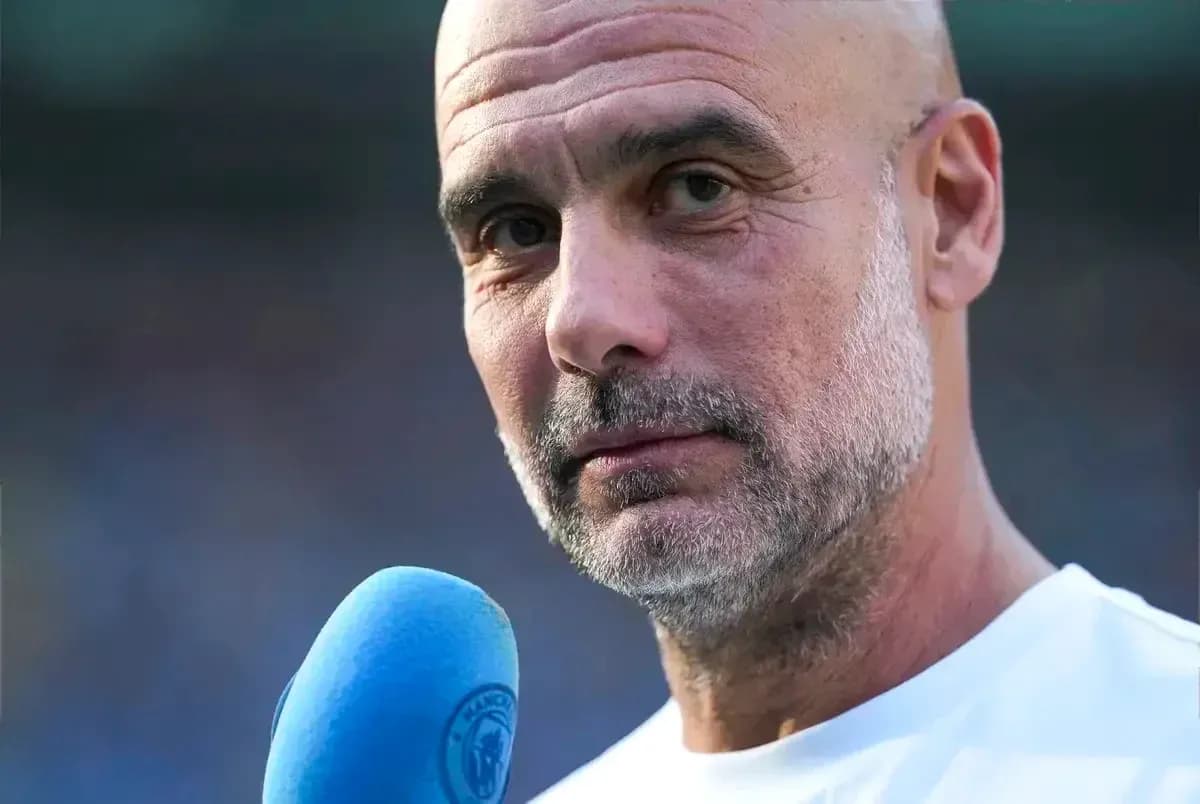
Pep Guardiola has never been one for gentle euphemisms. Not as a coach, and certainly not now as a decorated former Manchester City manager watching a new era take shape from a distance.
So when he offers advice to Hugo Viana and Enzo Maresca on how to build the next great City squad, it lands with the weight of a man who has already climbed that mountain and lived with the scars.
Guardiola’s warning from the summit
Guardiola spent a decade at the Etihad Stadium and left with a haul that will frame the club’s modern history: four consecutive Premier League titles, three FA Cups, a first UEFA Champions League. That record gives him the rare authority to talk plainly about what comes next – and what can go wrong.
In a new interview with OKX, he stripped away the romanticism around “project squads” and long-term planning, and went straight to the uncomfortable truth facing Viana and Maresca as they oversee one of the most significant rebuilds City have attempted in recent years.
“I spoke many times with the Manchester City sporting director(s) (former) Txiki Begiristain and (current) Hugo Viana, and said, ‘Now we have a young team for the next three or four years!’” Guardiola recalled.
Then he cut the idea down in one swing.
“It’s not true. You don’t know why, but it doesn’t work. A lot of players, young players, don’t play and say, ‘I want to leave! I’m here in cold Manchester, not playing, I want to leave!’ And you have to replace those guys.”
That is the heart of his warning. The illusion of stability. The belief that assembling a core of talented youngsters automatically buys a club three or four years of continuity. In reality, at a club where competition is suffocating and standards are unforgiving, patience runs thin very quickly.
The reality of “cold Manchester”
Guardiola’s line about “cold Manchester” was more than a throwaway quip. It captured the lived experience of young players on the fringes of an elite squad: training at a world-class facility, watching the same names start every week, and wondering how many winters they are prepared to endure without playing.
For Maresca, now stepping into his first pre-season as City manager, that tension is already visible. Several players are pushing to leave in search of minutes. Others are waiting to see where they sit in the new hierarchy. Every decision he makes in these early weeks will echo into the season and beyond.
For Viana, the picture is even broader. Loans, permanent exits, contract renewals, incoming transfers – all of it must be calibrated against a simple truth Guardiola laid bare: young players who don’t play will not quietly wait their turn. Not at this level. Not at this club.
“Make as few mistakes as possible”
Guardiola’s message did not stop at the warning. It moved quickly to the demand.
“The big task is how the club, organisation, sporting director, manager, CEO, hierarchy recruit the right players you need – everyone makes mistakes, but make as few as possible. That’s the key point.”
It was classic Guardiola: process over noise, structure over impulse. The emphasis on naming Txiki Begiristain and Hugo Viana, then widening the frame to include the CEO, manager and hierarchy, underlined his view that recruitment is not a one-man show. It is a shared responsibility, and when it fails, everyone feels it.
City’s current summer only reinforces that point. Viana is not just shopping for stars; he is trying to manage a delicate ecosystem. Who leaves permanently? Who goes on loan? Who gets a new deal? Who is trusted to grow into a role, and who is moved on before frustration turns into a problem?
Every misstep costs money. More importantly, it costs time. And time is the one commodity an elite club chasing every trophy never truly has.
Evidence in the market
If Guardiola’s counsel needed a practical example, City’s record £116 million move for Elliot Anderson from Nottingham Forest offers one.
This is not the profile of a panic buy. It is the kind of transfer that suggests long-term tracking, internal alignment and a clear plan for how a player fits into the system Maresca wants to build. In other words, exactly the sort of move that fits Guardiola’s demand to “make as few mistakes as possible”.
But the signing also sharpens the edge of his warning. A big-money arrival like Anderson inevitably squeezes the pathway for others. Some young players will see opportunity in training alongside him. Others will see a door quietly closing.
That is the tension Viana must live with: strengthen the squad, raise the level, but avoid building a dressing room full of restless talent staring at the bench.
A blueprint, and a test
Strip away the nostalgia around Guardiola’s decade at City and what remains is a blunt, almost clinical blueprint for the club’s next phase.
- Do not assume a young squad guarantees stability.
- Expect players to want out if they do not play.
- Accept that recruitment mistakes are inevitable, then work relentlessly to reduce their number.
- Treat every decision as a collective act, not an isolated call from one office.
Maresca now steps into that reality. Viana is already deep in it.
The rebuild is under way. The margins are thin. And in a “cold Manchester” where young players have options and ambition, the question is no longer whether City can attract talent.
It is whether they can keep enough of the right ones long enough to build the next great team.