.svg&w=384&q=75 "Pitchgist logo")
Fiorentina vs Genoa: Tactical Stalemate in Serie A
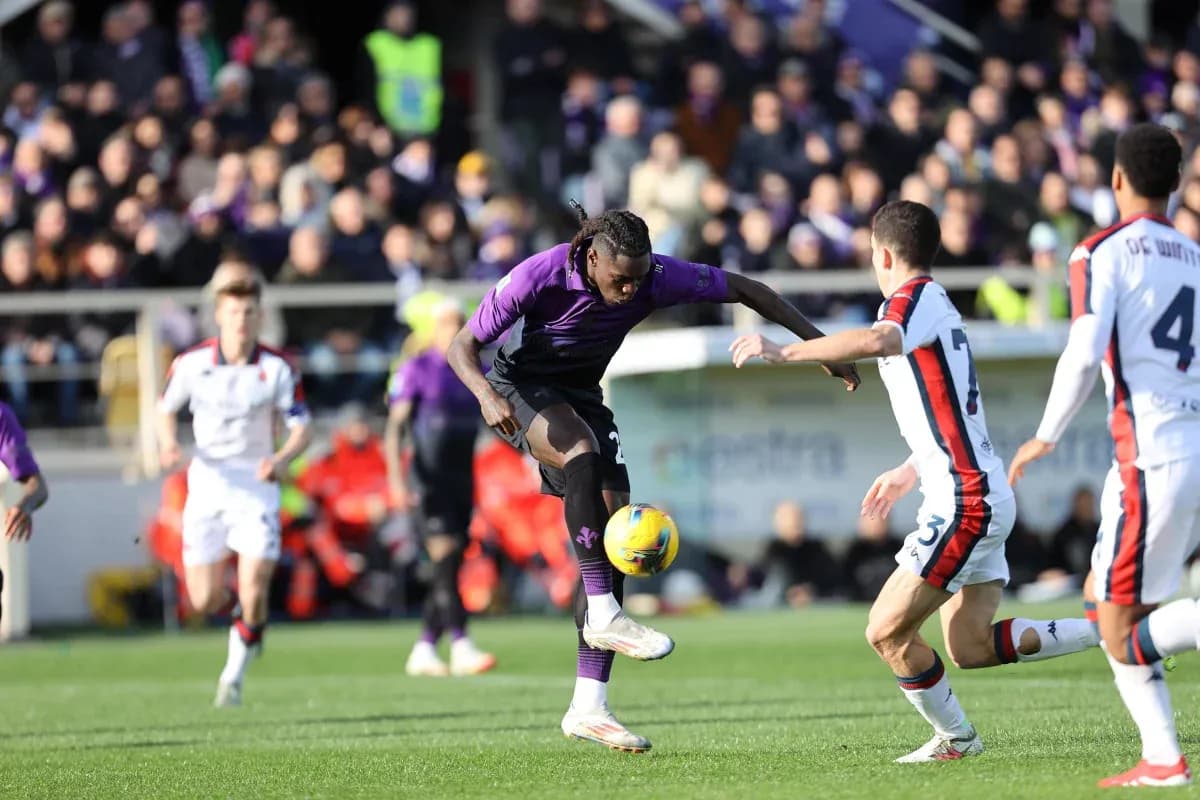
Fiorentina and Genoa played out a goalless tactical stalemate at Stadio Artemio Franchi in Round 36 of Serie A, a match defined more by structure and risk management than by penalty-box chaos. Fiorentina, under Paolo Vanoli, controlled territory and the ball, but Daniele De Rossi’s Genoa were compact, selective in their pressing, and ultimately successful in protecting their box. The 0-0 scoreline reflected a contest where Fiorentina’s 4-3-3 tried to stretch a Genoa 3-4-2-1 block, yet the hosts’ final-third execution and shot quality never truly overwhelmed a disciplined away side.
With no yellow or red cards recorded in the events or statistics, the game’s edge came from tactical duels rather than disciplinary flashpoints. Both sides committed a similar number of fouls (13 for Fiorentina, 14 for Genoa), but without escalating into bookings, which underlines how controlled and system-driven the contest remained.
Fiorentina's Tactical Setup
From the outset, Fiorentina’s 4-3-3 was geared towards territorial dominance. D. de Gea behind a back four of Dodo, M. Pongracic, L. Ranieri, and R. Gosens provided a stable platform. In midfield, R. Mandragora, N. Fagioli, and C. Ndour (before his later replacement) were tasked with dictating tempo and circulating possession, feeding a front three of F. Parisi, R. Braschi, and M. Solomon. The statistical output matches this design: Fiorentina had 57% possession, 417 total passes with 353 accurate (85%), and a clear shot volume advantage (13 total shots to Genoa’s 9).
However, the shot profile tells a more cautious story. Fiorentina managed only 1 shot on goal from those 13 attempts, with 7 off target and 5 blocked. The expected goals figure of 0.97 indicates they reached reasonable positions (9 shots inside the box), but the final actions were either rushed, blocked by Genoa’s back three, or poorly directed. Genoa’s 3-4-2-1, anchored by A. Marcandalli, L. Ostigard, and N. Zatterstrom, stayed narrow and deep, with wing-backs M. E. Ellertsson and A. Martin helping to double up in wide zones and protect the half-spaces where Fiorentina’s interior forwards tried to receive.
Genoa's Approach
Genoa’s approach with the ball was more direct and selective. With 43% possession and 316 total passes (255 accurate, 81%), they accepted a lesser share of the ball but aimed to be more vertical once possession was secured. Their 9 shots included 3 on target and an xG of 0.58, suggesting fewer but slightly cleaner chances relative to volume. The front trio of J. Ekhator, Vitinha, and L. Colombo tried to exploit transitions, particularly when Fiorentina’s full-backs advanced simultaneously.
Substitution Patterns
The substitution pattern from minute 58 onward subtly reshaped both teams’ attacking intentions. At 58', Genoa made a like-for-like change up front: L. Colombo (OUT) was replaced by C. Ekuban (IN). This injected fresh running and a more physical reference point to contest Fiorentina’s centre-backs and hold up counterattacks.
Fiorentina responded at 61' with a key attacking swap: R. Braschi (OUT) made way for R. Piccoli (IN). This altered the dynamics in the final third, giving Fiorentina a more traditional penalty-box presence. Piccoli’s introduction was aimed at attacking crosses and second balls, logical given Genoa’s compact central block and Fiorentina’s reliance on wide service from Gosens and Dodo.
Genoa then adjusted their second line at 71', making a double change. J. Ekhator (OUT) was replaced by R. Malinovskyi (IN), adding a long-range shooting threat and improved set-piece delivery, while A. Martin (OUT) came off for W. L. Ouedraogo (IN), refreshing the left flank defensively and athletically. These moves suggested De Rossi wanted more control over second balls and a better outlet for counters, while maintaining the integrity of the 3-4-2-1 structure.
Fiorentina’s midfield was refreshed at 72' and 73'. R. Mandragora (OUT) was replaced by M. Brescianini (IN), and C. Ndour (OUT) made way for G. Fabbian (IN). Both substitutions indicated a push for more forward runs and late arrivals into the box from midfield. With Genoa increasingly content to sit deep, Fiorentina tried to add dynamism between the lines and from the edge of the area, but Genoa’s block continued to force shots into crowded zones—explaining the high number of blocked efforts.
At 82', Genoa made a decisive defensive and midfield refresh: A. Marcandalli (OUT) was replaced by M. Doucoure (IN) in the back line, and Amorim (OUT) came off for P. Masini (IN) in midfield. These changes consolidated Genoa’s capacity to defend the box and maintain work-rate in front of the defence as Fiorentina pushed late.
Fiorentina’s final roll of the dice came at 86', when F. Parisi (OUT) was replaced by A. Gudmundsson (IN). This was a clear attacking tilt, introducing a more creative, goal-oriented profile to operate either from wide or as a second striker around Piccoli. Yet Genoa, with fresh legs in defence and midfield, held firm, helped by the fact that J. Bijlow was never forced into a save; Fiorentina’s only shot on target lacked the power or placement to trouble him.
Defensive Analysis
Defensively, Fiorentina’s structure was sound. D. de Gea made 3 saves, matching Genoa’s 3 shots on goal, and with Genoa’s xG at 0.58 and goals prevented listed as 0 for both keepers, the data suggests he dealt competently with what came his way without needing extraordinary interventions. Genoa’s deeper block meant Bijlow registered 0 saves, a testament not to Fiorentina’s lack of pressure but to Genoa’s effective shot suppression inside the box.
Overall Match Statistics
Statistically, Fiorentina’s Overall Form in this match leans towards control without incision: more possession, more shots, more corners (4 vs 3), but a marginally higher xG that still stayed under 1.0. Genoa’s Defensive Index for the day is strong: limiting a home side with 57% possession to a single shot on target, no goals, and forcing a high block rate on attempts. In the end, the 0-0 reflects a contest where Fiorentina’s structural dominance could not be converted into clear chances, and Genoa’s disciplined 3-4-2-1, aided by well-timed substitutions, executed an away game plan built on compactness and selective attacking.