.svg&w=384&q=75 "Pitchgist logo")
Dembélé Shines as France Defeats Norway 4-1
The posters sold one story. The night delivered another.
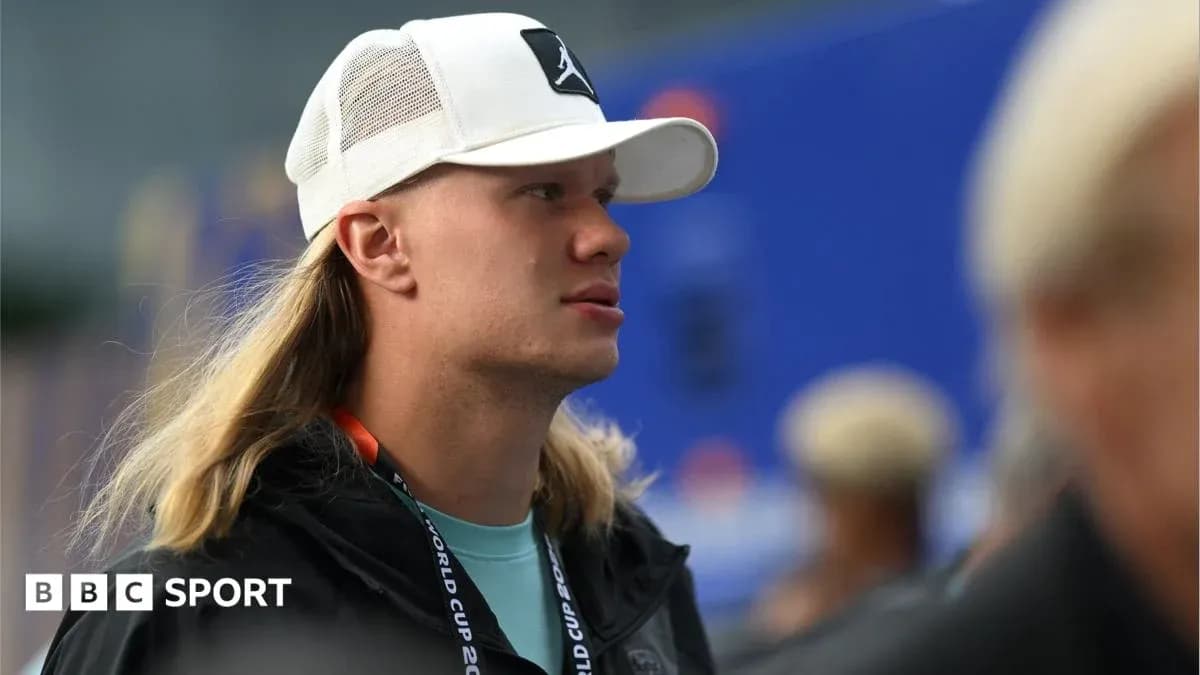
This was supposed to be Kylian Mbappé against Erling Haaland, a World Cup Golden Boot duel under the lights at Boston Stadium. Instead, Haaland sat in a tracksuit, Mbappé rattled the bar in the opening minute, and Ousmane Dembélé tore the script to shreds.
By half-time, the Ballon d'Or winner had a 25-minute hat-trick, France were cruising, and Norway’s gamble on rotation looked like a very public roll of the dice gone wrong. Les Bleus strolled to a 4-1 win and a perfect three-from-three in Group I. The marquee showdown never really happened.
Dembélé takes centre stage
The warning came early. Mbappé, given room on the edge of the box inside 60 seconds, crashed a fierce effort off the underside of the bar. Norway escaped, but only briefly. With Haaland watching on, Dembélé sensed space, sensed uncertainty, and went to work.
France had loaded the pitch with attacking talent, the sort of front line they hope will carry them all the way to New Jersey on 19 July. Norway, already through, had chosen this moment to turn the dial almost all the way down. Ten changes. Haaland out. Martin Ødegaard out. Rhythm, familiarity, threat – all heavily diluted.
“A no-brainer,” Ståle Solbakken called it, explaining that the medical and fitness data, and the players themselves, had pushed him towards mass rotation. The only hesitation, he admitted, came from knowing what the fans had travelled to see.
They saw Dembélé instead, gliding into pockets, punishing a makeshift back line that never quite got to grips with France’s movement. Once the first goal went in, the pattern felt set. France moved the ball with a swagger; Norway chased shadows and looked for footholds that never really arrived.
The pressure finally told, again and again. Dembélé filled his boots, his hat-trick wrapped up before the break, the contest effectively over while Haaland still waited for his first touch.
Haaland rests, Norway pay the price
The decision to rest Haaland was always going to dominate the post-match debate. Four goals in his first two group games, the face of Norway’s new era, and suddenly he’s on the bench for the biggest name on the schedule.
“If Erling Haaland needs a rest for the latter stages of the tournament he will take that,” Ian Wright had said on ITV Sport before kick-off, trying to frame the logic. Norway were already through. The knockouts awaited. Why risk the star?
Haaland himself had sounded almost dismissive when asked about facing France after his brace in the 3-2 win over Senegal.
“I couldn't care too much about that game now,” he said, with qualification secured. “They're probably going to win against us. They're probably going to win the whole tournament.”
Those words hung in the air as he watched from the sidelines. His stand-in, Jørgen Strand Larsen, had a huge chance to drag Norway back into it after the break, stepping up to a penalty that would have made it 3-2. He missed. Haaland stayed seated. The moment slipped away.
Wright admitted he was “surprised” by the scale of the changes, especially after Norway had gone unchanged in their wins over Iraq and Senegal. Pat Nevin, on BBC Radio 5 Live, cut to the heart of the dilemma: this is a physically brutal Norway side, built on size and intensity. Run them again at full tilt and risk injuries, or rotate heavily and accept the consequences?
“If they go and try that physical style and lose two players, was it worth it?” Nevin asked. Norway clearly decided it was not.
The cost of rotation
The decision wasn’t just about 90 minutes in Boston. It was about miles, recovery, and the map of a sprawling tournament.
France, by topping Group I, stay in the north-east. Their reward is a last-32 tie at the nearby New York New Jersey Stadium on 30 June, against the runners-up from Group F or G. Minimal travel. Maximum control.
Norway’s path looks far more punishing. Based in Greensboro, North Carolina, they now face a 1,100-mile trip to Arlington, Texas, to meet Ivory Coast on the same day. Had they topped the group, that journey would have been roughly half the distance. Win there, and they then swing back up to New Jersey for a last-16 tie on 5 July against the winners of Brazil–Japan.
“It is quite complicated,” Nevin said of the logistics. Lose to France and the distances balloon. Uproot the team, chase rest on planes rather than training pitches, and then try to be fresh enough for knockout football.
Norway’s staff clearly weighed all of that. Ten changes reflect a calculation as much as a concession. Protect the legs now, trust the squad depth, and hope the rested core can punch through the last 32.
Yet the sight of Haaland and Ødegaard sitting out a glamour tie, while thousands of Norwegian fans who had paid heavily to cross the Atlantic watched a second-string side get opened up, told its own story. There was head-scratching when the team news dropped, a sense of anti-climax. The Viking-style row celebration still broke out in the stands, but it felt like defiance as much as joy.
History’s warning – and encouragement
Norway have joined a small and curious World Cup club. They are only the fourth team to make 10 or more changes to their starting XI in a single edition.
Spain did it in 2006, rotating all 11 players against Saudi Arabia and still winning their final group game. It didn’t save them. France knocked them out 3-1 in the last 16.
Belgium offer the counterpoint. In 2018 they made 10 changes, edged Japan 3-2 in that dramatic last-16 comeback, then went on to beat Brazil 2-1 in the quarter-finals before finally falling to France. Heavy rotation didn’t derail them; it fuelled them.
Norway will cling to that precedent. Their style, as Nevin pointed out, is punishing on the body. Several players were “very affected” after 80 minutes against Senegal, Solbakken revealed, including the entire back line and one or two midfielders. Run that group again at full intensity against France’s pace and movement, and the risk of losing key men for the knockouts spikes.
Had Norway put out their “normal side”, with that forest of six-foot-four and six-foot-five athletes, Haaland among them, they would have posed a very different question. France would not have enjoyed so much space to weave their patterns and feed Dembélé. The contest would have been more bruising, more aerial, more awkward.
Instead, France were allowed to play. They did so with style, with ruthlessness, and with the clear look of a team building towards something bigger.
What now for Norway?
The numbers are simple. Beat Ivory Coast in Arlington and Norway are in the last 16, bound for New Jersey and a showdown with Brazil or Japan. Lose, and the debate over Solbakken’s selection call against France will grow teeth.
Will a rested Norway relish the challenge more than a battle-hardened one would have? Will the extra energy outweigh the loss of momentum and the sting of a heavy defeat?
France already have their answer. Three wins, top of the group, and a statement performance from Dembélé on a night that was supposed to belong to someone else. The Golden Boot storyline can wait.
Norway’s answer comes next, far from Boston, under a different sky, with no room left for calculated gambles.