.svg&w=384&q=75 "Pitchgist logo")
Pochettino's Reaction to USMNT Loss: Context Ignored
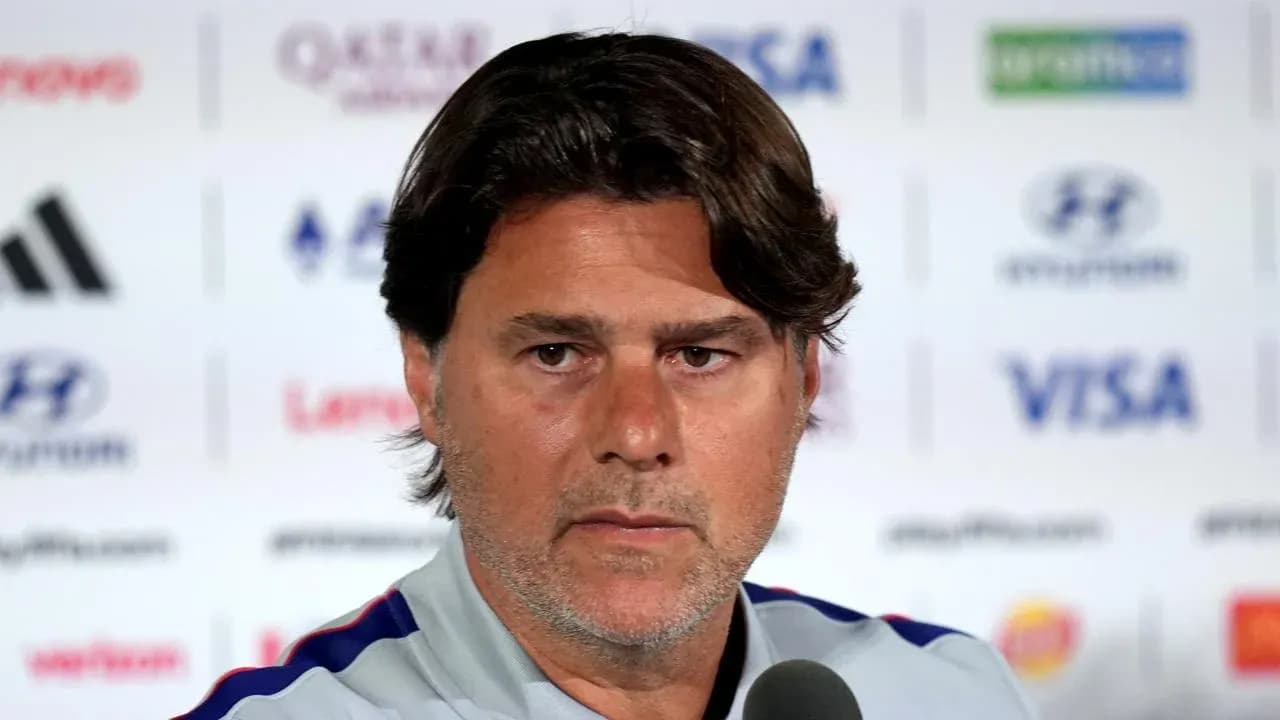
Mauricio Pochettino bristled. His team had just lost 3-2 to Turkiye, the questions were all about stumbles and momentum, and the United States had still finished top of the group.
Not one reporter had offered congratulations.
“The mood is like we [are going] home tonight and Turkey is staying,” he snapped. “I need to [remind] you and everyone that we won the group. Sorry guys, we won.”
It was classic Pochettino: thin smile, sharp edge. The former Chelsea and Spurs manager has never hidden his sensitivity to narrative, and on this night the storyline annoyed him. The defeat, yes. The tone around it, even more.
He had been pressed repeatedly on whether the loss to Turkiye signalled a dangerous dip before the World Cup knockouts. To him, the context was being ignored. The USMNT had already done the hard work. First place was secure before a ball was kicked.
And his team sheet underlined that. Pochettino had talked before the game about pushing for another win, but when the lineups dropped, the priorities were clear. Nine changes from the XI that beat Australia. A side built from the squad’s supporting cast, not its core.
If the United States had found a way to win again, it would have delivered a neat piece of history: three wins from three in the group stage for the first time ever at a World Cup. That angle didn’t impress him.
“Making history is winning the World Cup,” Pochettino said. “It’s not winning three matches only within the World Cup. I don’t really understand. It’s a little bit petty if you will — you’re thinking a little too small. You’re telling me you could make history — what does it mean to win three matches if you lose the next one?”
That is the standard he is trying to impose. Not plucky milestones. Not tidy stats. Trophies.
He pointed to Germany’s stumble earlier in the day as a warning about reading too much into one group result. The Germans, already qualified, had rolled out many of their regulars and still lost to a desperate Ecuador side fighting for survival. Full-strength or rotated, nothing is guaranteed once urgency enters the equation.
For Pochettino, the night still carried important wins beneath the scoreline. The United States, he felt, “handled the situation well” despite the defeat, not least in managing the return of Christian Pulisic.
The AC Milan forward had missed the Australia match with a calf problem after being withdrawn at half-time in the win over Paraguay. Getting him back on the pitch, back into rhythm, mattered more to the bigger picture than a perfect group record ever could.
The message from the coach was blunt. The group is won. The real judgment starts now.
Arnold’s Iraq future clouded after brutal exit
While Pochettino wrestled with perceptions of a first-place finish, Graham Arnold faced a very different reality: a World Cup campaign over in ruthless fashion and a future that suddenly looks uncertain.
Iraq’s 5-0 defeat to Senegal ended their tournament and left Arnold lamenting a single moment that, in his eyes, changed everything. Rebin Sulaka’s red card in the 13th minute, with Senegal already 1-0 up, ripped the game away.
“The early red card was mentally tough on the players. Against a team like Senegal, mistakes are always punished,” Arnold said.
He didn’t spare his own side either. Across three matches, Iraq conceded 12 times; Arnold told his players that 9 of those goals came directly from individual errors. The numbers stung, but they also framed his central point: this was a harsh education.
“I told the players after the match that we conceded 11 goals at this World Cup, and nine came from our own individual mistakes. We have to learn from that.
“In the second half, we ran out of energy. I also made changes to give more players the chance to experience representing Iraq at the World Cup, and I take full responsibility for that.”
Group I, with France and Norway alongside Senegal, always promised to be unforgiving. Iraq were the last team to qualify, squeezed through an intercontinental playoff to reach a World Cup for the first time in 40 years. Just getting there was a seismic achievement.
“Everyone in Iraq should be proud of the fact that we made it here and we performed very well in two out of the three games,” Arnold said in Toronto.
But the heavy defeat to Senegal, the errors, and the red card now feed into a bigger question. Arnold’s contract expires at the end of the tournament, and he has already parked talks over a new deal.
“I’ve just asked them to leave it until after World Cup, then we can have a chat then,” he said on Friday.
On the horizon sits a possible reunion with the Socceroos at next year’s Asian Cup in Saudi Arabia, if he stays in charge. That decision now hangs in the balance, shaped by pride in qualification and the scars of a brutal group.
Fire in Panama camp as England loom
Elsewhere, a different kind of tension flared. Panama are already out, eliminated after back-to-back 1-0 defeats to Ghana and Croatia in Group L, but training on Friday suggested nobody is easing off.
Cecilio Waterman and Jose Luis Rodriguez clashed in a session ahead of Saturday’s game against England in New Jersey. Tempers boiled, teammates intervened. For coach Thomas Christiansen, it was exactly the sort of spark he wants.
“What happened today in training, this is a normal situation,” said Christiansen, the Danish-born former Spain international. “I would’ve liked to see these situations more often, that means the team is alive. They are willing to do a good effort... to be in the first XI for the game.
“If this happens another time, it’s a good sign that they are alive,” he added.
Panama have never taken a point at a World Cup. Five games, five defeats, including the 6-1 hammering by England in 2018 that still lingers in the memory. Now they face the same opponent again, with nothing tangible to play for except pride and a line in the record books.
“Now we have the last game against England, a good way to finish a World Cup if it goes our way,” said Christiansen, who has been in charge since 2020 but, like Arnold, is out of contract after the competition.
“I think we have made changes from the last time they faced Panama eight years ago, but we need to show it tomorrow.
“It will be a tough one but I’m thinking that the team will be able to compete and do a good game.”
No points on the board, a coach out of contract, and England waiting. For Panama, a single result could change how this entire cycle is remembered.
France win big as Deschamps mourns
France, meanwhile, produced a 4-1 win over Norway with their head coach thousands of kilometres away, mourning.
Didier Deschamps missed the match after returning home for his mother’s funeral. The players wanted to mark the occasion with black armbands, a simple visual tribute to the man who led them to a World Cup title as both captain and coach.
The French Football Federation confirmed to The Athletic that FIFA blocked the request.
Confusion deepened around a planned minute’s silence before kick-off. It had been briefed that the silence would honour Deschamps’s mother, only for the FFF to later clarify that it was instead for the victims of the Venezuelan earthquake.
On the pitch, France handled their business. Off it, the night carried a more complicated emotional weight, their coach grieving at home while his team powered on without the symbolic gesture they had hoped to make.
Group winners frustrated by the narrative, a proud underdog bruised by a heavy defeat, a squad already out still fighting each other for standards, and a giant winning under a cloud of grief — the World Cup rarely moves in straight lines.