.svg&w=384&q=75 "Pitchgist logo")
Declan Rice: The 'Freak of Nature' Facing Fitness Challenges
Aaron Cresswell calls Declan Rice “a freak of nature”. It is not a throwaway line. It is the only way a former teammate can make sense of a midfielder who seems to live on the red line and stay there.
Rice has played 360 games since the start of the 2020‑21 season. Six, sometimes seven matches a week in training terms, constant travel, constant pressure. He carried West Ham through deep European runs in 2022 and 2023, became a pillar of Gareth Southgate’s England, then walked straight into Arsenal and shouldered a title challenge and a Champions League campaign. The dial has never moved off “full tilt”.
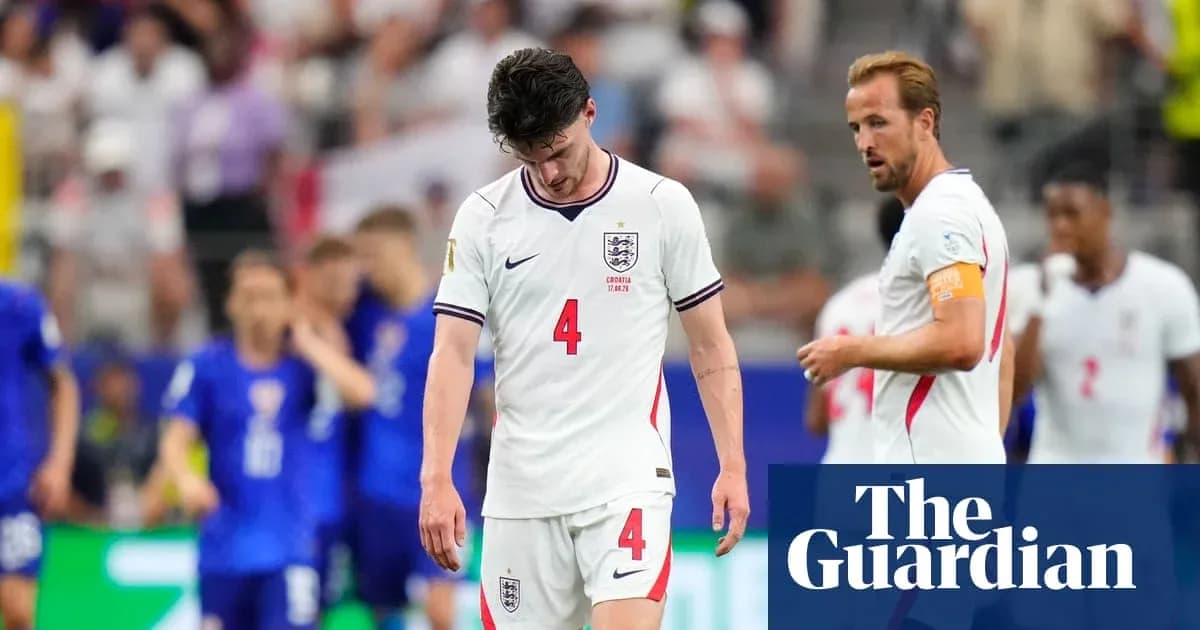
But on Wednesday night in England’s chaotic 4-2 win over Croatia, the machine finally looked human.
A rare off-night
This was Rice’s 63rd appearance of the 2025‑26 season. It showed. The 27‑year‑old did not anchor England so much as orbit around the wrong spaces. The midfield shape sagged. Gaps opened between Rice and Elliot Anderson, and Luka Modric, even at this stage of his career, did not need a second invitation.
Rice dropped too deep, then was dragged out of position. England’s first half, for all the goals and drama, carried a worrying thread: their most reliable presence in the middle of the pitch looked off balance, both tactically and physically.
Thomas Tuchel can fix structure. He will pore over the distances between his midfielders before Ghana on Tuesday, adjust the pressing triggers, redraw the lines on the training pitch. But he cannot ignore the moment that truly jarred: Rice walking off with 18 minutes to go and England clinging to a 3-2 lead.
Rice almost never comes off in that situation. He is the one managers lean on when the game becomes frantic and legs begin to go. Tuchel’s explanation was straightforward enough: discomfort in Rice’s lower back and upper hamstring, a precaution, nothing more. Rice, predictably, declared himself ready for Ghana.
England cannot simply take his word for it.
No like-for-like safety net
The question Tuchel cannot escape is brutal in its simplicity: what if this gets worse?
Even at something below full power, Rice’s absence from the heart of England’s game was glaring. Tuchel called it “some unusual ball losses” and left it there, but the bigger issue is structural. This squad has no other player who does what Rice does, at his size, with his range, and with his reliability.
Kobbie Mainoo is a wonderful technician, brave on the ball and imaginative in tight spaces, but he does not yet have Rice’s frame or his set-piece threat. Jordan Henderson remains an organiser and a leader, but at 36 he was not summoned when England needed to maintain a high tempo against Croatia. That told its own story.
Tuchel tried the obvious reshuffle when Rice went off. Jude Bellingham dropped deeper. For eight minutes, England looked one pass away from disaster. Croatia almost made them pay. The experiment did not last.
Only when Djed Spence came on for Bellingham and Reece James stepped out of right‑back did England stumble onto something that looked like a plan B.
The Reece James solution
James in midfield is no longer a wild idea. It is lived experience at Chelsea.
He played there on loan at Wigan in 2018‑19, then grew into one of the Premier League’s best right‑backs. Under Enzo Maresca, though, his role shifted. Maresca pushed him into midfield, took the early criticism, and stuck with it. The payoff was huge: James excelled in the centre of the pitch, culminating in Chelsea’s win over Paris Saint‑Germain in last year’s Club World Cup final.
Tuchel was among the early doubters. He had coached James as a full‑back at Chelsea and initially insisted he saw him only as a right‑back for England. Time – and James’s performances – changed his mind. The German now talks about James as a genuine option at No 6, and he backed that belief by leaving out Adam Wharton and Alex Scott from his World Cup squad.
The evidence is hard to argue with. James’s display against PSG was not a one‑off. He dominated midfield alongside Moisés Caicedo in Chelsea’s 3-0 dismantling of Barcelona last November, then outplayed Rice himself when Arsenal came to Stamford Bridge five days later.
He reads the game, he tackles, he passes with authority. He brings the physical presence England would lose without Rice. If Tuchel has to ration his vice‑captain’s minutes, James looks the most credible answer.
And Tuchel has built the squad around that versatility. If James steps into midfield, Spence, Ezri Konsa or Jarell Quansah can slide into right‑back. Konsa, in particular, offers the possibility of a back three with John Stones and Marc Guéhi, with Nico O’Reilly surging from left‑back and giving England a different angle of attack.
On the tactics board, it all fits neatly.
On the medical charts, it is far messier.
The fitness tightrope
James’s own body is the catch. His history of hamstring injuries is long and uncomfortable reading. The latest setback came in March and cost him almost two months of football. Chelsea have had to manage his load carefully, picking their moments, counting his minutes.
England have already lost Tino Livramento to a calf injury, with Trevoh Chalobah drafted in as cover. James is first choice at right‑back, but he cannot be asked to play every game there and then solve a crisis in midfield on top. Not at this World Cup pace. Not with his record.
Tuchel knew this tournament would be a test of durability as much as talent. He took England to Florida early for a pre‑World Cup camp in the sun, all in the name of conditioning and recovery. Yet even that plan ran into reality. Rice arrived late after playing in the Champions League final for Arsenal, rolling straight from one peak into another.
He keeps pushing to the limit. At some point, the bill arrives.
If England reach the World Cup final and Rice does not get a proper rest, he will finish the season on 70 appearances for club and country. Seventy. For a central midfielder asked to cover every blade of grass and win every duel, those are extreme numbers.
Tuchel has built an England side with Rice at its core. Now, with the tournament barely under way and the “freak of nature” finally showing signs of strain, the head coach must confront the question he hoped to avoid.
What does this team look like when the man who never stops finally has to?