.svg&w=384&q=75 "Pitchgist logo")
Crystal Palace vs Everton: Tactical Analysis of 2-2 Draw
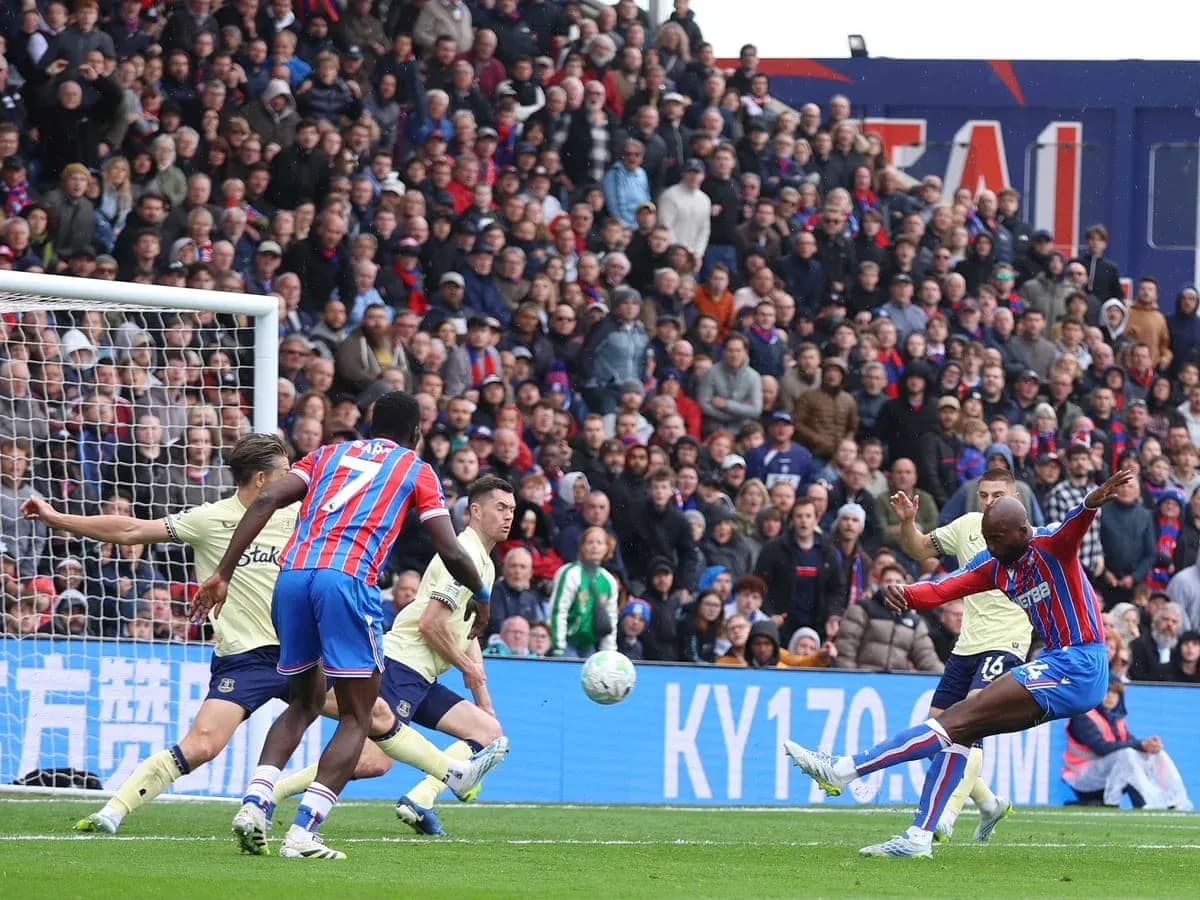
Crystal Palace and Everton played out a 2-2 draw at Selhurst Park in Round 36 of the Premier League, a match that was tactically defined by Palace’s territorial control against Everton’s direct, set-piece-heavy threat. Palace overturned an early deficit, then had to come from behind again, ultimately matching Everton’s efficiency with sustained pressure rather than clean penetration. The 59%–41% possession split, combined with a 21–13 shot count and a 2.66–1.44 xG edge in Palace’s favour, underlines a game where Oliver Glasner’s 3-4-2-1 structure largely dictated the rhythm, but Everton’s 4-2-3-1 exploited key moments, especially from James Tarkowski and Beto.
I. Executive Summary of Scoring and Discipline
The scoring opened on 6' when Everton centre-back James Tarkowski struck for the visitors, immediately validating their emphasis on early aggression and set-piece presence. Palace responded on 34', Ismaïla Sarr levelling the match and translating their mounting territorial dominance into a tangible reward. Just before the interval at 45', Vitaliy Mykolenko collected a yellow card for Everton (Foul), reflecting the strain on the away back line as Palace’s wing-backs pushed high.
Early in the second half, Everton reasserted themselves: at 47', Beto restored the visitors’ lead, assisted by Tarkowski, a pattern that highlighted Everton’s reliance on vertical deliveries and aerial superiority. Glasner’s key adjustment came on 65', when Jean Philippe Mateta (IN) came on for Jørgen Strand Larsen (OUT), a substitution that would later prove decisive. Everton responded on 70' with Thierno Barry (IN) for Beto (OUT), trading a focal target man for fresh running in behind.
Palace’s pressure told again on 77', as Mateta struck to make it 2-2, confirming the impact of Glasner’s central-forward reshuffle. On 80', Jefferson Lerma (IN) replaced Brennan Johnson (OUT) for Palace, adding midfield ballast, while Tyrique George (IN) came on for Merlin Röhl (OUT) for Everton, injecting energy into the attacking band. The final substitution came at 90+4', with Carlos Alcaraz (IN) replacing Kiernan Dewsbury-Hall (OUT) for Everton, a late tactical tweak to shore up central areas and transition threat.
Disciplinary log (cards only):
- 30' James Garner (Everton) — Foul
- 45' Vitaliy Mykolenko (Everton) — Foul
Card verification: Crystal Palace: 0, Everton: 2, Total: 2.
II. Tactical Breakdown & Personnel
Glasner’s 3-4-2-1 was built around a back three of Chris Richards, Maxence Lacroix, and Jaydee Canvot, with Dean Henderson behind them. The structure aimed to create a numerical advantage in the first line of build-up and free the wing-backs, Daniel Muñoz and Tyrick Mitchell, to push high. In possession, Adam Wharton and Daichi Kamada acted as the double pivot, with Brennan Johnson and Ismaïla Sarr operating as narrow attacking midfielders behind Jørgen Strand Larsen.
The numbers support Palace’s control: 459 passes, 382 accurate (83%), and 59% possession. Their 21 total shots, with 8 on goal and 15 inside the box, show that the system consistently delivered the ball into dangerous central areas. The 2.66 xG figure confirms that these were not speculative efforts; Palace created repeated high-quality chances. However, the need to come from behind twice indicates some inefficiency in converting pressure into a decisive lead.
Everton’s 4-2-3-1, by contrast, was more conservative in possession but sharper in key moments. Jordan Pickford’s side attempted 313 passes, 232 accurate (74%), and accepted long spells without the ball in favour of compactness and counter-attacks. The double pivot of Tim Iroegbunam and James Garner shielded the back four and tried to block central access into Kamada and Wharton. Ahead of them, Merlin Röhl, Kiernan Dewsbury-Hall, and Iliman Ndiaye supported Beto, with the plan clearly to hit the striker early and often, then play off second balls.
The early Tarkowski goal at 6' and Beto’s strike at 47' both fit that template: Everton leveraged their centre-backs’ aerial power and Beto’s presence to threaten from restarts and direct balls, rather than through sustained possession. Their 13 shots (6 on goal, 10 inside the box) and 1.44 xG show a more selective, efficiency-based approach.
Henderson’s 5 saves and Pickford’s 6 underline how open the game became, particularly as Palace chased equalisers. Notably, both keepers are credited with 1.2 goals prevented, suggesting that each made at least one high-impact intervention to keep the scoreline level. For Palace, Henderson’s shot-stopping compensated for the vulnerabilities of a high defensive line and aggressive wing-back positioning. For Everton, Pickford’s work was essential in surviving Palace’s waves of attacks, especially after Mateta’s introduction.
Substitutions were tactically coherent. Mateta for Strand Larsen at 65' shifted Palace’s focal point: Mateta is more penalty-box oriented, and his 77' goal validated Glasner’s decision to prioritise pure finishing presence. Lerma for Johnson at 80' rebalanced the side, bolstering central control to guard against counters as Palace continued to push. For Everton, Barry for Beto at 70' and George for Röhl at 80' injected pace and pressing energy into the front line, aiming to exploit the spaces behind Palace’s advancing wing-backs. Alcaraz for Dewsbury-Hall at 90+4' was a late move to secure midfield structure and transitional passing in the dying minutes.
III. The Statistical Verdict
The raw numbers underline a match where Palace’s overall form on the day, in terms of territorial and chance creation metrics, was superior: more possession, more shots, higher xG, and a strong passing platform. Everton’s defensive index, however, was robust: 13 fouls committed and 2 yellow cards (Garner and Mykolenko, both for Foul) show a willingness to disrupt rhythm, and their block and save counts, combined with 1.2 goals prevented by Pickford, kept Palace from turning dominance into victory.
Everton’s attacking efficiency—two goals from 1.44 xG and 6 shots on target—matched Palace’s output closely enough to justify the draw. Palace’s 2.66 xG and 8 shots on target suggest they had the opportunities to win, but Everton’s compact 4-2-3-1, disciplined central block, and set-piece strength ensured that, tactically, this was a contest of Palace’s structured pressure against Everton’s situational ruthlessness. The 2-2 result reflects that balance: Palace controlled more phases; Everton controlled more moments.