.svg&w=384&q=75 "Pitchgist logo")
Cremonese Dominates Pisa 3-0 in Tactical Masterclass
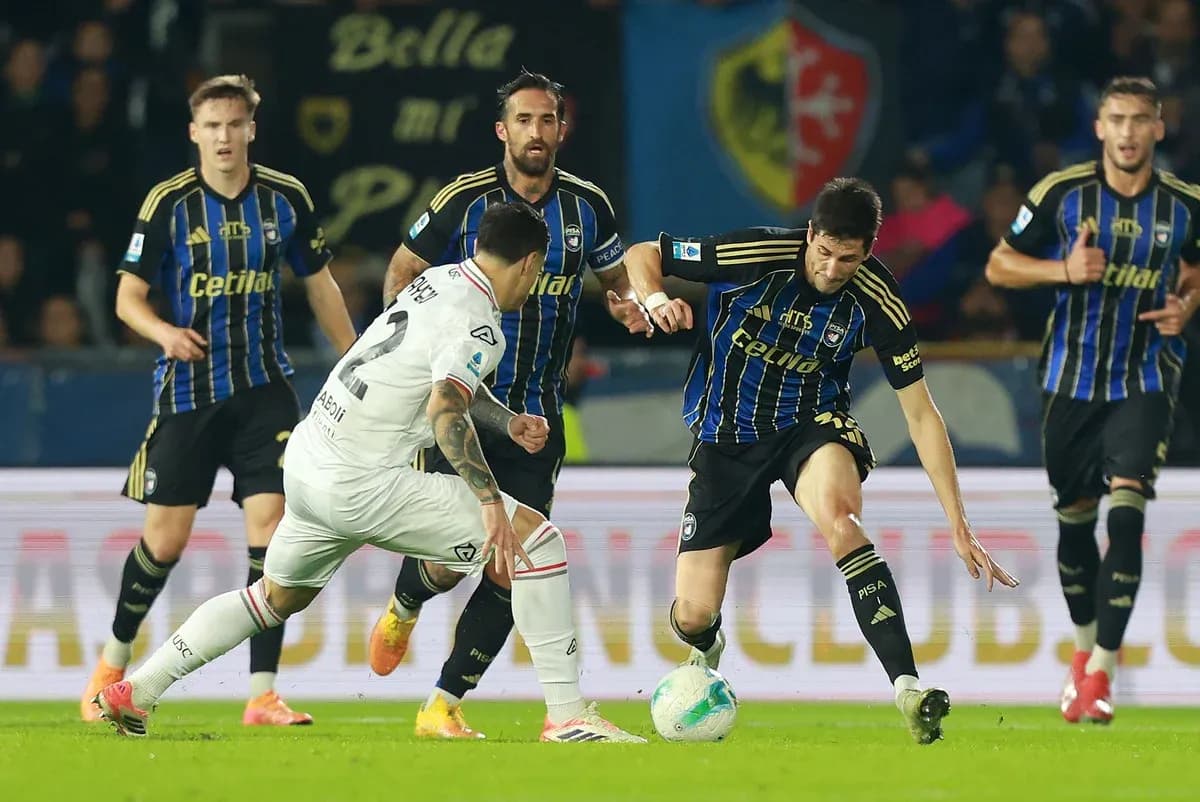
Cremonese’s 3-0 home win over Pisa at Stadio Giovanni Zini was a tactical strangling as much as a scoreline. In Serie A’s Regular Season - 36, Marco Giampaolo’s 4-4-2 imposed near-total control of territory and tempo, while Oscar Hiljemark’s 3-5-2 disintegrated under numerical inferiority and structural stress. With the score already 1-0 at half-time and Pisa reduced to ten men inside 23 minutes, the contest quickly became an exercise in game management and exploitation of width, culminating in a dominant 3-0 full-time result.
I. Scoring sequence & disciplinary log
Disciplinary events (chronological, with reasons):
- 16' Rosen Bozhinov (Pisa) — Foul
- 23' Rosen Bozhinov (Pisa) — Foul
- 23' Rosen Bozhinov (Pisa) — Foul (Red Card)
- 49' Arturo Calabresi (Pisa) — Foul
- 57' Felipe Loyola (Pisa) — Foul (Red Card)
- 89' Malthe Højlholt (Pisa) — Foul
All six cards fell to Pisa: four yellows, two of which combined into an early dismissal, and a straight red later. Cremonese finished without a single booking.
The game’s tactical hinge came from those early incidents. Bozhinov’s first yellow on 16' for “Foul” signalled Pisa’s difficulty defending wide spaces. His second yellow, again for “Foul” at 23', immediately converted into a red card, forcing Hiljemark to abandon any notion of pressing high with his back three. Down to ten, Pisa retreated into a low block, but Cremonese’s structured 4-4-2 soon broke them.
At 31', J. Vardy struck the opener for Cremonese, capitalising on the numerical advantage and sustained pressure. The 1-0 scoreline held to half-time, fully aligned with the match flow: Cremonese dominant, Pisa reactive and already compromised.
After the interval, Pisa’s attempts to stay compact were undermined by further indiscipline. Arturo Calabresi’s yellow at 49' for “Foul” arrived just as Pisa were trying to reset their shape. Two minutes later, at 51', F. Bonazzoli doubled Cremonese’s lead, finishing a move assisted by J. Vandeputte to make it 2-0 and effectively kill the contest as a contest.
Any residual hope vanished on 57', when Felipe Loyola received a red card, again with “Foul” as the explicit reason. Pisa were now down to nine, and from that point Hiljemark’s side simply tried to limit damage. Substitutions on both sides followed, but the structural imbalance remained. At 86', D. Okereke, supplied by A. Zerbin, added Cremonese’s third to complete the 3-0 scoreline. The final disciplinary note came at 89', with Malthe Højlholt booked for “Foul”, encapsulating a night where Pisa defended mostly through last-ditch interventions.
II. Tactical breakdown & personnel
Giampaolo’s 4-4-2 was textbook control through possession and width. With E. Audero in goal behind a back four of G. Pezzella, S. Luperto, M. Bianchetti and F. Terracciano, Cremonese built patiently from deep. The double pivot of A. Grassi and Y. Maleh provided circulation and cover, while wide midfielders J. Vandeputte and T. Barbieri stretched Pisa’s wing-backs horizontally. Up front, the pairing of F. Bonazzoli and J. Vardy offered complementary profiles: Vardy attacking depth and channels, Bonazzoli dropping to connect.
The numerical and structural dominance is reflected in the ball data: Cremonese had 77% possession, completing 735 passes with 684 accurate at an exceptional 93%. This volume and precision allowed them to pin Pisa’s 3-5-2 back into a de facto 5-3-1 once Bozhinov was dismissed. Pisa, by contrast, managed only 218 total passes, 161 accurate (74%), rarely escaping their own half in organised fashion.
Hiljemark’s starting 3-5-2 — A. Semper behind a back three of Rosen Bozhinov, A. Caracciolo and S. Canestrelli; a midfield line of M. Leris, I. Vural, F. Loyola, E. Akinsanmiro, I. Toure; and a front two of S. Moreo and F. Stojilkovic — was designed to contest central spaces and counter. But once reduced to ten, then nine, Pisa’s wing-backs were forced into a permanent back five, and the midfield lost any capacity to press Cremonese’s build-up.
The substitution vectors underline the tactical adjustments:
- 37' Pisa: A. Calabresi (IN) came on for S. Moreo (OUT) — a forward sacrificed to restore defensive numbers after Bozhinov’s dismissal, sliding into the back line.
- 37' Pisa: S. Angori (IN) came on for M. Leris (OUT) — another defensive-minded change, shoring up the left.
Giampaolo’s changes were about energy and maintaining width against a tiring, undermanned opponent:
- 59' Cremonese: M. Thorsby (IN) came on for Y. Maleh (OUT) — fresh legs in midfield to sustain pressure.
- 59' Cremonese: A. Zerbin (IN) came on for G. Pezzella (OUT) — an attacking switch, effectively pushing even more numbers forward against nine men.
- 72' Cremonese: A. Sanabria (IN) came on for J. Vardy (OUT) — like-for-like to keep depth running.
- 72' Cremonese: D. Okereke (IN) came on for J. Vandeputte (OUT) — more direct threat from wide/half-spaces, later rewarded with the 3-0 goal.
- 85' Cremonese: F. Folino (IN) came on for S. Luperto (OUT) — rotation at the back with the game secure.
Pisa’s later changes — M. Højlholt for I. Vural at 65', H. Meister for F. Stojilkovic at 65', E. Akinsanmiro off for G. Piccinini at 72' — were largely damage-limitation and fresh legs in a deep block, but they never altered the flow.
Goalkeeper reality was telling. A. Semper made 2 saves for Pisa, but the underlying figures show he was constantly exposed: Cremonese produced 6 shots on goal from 10 total shots, with an xG of 1.15. E. Audero, by contrast, did not register a single save because Pisa failed to record any shot — 0 total shots, 0 on target, 0 inside or outside the box. Cremonese’s defensive structure, aided by numerical superiority, completely smothered any attacking threat.
III. The statistical verdict
The statistical profile confirms the tactical story. Cremonese’s Overall Form on the day was one of controlled aggression: 10 shots, 6 on target, 7 corners, and 77% possession, underpinned by 735 passes, 684 accurate (93%). Their xG of 1.15 suggests clinical finishing and exploitation of a broken opponent rather than sheer volume of chances, but the territorial dominance was absolute.
Pisa’s Defensive Index collapsed under the weight of indiscipline. They conceded 3 goals from an xG against of 1.15, with 12 fouls, 4 yellow cards and 2 red cards, and just 1 corner of their own. Their offensive metrics — 0 shots, 0 xG — underline a side that never managed to translate defensive suffering into counter-attacking threat, especially after dropping to nine men.
In sum, Cremonese’s 4-4-2, built on high passing accuracy and wide overloads, systematically dismantled a Pisa team whose 3-5-2 was first stretched, then undermanned, and finally reduced to pure resistance. The 3-0 scoreline, with Cremonese’s goals at 31', 51' and 86', was the logical endpoint of a match where structure, discipline, and possession all pointed in one direction.