.svg&w=384&q=75 "Pitchgist logo")
Como Edges Hellas Verona in Tactical Battle
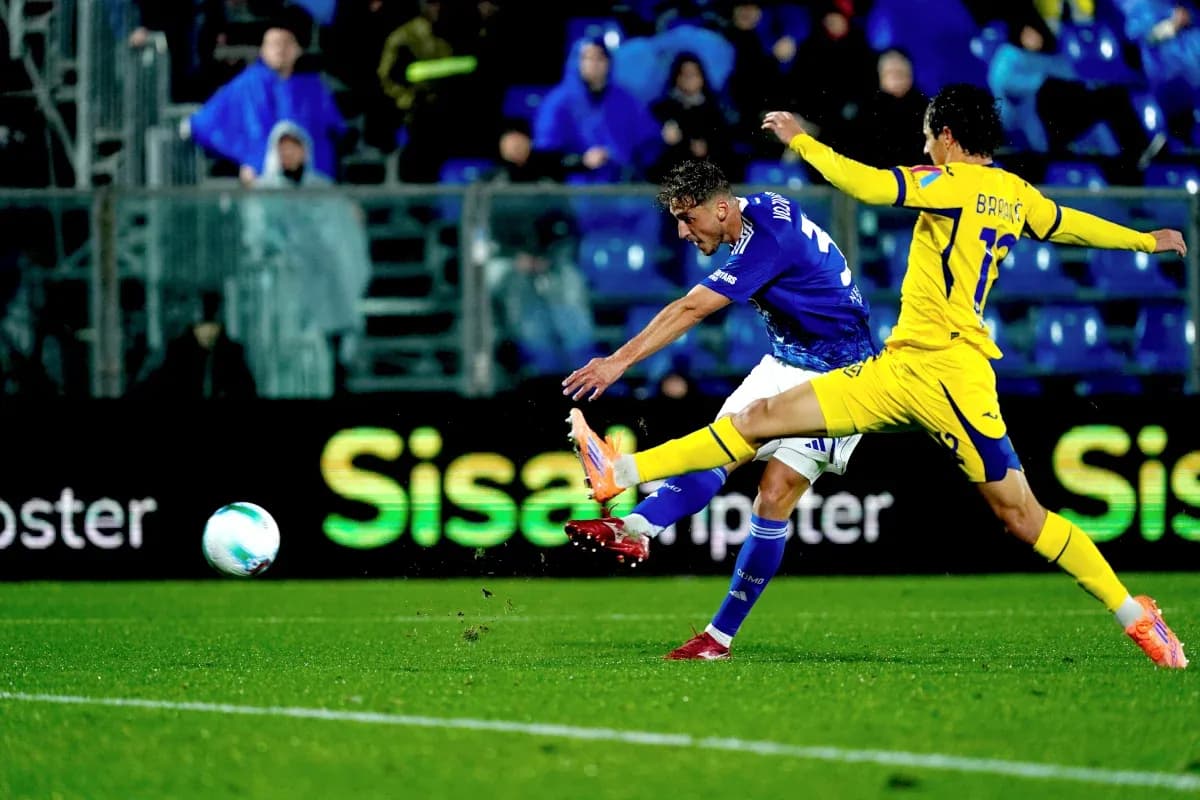
Hellas Verona’s 0-1 home defeat to Como at Stadio Marcantonio Bentegodi unfolded as a control-versus-directness battle that Cesc Fabregas’ side ultimately edged. In a Round 36 Serie A fixture refereed by Marco Di Bello, Como’s command of possession and structure in a 4-2-3-1 gradually wore down Paolo Sammarco’s 3-5-1-1, with A. Douvikas striking the decisive blow on 71 minutes. Despite Verona generating slightly higher xG (0.97 to 0.9) and matching Como for total shots (11-11), the visitors’ superior passing rhythm and territorial control tilted the contest, leaving Verona chasing in the final quarter-hour without the precision to rescue a point.
Minute-by-minute disciplinary log
- 61' Maxence Caqueret (Como) — Persistent fouling
- 89' Martin Frese (Hellas Verona) — Foul
The match’s lone goal arrived in the 71st minute: A. Douvikas finished for Como, assisted by centre-back M. O. Kempf, reflecting Fabregas’ willingness to push his defenders into advanced zones during sustained possession. Up to that point, the game had been tactically cagey. Como made their first structural adjustment early, at 36', when A. Moreno (IN) came on for A. Valle (OUT), reshaping the back line while maintaining the 4-2-3-1 base.
A triple change at 46' further sharpened Como’s midfield and attacking dynamics: I. Smolcic (IN) for M. Vojvoda (OUT), M. Caqueret (IN) for M. Perrone (OUT), and M. Baturina (IN) for J. Rodriguez (OUT). Caqueret’s introduction was particularly significant; his later booking for "Persistent fouling" at 61' underlined both his defensive workload and Verona’s attempts to break through centrally. Sammarco responded on 63' with S. Lovric (IN) for A. Bernede (OUT), chasing more vertical thrust from midfield.
After Douvikas’ strike, Verona threw on additional forwards: Isaac (IN) for J. Akpa Akpro (OUT) at 80' and I. Vermesan (IN) for R. Belghali (OUT) at 81', shifting the 3-5-1-1 into a more aggressive, striker-heavy configuration. Simultaneously, Como refreshed their wide threat with I. Van der Brempt (IN) for A. Diao (OUT) at 81', helping them manage transitions and protect the lead. The final yellow card went to Martin Frese at 89' for "Foul", encapsulating Verona’s increasingly urgent, and at times untidy, late-game defending and pressing.
Tactically, Verona’s 3-5-1-1 was designed to congest central zones and spring K. Bowie and T. Suslov in advanced roles. With three centre-backs — N. Valentini, A. Edmundsson, and V. Nelsson — Verona aimed to defend with numerical superiority against Douvikas while wing-backs R. Belghali and M. Frese pushed on. The structure did limit Como to 10 shots inside the box from 64% possession, but Verona struggled to turn their compactness into controlled build-up: 277 total passes, 202 accurate (73%), against a side that completed 506 passes, 442 accurate (87%).
In possession, Verona leaned on R. Gagliardini and J. Akpa Akpro to connect first and second phases, but Como’s double pivot and advanced midfield line (A. Diao, N. Paz, J. Rodriguez) consistently screened passing lanes into Suslov between the lines. The result was a Verona attack that often defaulted to more direct balls toward Bowie, leading to 11 total shots but only 3 on goal, and an xG of 0.97 that reflected half-chances rather than clear, repeated patterns of penetration.
Como’s 4-2-3-1, by contrast, was about control and layering. With Diego Carlos and M. O. Kempf anchoring the defence and full-backs (initially A. Valle and M. Vojvoda, later A. Moreno and I. Smolcic) providing width, Como were able to sustain long phases in Verona’s half. The midfield rotations after halftime — especially the introduction of Caqueret and Baturina — gave Como greater tempo and vertical passing. Caqueret’s aggressive counter-pressing both created turnovers and drew his booking for "Persistent fouling", a trade-off Fabregas accepted to keep Verona pinned back.
Douvikas’ goal, assisted by Kempf, encapsulated Como’s structure: a centre-back stepping into midfield to overload a line, then exploiting Verona’s stretched shape once the first press was broken. With Verona’s wing-backs advanced and their midfield tiring, the distances between lines grew, and Como finally converted one of their controlled entries into a decisive chance.
In goal, both L. Montipo for Verona and J. Butez for Como registered 3 saves each, underscoring the balance in shot quality despite Como’s territorial advantage. Verona’s defensive index — 3 saves, 17 fouls, and 3 blocked shots — suggests a back line that was often reacting rather than dictating, forced into repeated interventions by Como’s circulation. Como, with 14 fouls and 3 blocked shots of their own, defended more by prevention than last-ditch actions, using possession as their primary defensive tool.
Statistically, Como’s 64% possession and superior passing accuracy (506 passes, 442 accurate, 87%) framed the narrative: they controlled rhythm and territory, even if their xG of 0.9 was marginally lower than Verona’s 0.97. Both keepers posted the same goals prevented value (0.73), highlighting that the difference lay less in shot-stopping and more in structural efficiency in both boxes.
Verona’s overall form in this match reflects a side capable of generating chances from a lower-possession platform but lacking the composure and technical security to sustain pressure against a high-possession opponent. Como’s overall form, meanwhile, shows a team comfortable dictating play away from home, with a defensive index built on compactness, selective fouling, and strong goalkeeping rather than sheer volume of defensive actions. Over 90 minutes, that control made Douvikas’ single strike feel like a logical outcome rather than a smash-and-grab.