.svg&w=384&q=75 "Pitchgist logo")
Chelsea's Fragility Exposed in 3-1 Defeat to Nottingham Forest
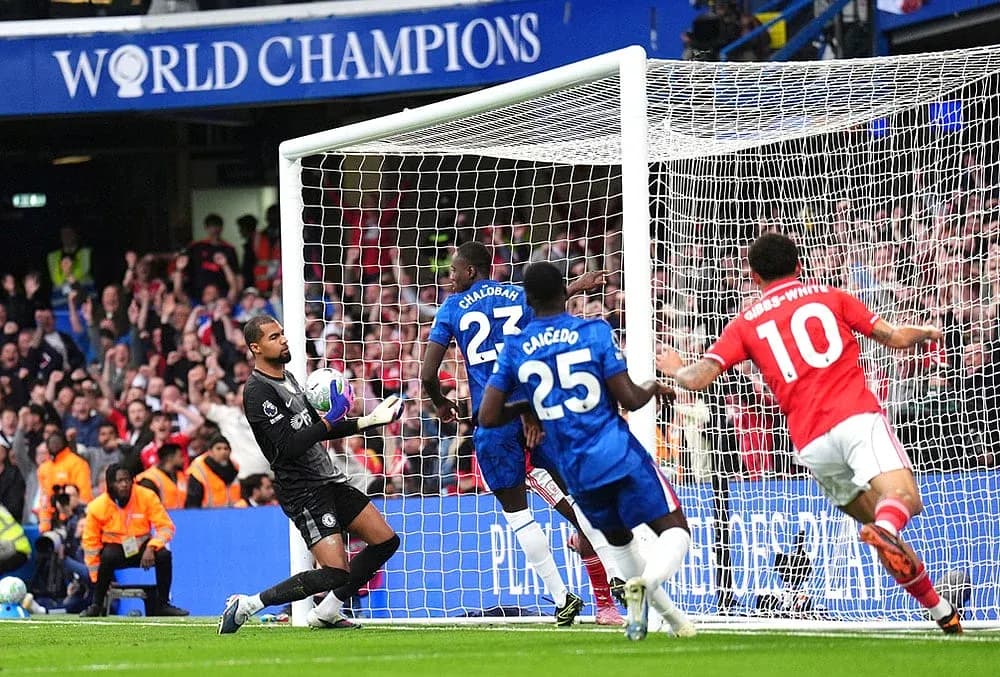
Stamford Bridge felt heavy at full time. Under a grey London sky, Chelsea’s season-long fragility crystallised into a 3-1 home defeat to Nottingham Forest, a result that cut through the league table as sharply as it did the mood in the stands. Following this result in the Premier League’s Regular Season - 35, the contrast between Chelsea’s structural promise and Forest’s hardened survival instincts was laid bare.
Heading into this game, Chelsea’s campaign had been defined by imbalance. Overall they had scored 54 goals and conceded 48, a goal difference of 6 that spoke of attacking talent but defensive looseness. At home, they were averaging 1.3 goals for and 1.3 against per match – a side that rarely controlled the Stamford Bridge narrative. Forest, by contrast, arrived as a team forged in jeopardy: 44 goals for and 46 against overall, a goal difference of -2, yet with 7 away wins from 18 and 26 goals scored on their travels at an average of 1.4 per game. They were built to live on the edge – and at the Bridge, they thrived there.
I. The Big Picture: Structures and Intent
Calum McFarlane stayed loyal to Chelsea’s seasonal blueprint, rolling out the familiar 4-2-3-1 that has been used in 30 league matches. Robert Sánchez started in goal behind a back four of Malo Gusto, Trevoh Chalobah, Tosin Adarabioyo and Marc Cucurella. In front of them, the double pivot of Romeo Lavia and Moisés Caicedo was meant to stabilise and launch, freeing an attacking band of Cole Palmer, Enzo Fernández and Jimi Derry behind lone striker Joao Pedro.
On paper, it was a side built to dominate the ball and compress the game into the Forest half. In reality, it left Chelsea stretched between their own ambition and their defensive reality.
Vitor Pereira’s Forest arrived in a more pragmatic 4-4-2 – a shape he has used far less frequently than his preferred 4-2-3-1, but one perfectly calibrated for this away assignment. Matz Sels was shielded by a back four of Zane Abbott, Cunha, Morato and Luca Netz, with a hard‑working midfield line of Dilane Bakwa, Ryan Yates, Nicolás Domínguez and James McAtee. Up front, Igor Jesus and Taiwo Awoniyi formed a classic strike partnership: one to run channels, one to occupy centre-backs.
Forest’s structure was simple: two banks of four, deny central progression, then break quickly into the wide spaces Chelsea’s full-backs would vacate.
II. Tactical Voids: Absences and Discipline
Both squads carried scars into this fixture. Chelsea were without A. Garnacho, J. Gittens, M. Mudryk and P. Neto – a cluster of wide forwards and attacking options removed from McFarlane’s bench. It forced him to lean even more heavily on Joao Pedro and Palmer as sources of penetration and end product. With Chelsea having failed to score in 7 league matches overall this season, that lack of attacking depth felt significant once Forest took control of the scoreline.
Forest’s absentee list was even longer: O. Aina, W. Boly, C. Hudson-Odoi, John Victor, Murillo, D. Ndoye, I. Sangare and N. Savona all missed out. That stripped Pereira of experience at full-back, aerial dominance at centre-back and ball-winning in midfield. Yet the players on the pitch responded with a disciplined, collective defensive effort that belied the names missing.
Season-long disciplinary trends framed the risk each side carried. Chelsea’s yellow cards peak late, with 22.35% of their cautions arriving between 76-90 minutes and another 20.00% from 61-75 – a reflection of a team often chasing games and losing control in the closing stages. Their red-card profile is spread across the match, with notable spikes at 61-75 (28.57%). Forest, meanwhile, are most combustible in the middle third: 23.21% of their yellows between 46-60 and another 23.21% between 61-75, plus a single red in the 31-45 range. At Stamford Bridge, that history translated into a Forest side that tackled on the edge but rarely overstepped, while Chelsea’s frustration grew as the scoreboard turned against them.
III. Key Matchups: Hunter vs Shield, Engine Room Battles
The headline duel was always going to be Joao Pedro against Forest’s defensive block. Overall this season, Joao Pedro has 15 league goals and 5 assists, underpinned by 48 shots (28 on target) and 29 key passes. He is both Chelsea’s finisher and their creator, a forward who drops off to link play as much as he runs in behind. Against a Forest team conceding 1.4 goals per game away, his movement between the lines should have been decisive.
But Forest’s “shield” was not just the centre-backs; it was the whole unit. Cunha and Morato defended aggressively in front of Sels, while Yates and Domínguez compressed the central spaces Joao Pedro loves to occupy. With Chelsea’s full-backs high, Forest were content to defend narrow, trusting Abbott and Netz to deal with wide threats. The result: Joao Pedro was often forced to receive with his back to goal, far from the penalty area where his instincts are most lethal.
In the engine room, the clash between Caicedo and Forest’s central trio defined the match’s rhythm. Caicedo has been Chelsea’s metronome and enforcer all season: 1,877 passes at 92% accuracy, 83 tackles, 56 interceptions and 14 blocked shots. He is also one of the league’s most carded players, with 10 yellows and 1 red, and his aggression is both asset and liability.
Against Forest, his task was double: protect a back line that has conceded 24 goals at home and initiate transitions quickly enough to unbalance Forest’s 4-4-2. Yet Yates and Domínguez were relentless in their pressing, and McAtee drifted inside to create overloads. Caicedo’s influence was diluted, and Chelsea’s build-up became predictable: sideways, then out to full-backs, then into a crowded final third where Forest’s numbers told.
At the back, Chalobah – who has blocked 16 shots this season and completed 93% of his 2,256 passes – was dragged into uncomfortable territory by Awoniyi’s physical presence and Igor Jesus’s movement. Forest’s willingness to play early into the channels exposed the space behind Gusto and Cucurella, forcing Chalobah and Adarabioyo into running duels rather than the controlled defending they prefer.
IV. Statistical Prognosis: Why Forest’s Plan Won
Following this result, the numbers that framed the contest feel prophetic. Chelsea’s home record – 6 wins, 5 draws, 7 defeats, 24 scored and 24 conceded – paints a side that cannot turn possession into control. Their overall average of 1.5 goals scored per game is undermined by 1.4 conceded, and while they have kept 5 clean sheets at home, the defensive lapses that have cost them all season resurfaced here.
Forest’s away profile, by contrast, is that of a punchy counter-attacking side: 7 wins, 3 draws and 8 defeats on their travels, with 26 goals scored and 25 conceded. They rarely shut games down entirely, but they are efficient in the moments that matter. Their 9 clean sheets overall show they can defend deep when required, and at Stamford Bridge they blended that resilience with sharp attacking transitions.
Without explicit xG data, the shape of the game still feels clear. Forest created the better chances relative to their possession, striking twice before half-time and adding a third after the break, while Chelsea’s sterile dominance produced just a single reply. Chelsea’s perfect penalty record this season – 7 from 7 overall – never came into play; Forest were disciplined enough in the box to deny them that lifeline.
In narrative terms, this was the story of a team that knows exactly who it is against one still searching for its identity. Forest, hardened by a season of survival football, executed a clear away plan: compact 4-4-2, ruthless in transition, emotionally controlled. Chelsea, rich in talent but poor in cohesion, were left with possession, territory and another home defeat that underlines just how far their rebuild still has to run.