.svg&w=384&q=75 "Pitchgist logo")
Charleston Battery Edges Pittsburgh Riverhounds in Penalty Shootout
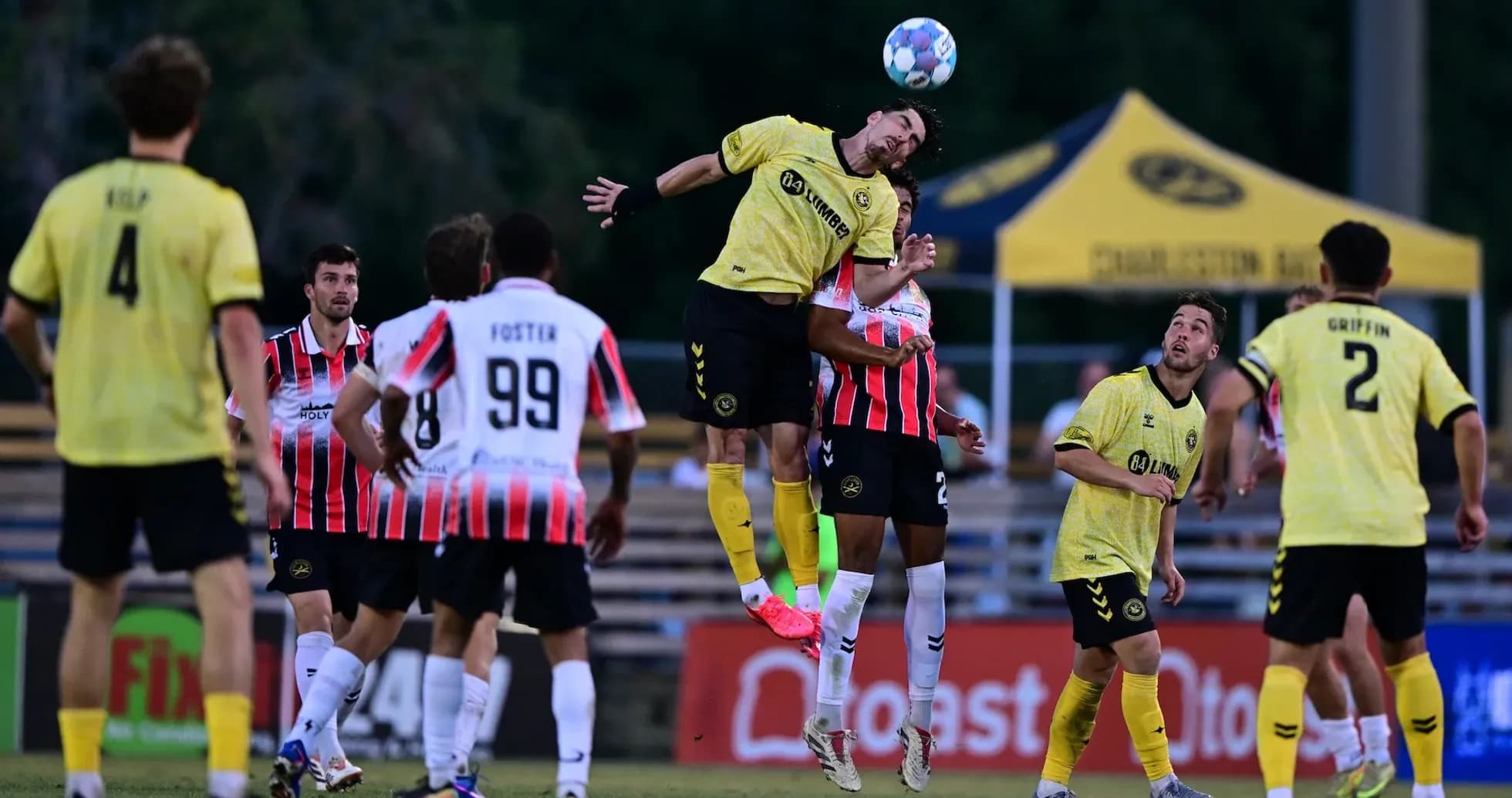
Under the lights at Patriots Point Soccer Complex, Charleston Battery and Pittsburgh Riverhounds went the full distance and then some, locked at 0–0 after 120 minutes before Charleston finally edged it 4–2 on penalties. Following this result in the USL League One Cup group stage, the shootout drama felt like the only fitting way to separate two sides whose seasonal identities had been converging toward this knife‑edge contest.
I. The Big Picture – contrasting trajectories, same crucible
Charleston entered the night as group leaders, ranked 1st in USL Cup 2026, Group 6. Overall this campaign, they had taken 8 points from 3 matches with a formidable goal difference of 7, built on 10 goals for and 3 against. The season’s statistical DNA paints them as ruthless and controlled: in total this campaign they average 2.3 goals for and only 0.3 goals against, with a perfect record of 3 wins from 3 and 2 clean sheets across all venues.
At home, Charleston had been more minimalist but just as efficient: 1 win from 1, scoring 1 and conceding 0, an average of 1.0 goal for and 0.0 against at Patriots Point. On their travels, they have been explosive, with 6 goals scored and 1 conceded across 2 away matches, averaging 3.0 goals for and 0.5 against.
Pittsburgh, ranked 3rd in the same group heading into this fixture, came in as a more volatile proposition. Overall, they had 5 points from 3 matches with a goal difference of -1, rooted in 8 goals for and 9 against. Their season splits are stark: at home they have been dominant, winning their only home match 3–0, averaging 3.0 goals for and 0.0 against. Away, the Riverhounds have struggled badly: 2 defeats from 2, only 1 goal scored and 3 conceded, an away average of 0.5 goals for and 1.5 against.
The goalless draw over 120 minutes therefore felt like a tactical stalemate between Charleston’s usually incisive attack and a Pittsburgh side that, despite their away woes, has shown they can keep things tight when needed.
II. Tactical Voids and Discipline – walking the line
There were no officially listed absentees in the pre‑match data, so both coaches, Ben Pirmann for Charleston and Rob Vincent for Pittsburgh, appeared to have close to full decks to play with.
Season-long disciplinary patterns, though, shaped the risk profiles. Charleston’s yellow cards are clustered around the restart and late regulation: 50.00% of their cautions arrive between 46–60 minutes, with additional bookings spread at 0–15 (16.67%), 16–30 (16.67%) and 76–90 (16.67%). That mid‑second‑half spike hints at a side that raises intensity – and occasionally oversteps – as they try to lock games down or press for a winner.
Pittsburgh’s caution curve is similar but slightly more volatile. In total this campaign, 42.86% of their yellows arrive between 46–60 minutes, with further cards at 0–15 (14.29%), 31–45 (14.29%), 61–75 (14.29%) and 76–90 (14.29%). Crucially, they also carry a red‑card flashpoint: 100.00% of their reds this season have come in the 76–90 window. That late‑game combustibility is a tactical fault line; in a match that went to 120 minutes, the Riverhounds had to manage their emotions as much as Charleston’s pressure.
Neither side had taken or missed a penalty in open play this campaign (both have 0 total penalties, 0 scored, 0 missed), which made the post‑120‑minute shootout a psychological leap into the unknown rather than a continuation of established trends.
III. Key Matchups – Hunter vs Shield, Engine Room vs Enforcer
Hunter vs Shield
For Charleston, the “hunter” is more collective than individual. With 7 goals in total this campaign across 3 fixtures and no failures to score, they usually find a way. The front line of M. Berry and L. Blackstock, supported by E. Ycaza and M. Foster, embodies that multi‑channel threat: Berry offers penalty‑area presence, Blackstock stretches the back line, while Ycaza and Foster occupy half‑spaces and second‑ball zones.
They were up against a Pittsburgh defence that, on their travels, has conceded 3 goals in 2 matches – an away average of 1.5 against – with V. Souza and L. Kelp central to the back line, flanked by P. Barnes and O. Mikoy. On paper, Charleston’s season‑long attacking averages suggested they should eventually crack that unit, especially given their 3.0 away goals per match translating into overall confidence in the final third. Yet in this match, Pittsburgh’s “shield” held through 120 minutes, with M. Sheridan anchoring a disciplined defensive block.
Engine Room – shaping the tempo
In midfield, the contest between Charleston’s K. Pakhomov, S. Suber and Ycaza against Pittsburgh’s trio of D. Griffin, R. Mertz and C. Ahl defined the rhythm. Charleston’s season stats show they rarely lose control: they have never failed to score and have kept 2 clean sheets in total, suggesting a side that dominates both phases through structure and ball circulation.
Pittsburgh’s engine room, however, carries a different profile. Overall this campaign they average 1.3 goals for and 1.0 against, with a single clean sheet and one match where they failed to score. Griffin’s industry and Mertz’s connective passing are tasked with bridging to forwards like T. Amann and S. Bassett, but away from home that link has often been severed, reflected in their 0.5 away goals per match.
In this fixture, the Riverhounds’ midfield leaned into containment, screening the back four and limiting the spaces where Ycaza and Foster like to operate. The result was a game of attrition rather than flowing combinations, with both engines running more in protection mode than creation.
IV. Statistical Prognosis – what the numbers say about the shootout
Following this result, the underlying numbers still tilt the long‑term prognosis in Charleston’s favour. Their overall goal difference of 7, built on 7 goals for and just 1 against in the detailed season stats, underscores defensive solidity that is elite at this level. Two clean sheets in 3 matches, plus never having failed to score, is the profile of a side whose Expected Goals (xG) balance is likely heavily positive: they create enough, concede little, and manage game states well.
Pittsburgh’s overall goal difference of -1, with 4 goals for and 3 against in the detailed stats, suggests a more modest xG footprint: competitive but not dominant, especially away where their attack drops to 0.5 goals per match and the defence softens to 1.5 conceded.
In a one‑off cup tie decided by penalties, variance took over. But stretched across the group campaign, Charleston’s blend of controlled aggression, second‑half intensity and defensive parsimony marks them as a genuine contender. Pittsburgh’s resilience at Patriots Point, holding a prolific side scoreless for 120 minutes, hints that if they can import even a fraction of their home attacking edge into away fixtures, their xG profile – and their fortunes – could swing upward. For now, though, Charleston’s shootout nerve merely confirms what the numbers have been whispering all along: this is a squad built for high‑stakes moments.