.svg&w=384&q=75 "Pitchgist logo")
Sarasota Paradise Secures 2–0 Victory Over Naples in USL League One Cup
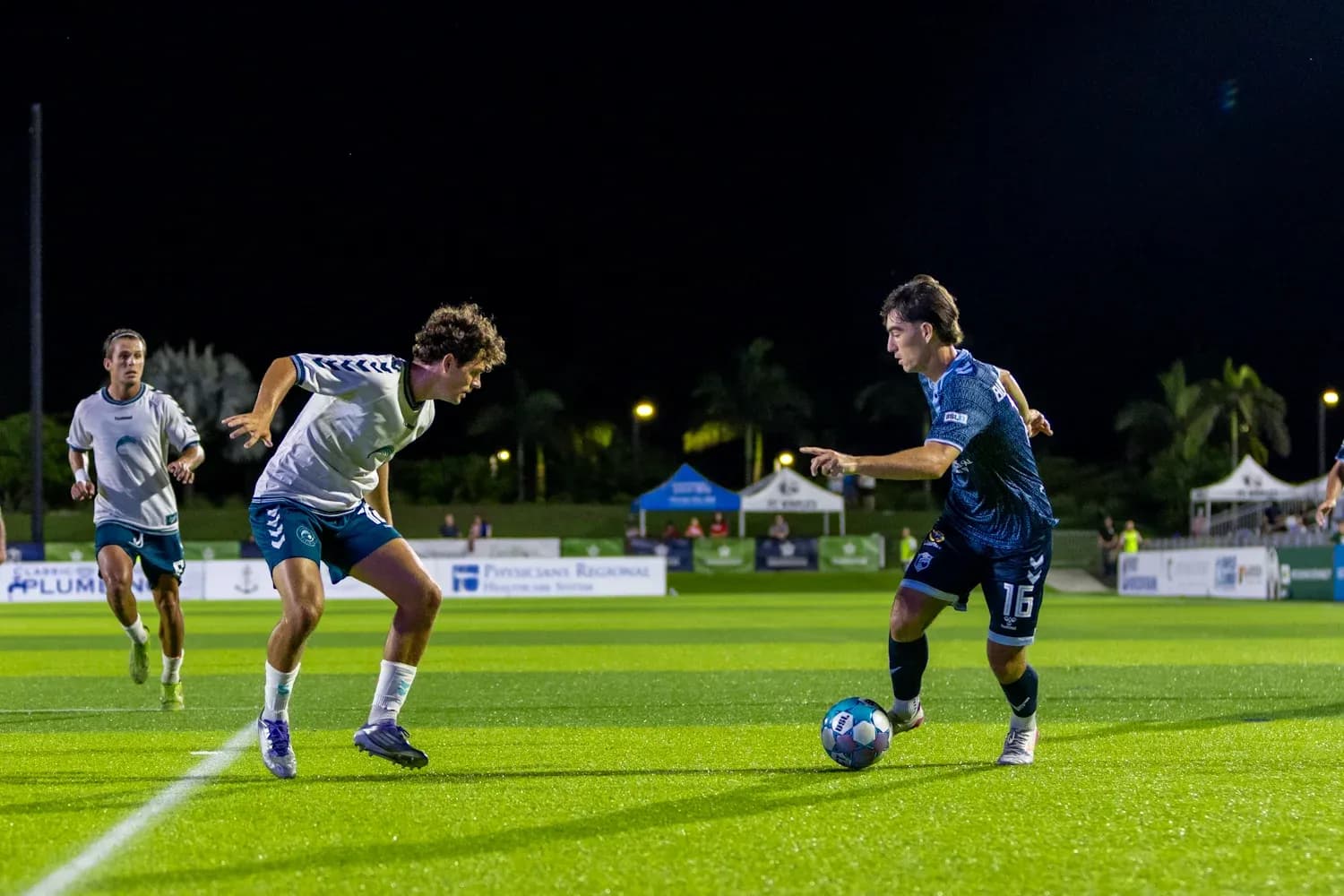
Under the late lights at Paradise Coast Sports Complex, this USL League One Cup Group 7 meeting closed with a clear verdict: Sarasota Paradise left with a 2–0 away win, while Naples were left staring at a table that now frames their campaign as an uphill climb. Following this result, Naples sit 5th in the group on 2 points with a goal difference of -3 (5 goals for, 8 against overall), while Sarasota climb to 4th on 3 points, their goal difference trimmed to -2 (2 goals for, 4 against overall).
The scoreline matched the broader seasonal DNA of both sides. Naples have been a volatile, open team in this competition: across 3 matches in total they score 1.0 goals per game and concede 2.3, with no clean sheets and one failure to score. At home they average 1.0 goal for and 1.5 against, and this was another night where their defensive frailty outweighed their attacking promise. Sarasota, by contrast, have been more controlled if less explosive: in total they average 0.7 goals for and 1.3 against, with one clean sheet and two games where they failed to score. On their travels they are almost perfectly balanced, with 1.0 goal scored and 1.0 conceded per away game; this win fits that profile of a side that doesn’t need volume of chances to make them count.
Tactical voids and discipline
With no official absences listed pre-match, both coaches had their full squads available and leaned heavily on familiar cores. Matthew Poland trusted a front-loaded Naples XI built around the physical presence of J. Grant (99) and the movement of G. Miglietti (9), supported by the energy of J. Osorio (8) and the wide running of C. Garcia (11). Yet the lack of a defined formation in the data mirrors how the team has felt in this Cup: ideas in abundance, structure less so.
The disciplinary profile of Naples has been a quiet, creeping problem. Across the competition, their yellow cards are clustered in the 31–45, 46–60, 76–90 and 91–105 minute bands, with a notable 40.00% of cautions arriving between 46–60 minutes and a red card already shown in that same window. It paints a picture of a side that starts each half with intensity that easily tips into rashness. Against a Sarasota team that grows into games, those lapses are costly.
Sarasota’s disciplinary curve is different: their yellows are spread, but with a pronounced late-game surge — 37.50% of their cautions come between 76–90 minutes, and another 25.00% between 46–60. They walk a fine line as they protect leads, but crucially they have not yet seen red. In a match where they were defending a 1–0 half-time advantage and then a 2–0 cushion, that capacity to play on the edge without crossing it was central.
Hunter vs shield: key matchups
Without official top-scorer data, the “hunter” role for Naples is shared, but this match again revolved around the forward trident of Grant, Miglietti and Garcia. Grant offers a central reference point; Miglietti drifts to find pockets; Garcia stretches the field. Their task was to unpick a Sarasota defence that, in total, had conceded just 4 goals in 3 games and only 2 in 2 away outings.
On their travels, Sarasota’s back line — anchored by R. Burlew (2), D. Watters (4) and R. Valentine (3) — has been quietly efficient: 1.0 goal conceded per away match, with one away clean sheet before this fixture. They defend more by control than by siege mentality, aided by the positional intelligence of H. Backstrand (22) and the screening work of A. Rodriguez (16). Against Naples, that unit again played compact, forcing the hosts’ forwards to receive with their backs to goal and limiting clean shooting angles.
The other side of the “hunter vs shield” duel came when Sarasota attacked. Their goals in this Cup have been scarce but timely, and the creative axis of E. Bryant (7), J. Bender (9) and M. Tainio (20) offered different threats. Bryant’s ability to carry the ball at pace, Bender’s penalty-area instincts and Tainio’s link play gave Sarasota a varied front line that tested a Naples defence conceding 2.3 goals per game in total and 4.0 per away match, but still porous at home as well.
Naples’ back line — with J. Cisneros (3), J. Yoder (22), H. Gay (12) and M. Torrellas (21) in front of goalkeeper D. Bachstein (18) — once again found itself stretched between stepping out to engage Bryant and Bender and dropping to protect space behind. With no clean sheets in total and 3 goals conceded at home across 2 matches, the structural issues are clear: the distances between lines grow too large when they chase the game, and Sarasota exploited those gaps.
Engine room: control vs chaos
In midfield, the contest was about whether Naples could turn their emotional surges into sustained pressure. J. Yearwood (20) and I. Cerro (30) tried to set a tempo, while Osorio buzzed between lines. But their season-long discipline trends suggest a side that often loses control just as matches become most tactical — that 46–60 minute window where they both collect the bulk of their yellows and have already seen a red is exactly when coaches usually make structural adjustments.
Sarasota’s engine room, led by Rodriguez and supported by the intelligent movement of Tainio and the wide industry of S. Karani (11), leaned into a different model: absorb, compress, and then break with precision. With their overall goals against average of 1.3 and an away figure of just 1.0, they are comfortable in medium-to-low possession scenarios, trusting their shape and waiting for Naples’ impatience to open doors.
Statistical prognosis and what it tells us
Following this result, the numbers harden the tactical story. Naples’ overall goal difference of -3 (5 scored, 8 conceded) underlines a side whose attacking output cannot yet offset their defensive leaks. With no clean sheets and a failed-to-score tally of 1 in total, they oscillate between open, chaotic contests and nights like this one where they simply run into a better-organised block.
Sarasota, with an overall goal difference of -2 (2 scored, 4 conceded), are hardly free-scoring, but their away profile is quietly encouraging: 1 win and 1 loss in 2 away fixtures, 2 goals scored and 2 conceded on their travels, and a clean sheet already banked. They manage risk better, foul smarter, and finish more clinically.
If we project forward in purely statistical terms — even without explicit xG data — the expected pattern in future fixtures is clear. Naples’ current averages suggest they will continue to be involved in games where they need to score twice just to feel safe, particularly given their 2.3 goals conceded per match overall. Sarasota’s defensive solidity, especially away, hints at more tight, one-goal contests where their ability to survive late pressure (despite that 37.50% late yellow-card spike) could be decisive.
Narratively, this match felt like a referendum on structure. Sarasota Paradise arrived with a clear defensive identity and left with a 2–0 win that fits their statistical profile. Naples brought energy, individual talent and home support, but their season-long numbers — the disciplinary spikes, the lack of clean sheets, the negative goal difference — all converged into a night where their flaws outweighed their flair.